Real Estate Glossary – Florida Property Terms Explained

Buying, selling, or investing in Florida real estate often involves terms that may be unfamiliar to international buyers and first-time investors. Our Real Estate Glossary helps you understand the most important property, financing, legal, and investment terms used throughout the Florida real estate market.

Whether you are searching for a vacation home in Cape Coral, a waterfront property in Fort Myers, a condominium in Naples, or an investment property elsewhere in Southwest Florida, understanding the language of real estate is essential. From mortgages and title insurance to HOA fees, appraisals, deeds, and closing costs, this glossary provides clear and easy-to-understand explanations.

The glossary is organized alphabetically, allowing you to quickly find definitions for common real estate terms used by agents, lenders, attorneys, title companies, and property managers. It is designed for both U.S. residents and international buyers who want to better understand the Florida property market before making important decisions.

Florida Real Estate Terms from A to Z

Explore our comprehensive collection of Florida real estate definitions and gain the knowledge needed to navigate property purchases, investments, financing options, and ownership responsibilities with confidence.

Jump to letter:

A

Illustration of a house with security surveillance, monitoring cameras and digital absence management.
AI generated

Absentee Owner – Property owner not residing at the property

What is an Absentee Owner?

An Absentee Owner is an individual or entity that owns a property but does not live there full-time. The property may be vacant, rented out, or used seasonally. In Florida, many vacation homes and investment properties are owned by absentee owners—both domestic and international.

Key characteristics

  • Owner’s primary residence is in a different city, state, or country
  • Property is managed remotely or through a third party
  • Usage varies: rental income, personal vacations, or long-term hold

Florida-specific insights

  • Absentee ownership is common in coastal and tourist areas like Cape Coral, Naples, Fort Myers
  • Important client group for property managers and vacation rental services
  • Requires trustworthy local support and strong communication

? Tip: As an Absentee Owner in Florida, it’s wise to hire a reputable home watch or property management company to handle maintenance and vacation rentals and to manage emergencies professionally.

A document titled 'Abstract of Title' is magnified by a lens focusing on a house, surrounded by various seals and legal imagery.
AI generated

Abstract of Title – Summary of a property's ownership history

What is an Abstract of Title?

An Abstract of Title is a concise summary of the legal history of a property’s ownership. It includes documents such as deeds, mortgages, liens, foreclosures, and other records affecting the title.

Who prepares it?

The abstract is compiled by a title company or attorney. It is used to determine whether the title is clear of claims or encumbrances before a sale or transfer occurs.

Why is it important?

The Abstract of Title helps protect the buyer and the lender by revealing any legal issues tied to the property. It ensures the new owner receives a valid and marketable title.

? Tip: In Florida, a full Title Search with Title Insurance is more common, but understanding the concept of an abstract is still valuable for buyers.

Businessmen discussing contract clause in modern office with illuminated house.
AI generated

Acceleration Clause – Loan term allowing early repayment demand

What is an Acceleration Clause?

An Acceleration Clause is a provision in a mortgage or loan agreement that allows the lender to demand immediate repayment of the entire loan balance if specific contract violations occur.

Eine Klausel im Hypothekenvertrag, welche dem Gläubiger erlaubt, die Hypothek vorzeitig für fällig zu erklären und Ablösung zu verlangen. Falls sich gewisse, im Vertrag spezifisch festgelegte Vorkommnisse ereignen, wie z.B. Zahlungsverzug, Nichtinstandhaltung der Immobilie.

Common triggers for acceleration

  • Default on monthly payments
  • Failure to maintain the property
  • Unauthorized transfer of ownership
  • Failure to pay property taxes or insurance

Impact on borrowers

  • Full balance becomes due immediately
  • Risk of foreclosure if the debt isn’t paid
  • Often triggered during loan assumptions or property sales

? Tip: In Florida, buyers and investors should carefully review mortgage contracts for acceleration clauses, especially when dealing with loan transfers or distressed properties.

Diagram shows the dimensions of an acre with various area comparisons like soccer and tennis fields, converted to square feet and square meters.
AI generated

Acre – U.S. land measurement unit equal to 43,560 square feet

What is an Acre?

An Acre is a standard unit of land measurement used in the United States, especially in real estate and agriculture. One acre equals exactly 43,560 square feet or about 4,047 square meters.

Use in real estate

  • Common for residential lots outside urban areas
  • Listed in property records, listings, and appraisals
  • Often referenced with lot dimensions in property descriptions

Size comparisons

  • 0.25 acres ≈ 10,890 sq ft: typical suburban home lot
  • 1 acre ≈ 43,560 sq ft: roughly 75% of a soccer field
  • 5+ acres: often used for farming, ranches, or estate developments

? Tip: In Florida, land size is almost always measured in acres. International buyers should convert to square meters to better understand the scale of a property.

Business meeting in a modern office with real estate contracts and a miniature house on the table.
AI generated

Addendum – Legally binding amendment to a real estate contract

What is an Addendum?

An Addendum is a written modification or addition to an existing real estate contract. It allows the parties to change terms, add conditions, or clarify existing clauses without rewriting the full agreement.

Common uses of an Addendum

  • Extending deadlines (e.g., inspection period, closing date)
  • Changing the purchase price after negotiations or appraisals
  • Adding conditions (e.g., seller repairs, inclusion of furnishings)
  • Clarifying or correcting contract terms

Florida-specific notes

  • Addenda are commonly used in Florida real estate transactions, especially with “As-Is” contracts
  • They must be written and signed by all parties to be enforceable
  • An Addendum becomes a legally binding part of the original contract

? Tip: In Florida, always use a properly drafted Addendum to document any changes—avoid verbal agreements and seek legal review if needed.

Illustration of a modern house with a man explaining ARM financing options. Includes symbols for interest rates and charts to depict adjustment periods and rate caps.
AI generated

Adjustable Rate Mortgage (ARM) – Mortgage with a changing interest rate

What is an Adjustable Rate Mortgage (ARM)?

An Adjustable Rate Mortgage (ARM) is a home loan with an interest rate that can change over time. It starts with a fixed-rate period and then adjusts periodically based on a benchmark index like SOFR or the Prime Rate.

Key features

  • Initial fixed-rate term: 3, 5, 7, or 10 years
  • Annual adjustments after the initial period
  • Rate caps to limit the amount the interest rate can rise
  • Typical term: 30 years

Pros and cons

  • Pro: Lower initial interest rate and monthly payments
  • Con: Future payment uncertainty after the fixed period
  • Best for: Buyers who plan to sell or refinance before rates adjust

ARM in Florida

  • Popular among investors, flippers, and second-home buyers
  • Attractive when interest rates are low at the time of purchase
  • Requires planning for future rate increases

? Tip: An ARM can be a smart move in Florida for short-term owners or those expecting rate drops. Always review adjustment caps, frequency, and worst-case payment scenarios.

Peaceful senior living community with a pool and green surroundings.
AI generated

Adult Community – Age-restricted residential community for adults 55+

What is an Adult Community?

An Adult Community is a housing development restricted by age, typically to residents who are 55 years or older. These communities are designed for active adults seeking independent living in a quiet, social, and low-maintenance environment.

Key features

  • Age requirement: usually 55+ or 62+
  • Amenities: clubhouse, pool, gym, golf course, events and clubs
  • Property types: condos, townhomes, or single-family homes
  • Restrictions: limited stay for children or guests under age threshold

Adult Communities in Florida

  • Florida offers a wide variety of 55+ communities with resort-style living
  • Popular in areas like Naples, Fort Myers, Cape Coral, and Sarasota
  • Some offer care options, home watch services, or concierge programs

? Tip: Before buying in a Florida Adult Community, review the HOA rules, age policies, and rental restrictions – especially important for investors or multi-generational families.

Close-up of a sale agreement document on a table with a miniature house, keys, and scales in the background. A person in a suit is seated at the table.
AI generated

Agreement of Sale – Binding real estate purchase agreement

What is an Agreement of Sale?

An Agreement of Sale is a legal contract between a buyer and a seller that outlines the terms and conditions of a real estate purchase. It includes details such as purchase price, closing date, payment terms, contingencies, and other negotiated items.

Is it the same as a purchase contract?

In many U.S. states, including Florida, the Agreement of Sale functions as the official purchase contract. Once signed, it becomes legally binding, subject to clauses such as inspection, financing, or appraisal contingencies.

What must it include?

Key elements are: sale price, deposit amount, contingency periods, property disclosures, closing timeline, and special conditions such as furnishings or post-closing occupancy.

? Tip: Never sign an Agreement of Sale without legal review—especially as an international buyer, since the agreement may be immediately binding under U.S. law.

Two people working on a computer reviewing contract amendments, with a model house on the table.
AI generated

Amendments to the Agreement – Formal changes to a signed real estate contract

What are Amendments to the Agreement?

Amendments are written changes or additions made to a real estate contract after it has been signed. They are used to modify specific terms without voiding the original agreement.

When are Amendments used?

Common scenarios include price changes after inspection, extended contingency deadlines, adjusted closing dates, or agreements about additional items to be included in the sale (e.g., furniture).

What should be considered?

All amendments must be in writing and signed by both parties. Verbal agreements are not enforceable. Once signed, the amendment becomes an official part of the original contract.

? Tip: Even minor adjustments should be documented through an official amendment form to avoid legal or financial misunderstandings later on.

Aerial view of a luxury residential complex with a large swimming pool, tennis courts, and modern apartment buildings under sunny skies.
AI generated

Amenities – Shared features and lifestyle facilities in residential communities

What are Amenities?

Amenities are non-essential but desirable features that enhance comfort and convenience in a residential property or community. Common amenities include pools, gyms, clubhouses, tennis courts, elevators, security gates, and more.

Where are Amenities found?

Amenities are common in condominiums, gated communities, and HOA-managed developments. They are available to all residents and are usually funded through HOA fees.

What should buyers consider?

Check what amenities are included, how well they are maintained, and whether there are any usage restrictions such as guest rules, reservation requirements, or limited hours.

? Tip: Luxurious amenities may look attractive, but make sure they fit your lifestyle and justify the added cost before making a purchase decision.

Illustration of a house on a chart with calendar sheets and symbols for financial topics such as mortgages and interest rates.
AI generated

Amortization – Loan repayment schedule for real estate financing

What is Amortization?

Amortization refers to the gradual repayment of a loan over time through scheduled monthly payments. In U.S. real estate, mortgage loans are typically amortized with payments covering both interest and principal.

How does it work?

An amortization schedule breaks down each payment to show how much goes toward interest and how much reduces the principal. In the early years, most of the payment covers interest; over time, the principal portion increases.

Why does it matter to buyers?

Understanding amortization helps buyers evaluate the true cost of borrowing and how long it will take to pay off the loan. It also helps identify opportunities to save money through early payments.

? Tip: Request a full amortization schedule from your lender to understand your repayment plan and forecast your equity buildup.

A modern shopping mall with several stores and people walking in the parking lot. Palm trees line the area.
AI generated

Anchor Tenant – Primary tenant attracting foot traffic to commercial properties

What is an Anchor Tenant?

An Anchor Tenant is a major and recognizable business that occupies a prominent space in a commercial property, such as a shopping mall or business park. Examples include large retailers, grocery chains, banks, or gyms that drive traffic to the location.

Why are Anchor Tenants important?

Anchor Tenants attract consistent customer visits, boosting visibility and business for smaller tenants. Their presence often stabilizes income streams and increases the property's market value.

What should investors consider?

Evaluate whether the property has a long-term lease with a financially strong anchor. The tenant’s brand strength and relevance to the market are key factors in reducing vacancy risk.

? Tip: While anchor tenants add value, over-reliance on a single tenant can be risky. Have a plan in place in case of early termination or vacancy.

Modern residential complex with a large outdoor pool, surrounded by palm trees and tall buildings under a clear blue sky.
AI generated

Apartment – Individual living unit in a multi-unit building

What is an Apartment?

An Apartment is a self-contained housing unit within a larger residential building or apartment complex. In the U.S., the term applies to both rented units and, in some contexts, privately owned units (condominiums).

Key features

  • Located in multi-family buildings or residential complexes
  • May be rented or owned, depending on structure
  • Available in various layouts: studio, 1-bedroom, 2-bedroom, etc.
  • Often includes shared amenities like pool, gym, laundry facilities

Florida-specific considerations

  • Apartment communities are common in urban and coastal areas
  • Most buildings are managed by property management companies
  • Clear distinction between rental apartments and condominiums (ownership)

? Tip: In Florida, be sure to check for HOA fees, rental restrictions, and community rules before purchasing or leasing an apartment – especially for short-term rentals or investment purposes.

A real estate appraiser stands in front of a modern house holding a clipboard with an appraisal report. In the foreground, there is a desk with a laptop and another report.
AI generated

Appraisal – Professional property valuation for lending or sale

What is an Appraisal?

An Appraisal is a formal evaluation of a property's market value, conducted by a licensed real estate appraiser. It is commonly required during a home purchase or refinance to ensure the price reflects true market conditions.

When is an Appraisal needed?

Appraisals are typically required by lenders before issuing a mortgage. The appraisal protects the lender by confirming the property is worth the amount being borrowed.

How is the value determined?

The appraiser evaluates the property based on recent comparable sales (comps), location, condition, upgrades, and other market data. Findings are presented in a detailed Appraisal Report.

? Tip: Always review the report carefully, especially if the appraised value differs significantly from the purchase price. It may impact your financing terms.

A man in a suit stands outside modern houses, holding a measuring device while writing on a clipboard. Futuristic data graphics hover above him.
AI generated

Appraiser – Licensed professional for property valuation

What does an Appraiser do?

An Appraiser is a state-licensed expert who evaluates and determines the market value of a property. Appraisals are commonly required for mortgage financing, purchases, sales, tax planning, estates, and divorce settlements.

Typical duties of an Appraiser

  • Inspecting the property for condition, layout, and improvements
  • Analyzing comparable property sales
  • Using income-based methods for rental or investment properties
  • Delivering an official appraisal report to client or lender

Florida-specific insights

  • Appraisers must be licensed by the Florida DBPR and Appraisal Board
  • They must follow USPAP standards for professional ethics and methodology
  • Appraisals are often mandatory for lender approvals in real estate transactions

? Tip: In Florida, always hire a licensed Appraiser for an accurate and credible property valuation—especially if a bank loan or legal documentation is involved.

Illustration of a house with a magnifying glass and coins representing rising real estate values.
AI generated

What Is Appreciation in Real Estate?

Appreciation refers to the increase in property value over time. It is a key concept for real estate investors and homeowners, as it directly impacts long-term returns.

Causes of Appreciation

Appreciation can result from several factors, including:

  • Market trends: Rising demand with limited supply
  • Location improvements: Better infrastructure, schools, or amenities
  • Economic growth: Population increase and higher income levels
  • Property upgrades: Renovations and improvements

Types of Appreciation

There are two main types:

  • Natural appreciation: Value increase due to market conditions
  • Forced appreciation: Value increase through improvements or renovations

Importance in Florida

In Florida, appreciation is especially significant due to strong migration, tourism demand, and international investment. Coastal areas and vacation rental markets often experience above-average value growth.

Distinction from Market Fluctuations

Appreciation should not be confused with short-term price changes. While market prices may fluctuate, appreciation reflects a long-term upward trend in value.

Conclusion

Appreciation is a fundamental component of real estate investing and plays a crucial role in building long-term wealth.

Modern houses in a sunny neighborhood with sale signs and a rising bar graph in the foreground symbolizing an increase in real estate sales.
AI generated

Real Estate Appreciation: A Key Factor for Investors

In real estate, appreciation refers to the increase in a property's value over time. This concept is crucial for investors in the USA, as it enables long-term capital growth and profitable returns. (Learn more about real estate appreciation on Investopedia)

What Influences Real Estate Appreciation?

Several factors contribute to a property's appreciation:

  • Location: Properties in high-demand areas with population growth and strong infrastructure tend to appreciate faster.
  • Economic Development: A strong job market and growing economy boost housing demand.
  • Supply and Demand: Low housing supply combined with high demand drives property prices up.
  • Interest Rates: Low mortgage rates make home purchases more attractive, leading to increased property values.
  • Renovations and Upgrades: Strategic improvements can significantly enhance a property's value.

(Explore the key factors that influence real estate appreciation)

Types of Real Estate Appreciation

There are two main types of appreciation:

  • Natural Appreciation: This occurs due to market growth, population increases, or economic improvements.
  • Forced Appreciation: Investors can actively increase property value through renovations or strategic developments.

(Learn about the two main types of real estate appreciation: natural and forced appreciation)

Average Appreciation Rate in the USA

Historically, the average annual appreciation rate for real estate in the USA is around 3–5%, with higher rates in booming markets such as Florida, California, and Texas. (View historical real estate appreciation rates in the USA)

Conclusion

For real estate investors, appreciation is a crucial factor for long-term profitability. By selecting the right location and implementing strategic improvements, investors can maximize appreciation potential.

Symbolic image of two shaking hands above a glowing city and a small house, surrounded by rising stock market curves.
AI generated
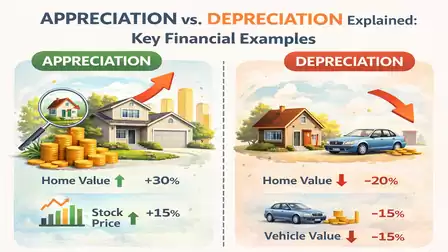
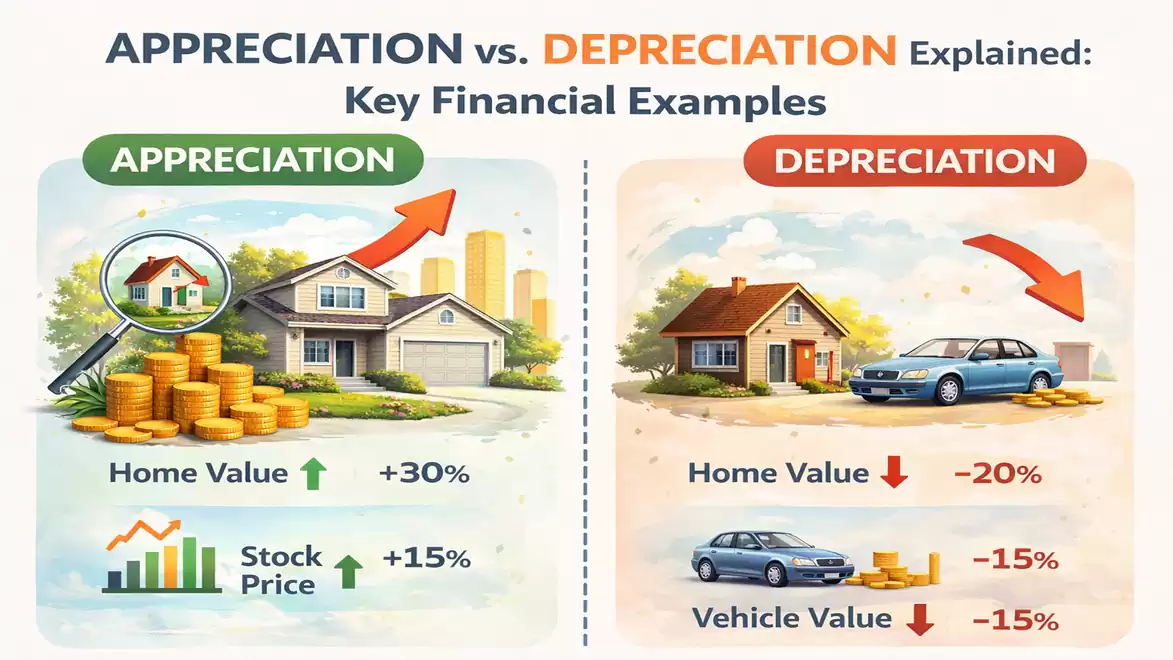
The image compares appreciation and depreciation using financial examples. On the left, a house and coins illustrate appreciation. On the right, a house and a car represent depreciation.
AI generated

What Is the Difference Between Appreciation and Depreciation?

Appreciation and depreciation represent two opposite movements in real estate value:

  • Appreciation: An increase in property value over time
  • Depreciation: A decrease in property value

These concepts are critical for investors, as they directly impact returns, tax strategies, and long-term wealth building.

Examples of Appreciation

Appreciation can result from several factors:

  • Market growth: Increased demand drives prices up
  • Location improvements: Better infrastructure or amenities
  • Renovations: Upgrades that enhance property value

Example: A property purchased for $300,000 increases in value to $360,000 over time, resulting in $60,000 appreciation.

Examples of Depreciation

Depreciation can occur under certain conditions:

  • Market downturns: Reduced demand or economic decline
  • Declining location quality: Increased vacancies or infrastructure issues
  • Wear and tear: Aging property without proper maintenance

Example: A property value drops from $300,000 to $270,000 due to market changes.

Tax Considerations in the U.S.

In the U.S., depreciation has a special meaning in tax law. It is often used as a tax deduction mechanism, regardless of actual market value changes.

  • Tax benefits: Depreciation reduces taxable income
  • Depreciation recapture: Taxes may apply upon sale

This differs significantly from actual market value trends.

Florida Market Insights

In Florida, appreciation often outweighs depreciation in high-demand areas. However, factors such as:

  • Insurance costs
  • Climate risks
  • Market cycles

can lead to temporary declines in value.

Conclusion

Appreciation and depreciation are fundamental concepts in real estate investing. While appreciation builds wealth, depreciation—especially for tax purposes—can provide strategic financial advantages.

Collage of houses with 'As Is Condition' signs. A home inspection checklist is being filled out, while a couple discusses real estate. Palms in the background.
AI generated

As Is Condition – Property sold without repair obligations

What does “As Is” mean in real estate?

As Is Condition means the property is being sold in its current state, with no warranties or guarantees from the seller regarding its condition. The buyer agrees to purchase the home exactly as it is at the time of contract.

What are the risks?

The seller is not obligated to make any repairs or compensate for defects—unless fraud or intentional concealment is involved. Buyers are responsible for any visible or hidden issues after closing.

Can the buyer still inspect the property?

Yes. Buyers can still perform a home inspection, and most contracts include the right to cancel or renegotiate based on the inspection results—even in an “As Is” sale.

? Tip: Always order a professional inspection. Knowing the condition beforehand helps avoid costly surprises—even if the seller won’t fix anything.
A person holds a clipboard with a property tax assessment in front of a sunny suburban area with palm trees and single-family homes.
AI generated

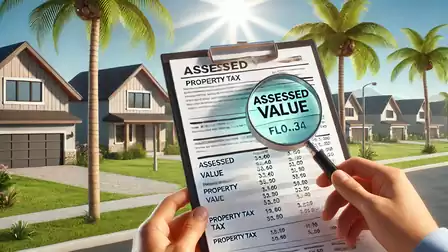
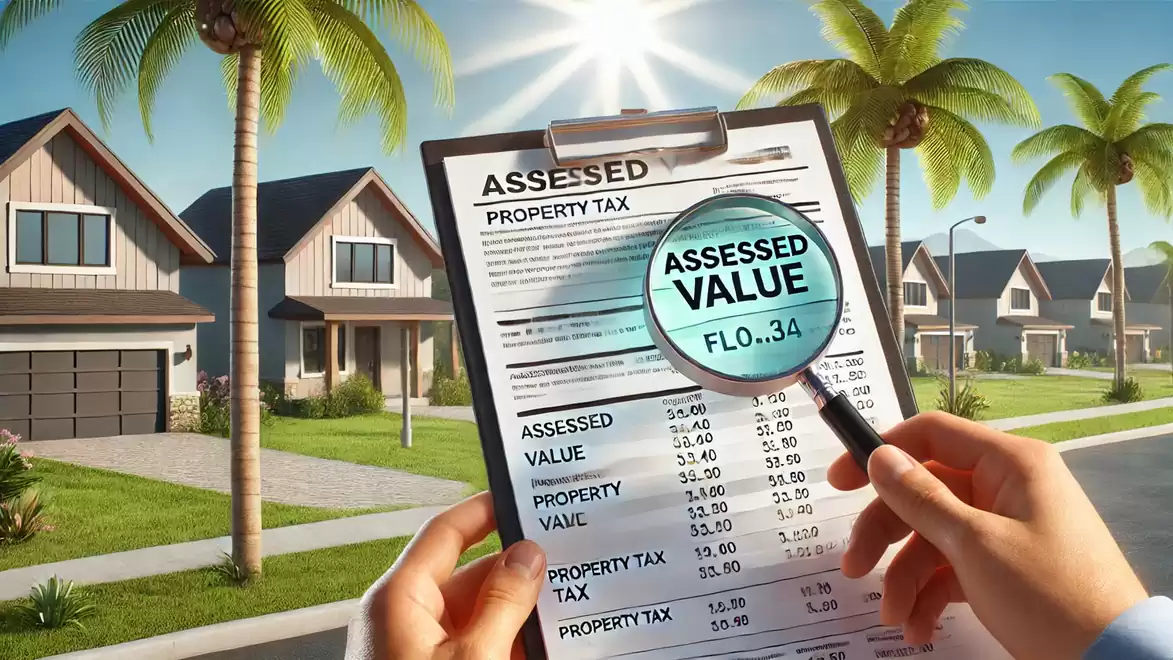
Assessed Value – Taxable value assigned to real estate by the county

What is Assessed Value?

Assessed Value is the valuation used by the county tax assessor to calculate annual property taxes. It is not necessarily equal to the market value or sale price of the property.

How is it calculated?

The value is determined by the county appraiser's office using market data and adjusted by local tax exemptions or caps. In Florida, the Homestead Exemption can reduce the assessed value for primary residences.

Why is it important?

The Assessed Value directly affects your yearly tax bill. It may change after purchase, construction, or reassessment, so buyers should be aware of the potential for increased tax liability.

? Tip: Don’t confuse Assessed Value with Appraised Value. For budgeting purposes, ask your realtor or title company to provide the most recent tax bill and valuation notice.
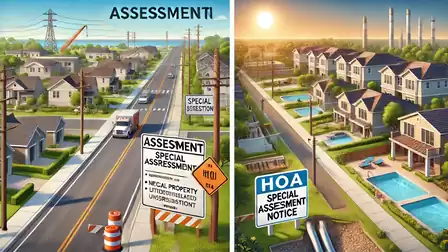
Two contrasting cityscapes: On the left, a busy urban street with special assessment signs; on the right, a serene residential area with modern houses and an HOA notice.
AI generated

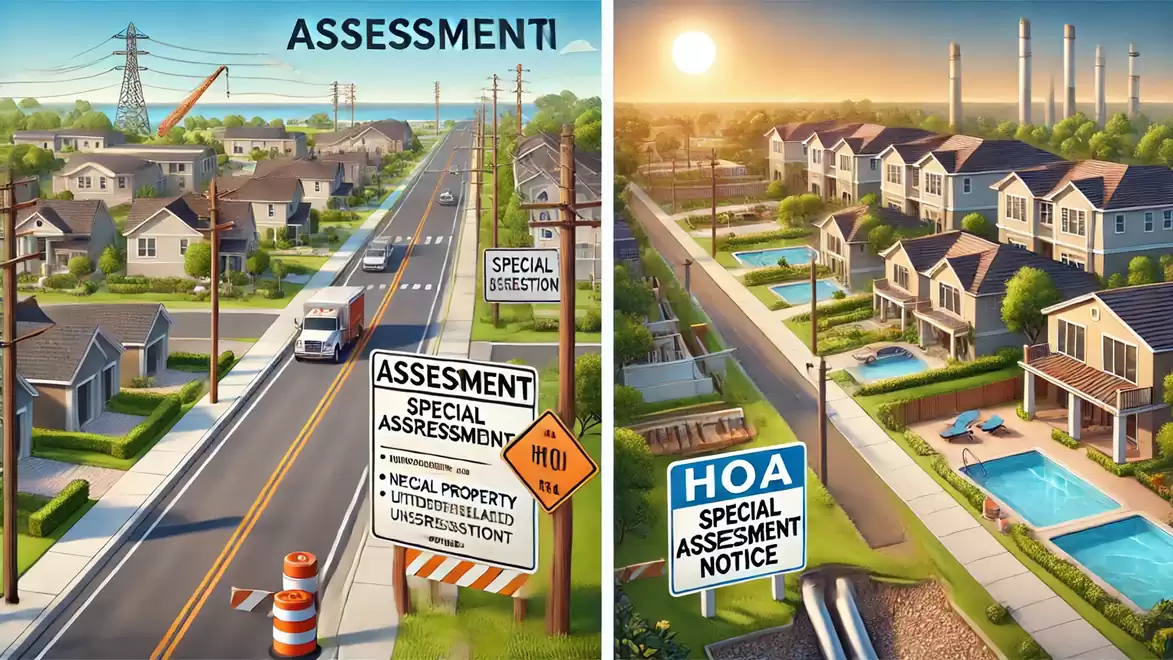
Assessment – Additional charges by the HOA or local government

What is an Assessment in real estate?

An Assessment is a special charge levied on property owners by either a homeowners association (HOA) or a local municipality. It covers costs for specific improvements or repairs not included in regular dues or taxes.

Common types of Assessments

Examples include roadwork, sewer upgrades, roof replacements, or new community amenities. These costs are usually divided among owners based on unit size or location.

Why is this important for buyers?

Before purchasing property, ask whether any current or upcoming assessments are in place. In Florida, such costs must be disclosed in the HOA documents or title search.

? Tip: Special Assessments can be significant. Always review HOA meeting notes and financial reports to avoid unpleasant surprises after closing.

Three men in suits sit at a table with a contract. One holds a document titled 'Assignment of Lease,' while another signs it. A cityscape with a tall building is visible in the background.
AI generated

Assignment of Lease – Transfer of a lease agreement to a new tenant

What is an Assignment of Lease?

An Assignment of Lease is the transfer of an existing lease from the current tenant (assignor) to a new tenant (assignee). The assignee assumes all rights and obligations under the original lease agreement.

When is lease assignment used?

  • Sale of a business including its leased premises
  • Relocation of the tenant with time remaining on the lease
  • Investment transitions in commercial or long-term rentals

Key legal considerations

  • Landlord consent is typically required under the lease terms
  • The original tenant may remain liable unless formally released
  • A separate agreement between assignor and assignee is strongly recommended

Florida-specific insights

  • Assignment agreements in Florida do not require notarization but should be in writing
  • Commercial leases usually include a landlord approval clause
  • Assignment is not the same as a sublease—in a sublease, the original tenant remains primarily responsible

? Tip: In Florida, thoroughly review any Assignment of Lease agreement and ensure all liability, duration, and consent requirements are clearly addressed before proceeding.

Illustration of a home purchase with a handshake in the foreground representing a mortgage, along with various financial and mortgage symbols in the background.
AI generated

Assumption of Mortgage – Transfer of an existing loan to the property buyer

What is Assumption of Mortgage?

Assumption of Mortgage refers to the process of a homebuyer taking over the seller’s existing mortgage loan. The buyer assumes the same interest rate, loan balance, and terms originally agreed upon by the seller and the lender.

Benefits of assuming a mortgage

  • Lower interest rates: Especially valuable if the existing loan predates recent rate hikes
  • Faster closing process than applying for a new mortgage
  • Reduced closing costs and paperwork

Key considerations

  • Only assumable loans can be transferred (e.g. FHA, VA – not conventional loans without lender approval)
  • Lender approval and buyer qualification are required
  • Seller should request a release of liability to avoid future risk

? Tip: In Florida, assuming a mortgage can be a smart financial move in a high-rate market. But buyers should always consult legal and financial professionals before proceeding.
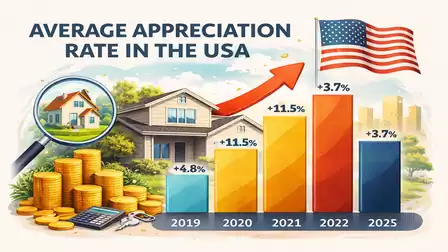
Infographic depicting average appreciation rate in the USA from 2019 to 2025 with rising arrow graphic, stacks of coins, magnifying glass, houses, and US flag.
AI generated

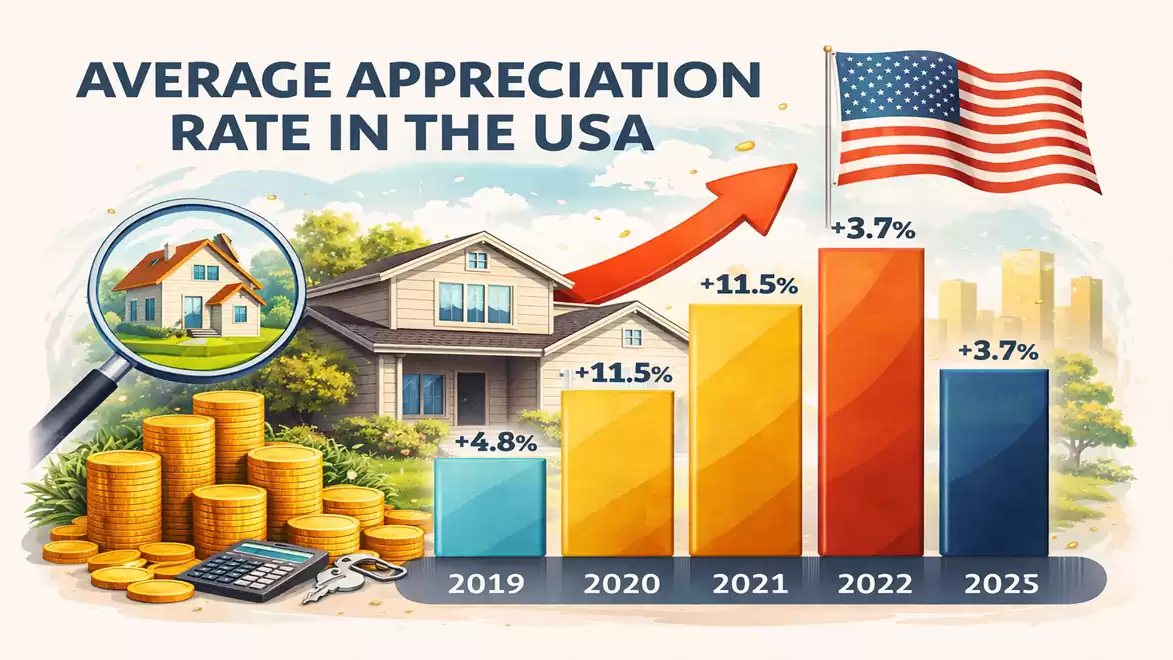
What Is the Average Appreciation Rate in the USA?

The Average Appreciation Rate refers to the average annual increase in property values across the United States over time. It is a key metric for real estate investors evaluating long-term market performance.

Typical Rates in the United States

Historically, the average appreciation rate in the U.S. is ????? 3% to 5% per year. However, this varies significantly depending on location, economic conditions, and market cycles.

  • Stable markets: approx. 2% – 4% annually
  • Growth markets: approx. 5% – 8% or higher
  • Volatile markets: higher fluctuations possible

Key Influencing Factors

The actual appreciation rate depends on several factors:

  • Interest rates: Lower rates typically boost demand and prices
  • Population growth: Increased housing demand
  • Job market: Regional economic strength
  • Supply and demand: Housing availability

Florida Market Insights

In Florida, appreciation rates often exceed the national average due to:

  • Strong inbound migration
  • High demand for vacation properties
  • International buyers

Coastal areas and popular investment locations may experience significantly higher appreciation rates.

Important Note for Investors

The average appreciation rate is a long-term benchmark, not a guarantee of future performance. Real estate markets are cyclical, and short-term declines can occur.

Conclusion

The Average Appreciation Rate in the USA is a valuable guideline for investment planning, but should always be combined with local market analysis.
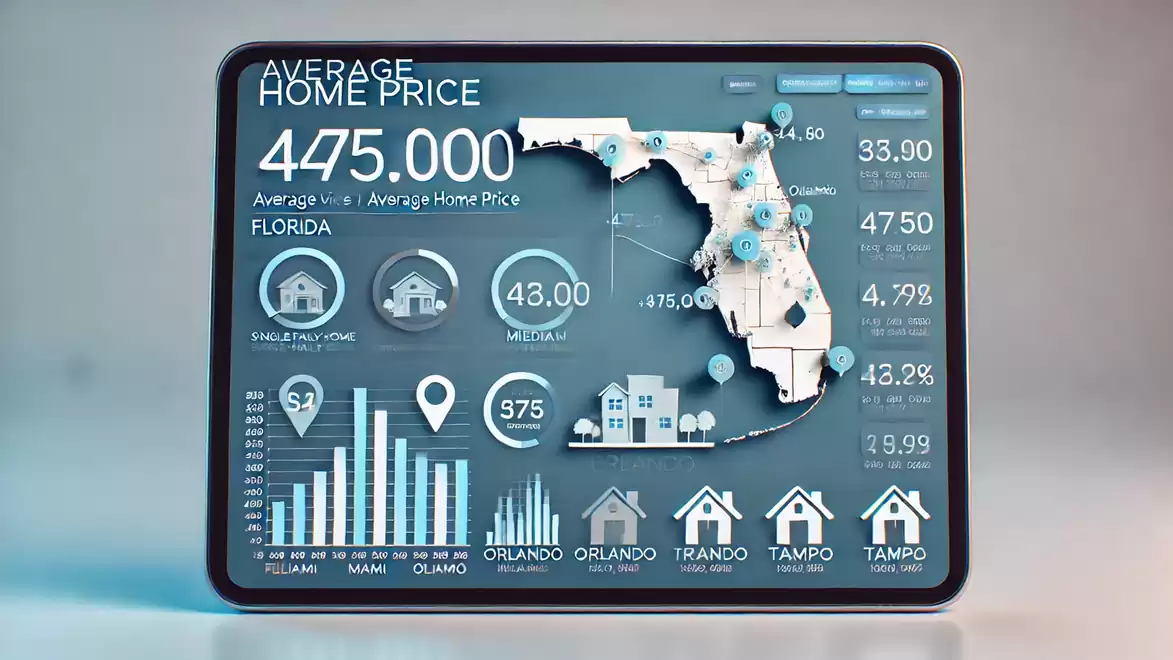
Digital display of average home prices in Florida with charts and a map.
Licensed by: Adobe

Average Price – Market’s mean home sale price over a given period

What does Average Price mean?

Average Price refers to the mean sale price of real estate in a specific area and time frame. It is calculated by dividing the total sum of all property sales by the number of transactions. In the U.S., it’s a key figure in real estate trend analysis.

Average Price vs. Median Price

  • Average Price: Can be skewed by outliers (very high or low values)
  • Median Price: Shows the middle value and is more stable in mixed markets

Applications in real estate

  • Analyzing market trends by city, zip code, or neighborhood
  • Comparing asking or purchase prices to area averages
  • Supporting negotiation or investment decisions

? Tip: In Florida, average home prices are published by Realtor associations and platforms like MLS or Zillow. Always compare with median price and $/sqft for a more balanced view.
B

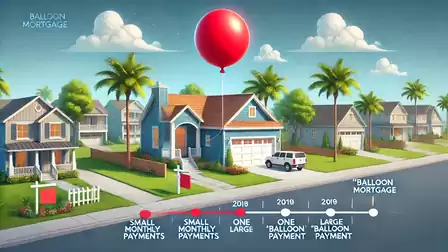
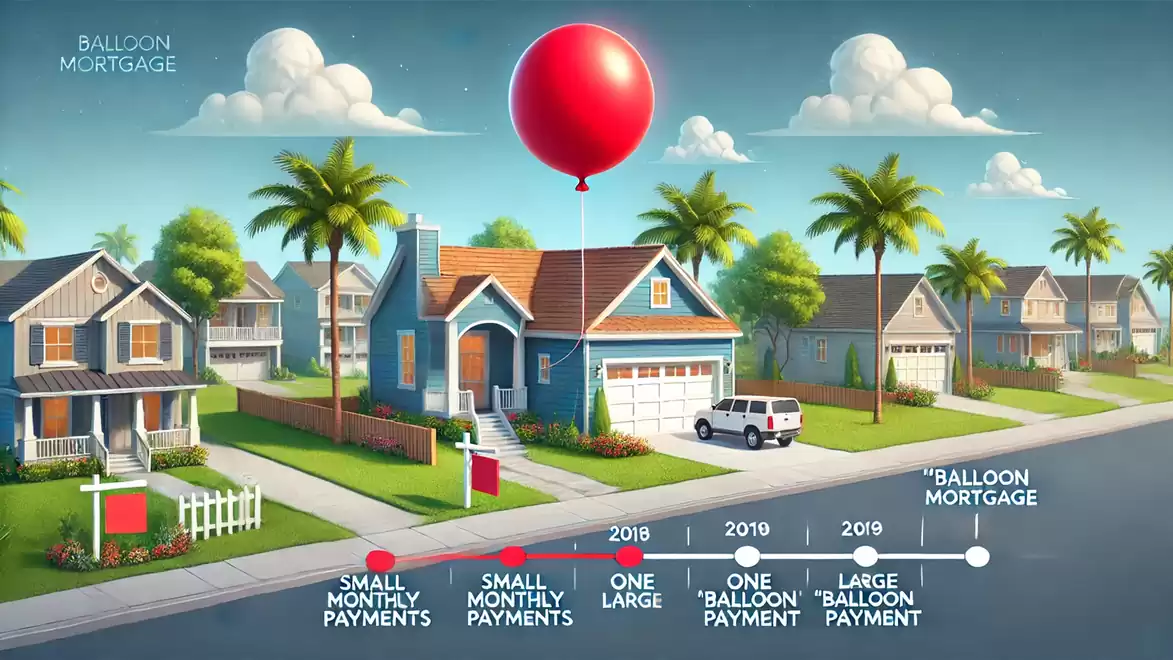
Illustration of a residential neighborhood with houses and palm trees, depicting a balloon mortgage with a large red balloon over a house.
AI generated

Balloon Mortgage – Short-term loan with large final payment

What is a Balloon Mortgage?

A Balloon Mortgage is a type of real estate loan where only partial repayment occurs during the loan term, followed by a large final payment (balloon payment) due at the end. It's structured with lower monthly payments during the term and a lump-sum payoff at maturity.

Key features

  • Term length: Usually 5, 7, or 10 years
  • Lower monthly payments (often interest-only)
  • Large balloon payment due at end of term
  • Often used in bridge financing or investment deals

Pros and cons

  • Pros: Lower initial costs, useful for short-term ownership
  • Cons: Significant risk if unable to refinance or sell in time
  • Best for: Investors, flippers, or short-horizon buyers

Balloon mortgages in Florida

  • Rarely used by primary homeowners
  • Popular for fix & flip projects or commercial property financing
  • Risky without a defined exit strategy

? Tip: In Florida, a Balloon Mortgage may suit short-term investment goals, but always ensure you have a clear plan for the final payment to avoid financial strain.

A couple in a modern office receives a pre-approval for a bank loan. A model house is on the table.
AI generated

Bank Pre-Approval – Mortgage qualification letter issued before home shopping

What is Bank Pre-Approval?

Bank Pre-Approval is a written statement from a lender confirming that a buyer is financially qualified for a mortgage based on credit, income, and debt review. It’s typically obtained before making offers and strengthens the buyer’s position in a competitive market.

Benefits of pre-approval

  • Clear budget framework: Know how much home you can afford
  • Stronger offers: Sellers prefer buyers who are pre-approved
  • Faster loan processing once under contract

How it works

  • Submit income documents, tax returns, and bank statements
  • Credit check by lender
  • Receive a pre-approval letter valid for 60–90 days

? Tip: In Florida, many agents require a pre-approval letter before scheduling property showings. Start this process early if financing through a U.S. bank or lender.
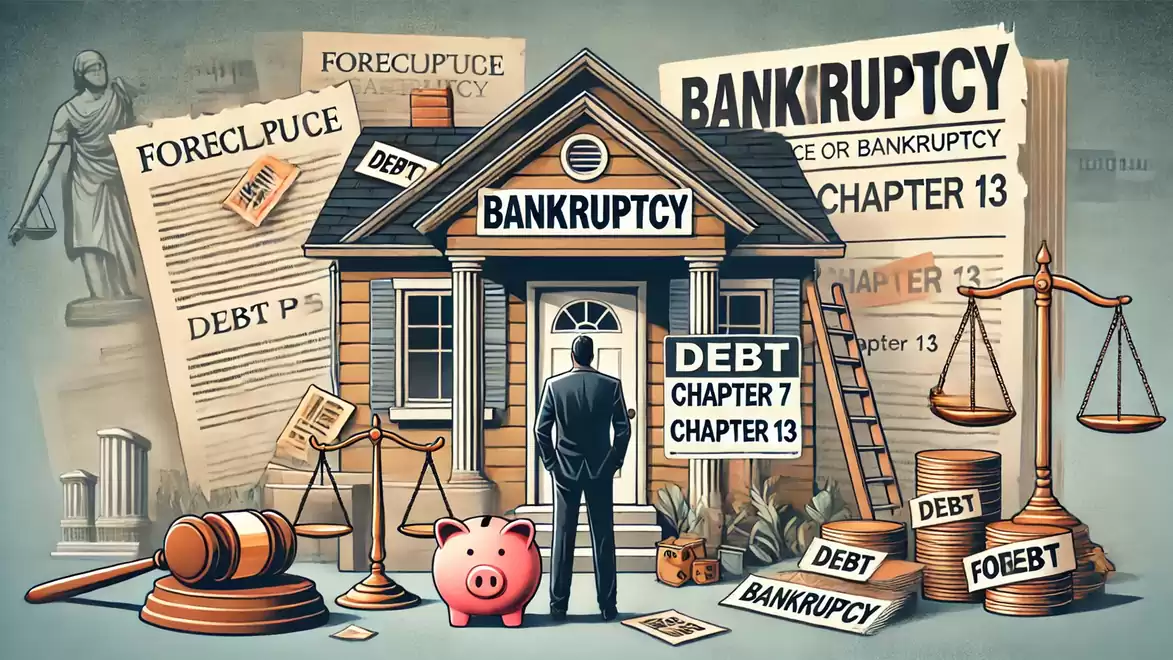
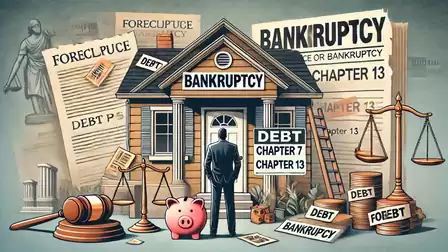
Illustration of a man standing in front of a courthouse with bankruptcy documents and debt notices.
AI generated

Bankruptcy – Legal debt relief process with real estate implications

What is Bankruptcy?

Bankruptcy is a federal legal process in the U.S. that allows individuals or businesses who cannot pay their debts to seek relief through court-managed reorganization or asset liquidation. It’s governed by the U.S. Bankruptcy Code and filed in federal bankruptcy court.

Impact on real estate

  • May delay or halt foreclosure on a mortgaged property
  • Property sales, leases, and ownership rights may require court approval
  • Purchasing property from bankruptcy (e.g. foreclosure or short sale) may offer opportunities but requires legal diligence

Common types of bankruptcy (individuals)

  • Chapter 7: Liquidation – assets sold to repay creditors
  • Chapter 13: Reorganization – structured repayment over 3–5 years

Consequences of bankruptcy

  • Significant credit score impact (reportable for up to 10 years)
  • Potential loss or restriction of real estate assets
  • Difficulties securing mortgages after filing

? Tip: In Florida, bankruptcy can complicate the sale or purchase of real estate. Buyers should always consult a real estate attorney when dealing with properties under bankruptcy protection.

Office scene with a man sitting at a table, reviewing documents and taking notes. In the background, there's a presentation showing a building and a depreciation schedule. Windows reveal a modern cityscape with palm trees.
AI generated

Basis for Depreciation – Tax depreciation value of a real estate investment

What is the Basis for Depreciation?

The Basis for Depreciation is the starting value used to calculate how much of a property’s cost can be deducted over time for tax purposes. It applies to rental and investment properties and is essential for determining annual depreciation expenses allowed by the IRS.

How it's calculated

  • Purchase price of the property minus the value of the land
  • + Capitalized closing costs (title fees, commissions, etc.)
  • – Non-depreciable portions such as land, landscaping, and personal items

Typical rules in the U.S. / Florida

  • Residential property is depreciated over 27.5 years (per IRS guidelines)
  • Only the structure is depreciable, not the land
  • Often determined with help from a CPA or cost segregation specialist

? Tip: For Florida real estate investors, a properly calculated Basis for Depreciation can maximize tax savings. It’s highly recommended to obtain a professional valuation or cost segregation study to separate building and land value accurately.

Real estate sale: Key handover between two businessmen in front of a modern house with scales and a purchase contract on the table.
AI generated

Beneficiary – Individual entitled to receive assets from a trust or estate

What is a Beneficiary?

A Beneficiary is a person or entity legally designated to receive assets from a trust, will, insurance policy, or transfer deed. In real estate, beneficiaries are common in estate planning, living trusts, and TOD deeds.

Common examples of Beneficiaries

  • Revocable Living Trust: Receives real estate upon the grantor’s death
  • Transfer-on-Death (TOD) Deed: Property passes directly to the beneficiary
  • Last will and testament: Names heirs to inherit assets

Beneficiary rights

  • Right to receive designated assets upon trigger event (e.g., death)
  • Right to information from trustee or estate administrator
  • Legal protection if trustee fails fiduciary duties

? Tip: In Florida, naming beneficiaries through trusts or TOD structures can avoid probate and simplify property transfers.

Two people sitting in a modern living room overlooking the pool. A bill of sale is on the table.
AI generated

Bill of Sale – Legal document for transferring personal property

What is a Bill of Sale?

A Bill of Sale is a legal document that records the transfer of ownership of personal property from a seller to a buyer. In real estate, it is commonly used to separately document the sale of furniture, appliances, or household items that are not part of the deeded property.

Typical use in real estate transactions

  • Lists furnishings, electronics, décor, or equipment included in the sale
  • Often used in addition to the Purchase Agreement
  • Specifies sale price, condition, transfer date, and disclaimers

Florida-specific notes

  • Especially common in vacation rental sales where properties are sold fully furnished
  • The Bill of Sale is not recorded in public records
  • May have tax implications if purchase price is allocated between real estate and personal property

? Tip: When buying or selling a Florida property with furnishings, include a Bill of Sale to clearly separate real estate from personal property – essential for clarity, taxes, and insurance purposes.

Infographic compares the meaning of 'billion' between the USA and Germany with charts and symbols.
AI generated

Billion – U.S. numerical term for one thousand million

What does Billion mean?

In the U.S. and international financial context, a Billion equals one thousand million (1,000,000,000 or 109). This differs from the traditional European usage, where “Billion” once meant 1012 (one million million).

Why is it important?

In global finance, real estate, and economic reporting, “Billion” nearly always follows the short scale system (used in the U.S. and internationally), meaning one thousand million. Misunderstanding this term can cause major confusion in data interpretation.

How does it apply to real estate?

Market volumes, capital investments, and housing statistics often use the term “Billion.” Real estate investors must understand that in a U.S. report, “$5 Billion” equals 5,000,000,000 – not 5 trillion as it would suggest in some European contexts.

? Tip: When working across languages, always double-check numerical terms. In U.S. English: 1 Billion = 1,000 Million (not 1 trillion).

A conceptual image of a bridge loan shows a person signing documents, with financial symbols and a miniature house model on a table.
AI generated

Bridge Loan / Bridge Financing – Short-term loan to bridge real estate transactions

What is a Bridge Loan?

A Bridge Loan (also known as Bridge Financing) is a short-term loan used to bridge the gap between the purchase of a new property and the sale of an existing one. It’s also common in development projects where long-term financing is not yet in place.

Common use cases

  • Buying a new home before selling the current one
  • Transition from construction loan to permanent mortgage
  • Temporary funding while waiting for long-term financing

Key characteristics

  • Short term – typically 6 to 12 months
  • Higher interest rates than standard mortgages
  • Secured by existing or newly purchased real estate

? Tip: In Florida, bridge loans are commonly used for relocations, renovations, or fix-and-flip deals. A clear exit strategy such as sale or refinance is essential to avoid financial risk.

A modern office workspace with a laptop, documents, books, and a coffee cup on a wooden desk. A framed real estate broker license hangs on the wall.
AI generated

Broker Real Estate License – License for real estate brokers in Florida

What is a Broker Real Estate License?

A Broker Real Estate License is an official certification that allows an individual to operate as an independent real estate broker in Florida. This license is required to open a real estate brokerage and manage real estate transactions.

Requirements for obtaining a Broker License

  • At least two years of experience as a licensed real estate sales associate
  • Completion of a broker’s course approved by the Florida Real Estate Commission
  • Successful passing of the state broker exam
  • Clean legal record (e.g., no criminal history)

Responsibilities of a Broker

  • Managing a real estate firm and supervising real estate sales associates
  • Overseeing real estate transactions, contracts, and ensuring legal compliance
  • Supervising agent behavior and upholding ethical standards

Florida-specific insights

  • The Broker License is regulated by the Florida Real Estate Commission (FREC)
  • Brokers must complete continuing education courses to renew their license
  • License fees and requirements vary by state and type of brokerage business

? Tip: If you’re looking to become a Broker in Florida, make sure to stay up to date with ongoing education and changes in real estate law to maintain your license.

A modern house in Florida with palm trees, an architect and a woman discussing building plans. Construction company signs in the foreground.
AI generated

A builder in Florida is a licensed contractor or developer responsible for constructing new homes or residential buildings.

Especially in areas like Cape Coral, Naples, or Fort Myers, buyers often work directly with a builder to customize floor plans, finishes, and features.

Many builders offer turnkey packages that include both the lot and the new construction, supporting clients from planning to final delivery.

Choosing a qualified builder is crucial for ensuring construction quality, staying within budget, and managing a smooth building process in Florida.

? Tip: Always check references and licensing when choosing a builder for your Florida real estate project.

A construction worker stands in front of a house under construction. The roof is being erected. Construction vehicles and materials are scattered around the building. A sign reading 'Building Permit' is clearly visible.
AI generated

Building Permit – Official approval for construction or remodeling

What is a Building Permit?

A Building Permit is an official authorization issued by a local government that allows property owners or contractors to construct, remodel, or repair structures in accordance with zoning laws, safety codes, and building standards.

When is a permit required?

  • New construction of homes, garages, pools, docks, etc.
  • Major renovations such as room additions, roof changes, or wall modifications
  • Electrical, plumbing, and HVAC installations or upgrades
  • Changes to water, sewer, or drainage systems

Building permits in Florida

  • Each county or city has its own permitting requirements
  • Many projects must be handled by a licensed contractor
  • Unpermitted work can result in fines, stop-work orders, or forced demolition

? Tip: When buying a home in Florida, check if all structural changes were properly permitted. Unpermitted work can affect insurance coverage, resale value, and legal liability.
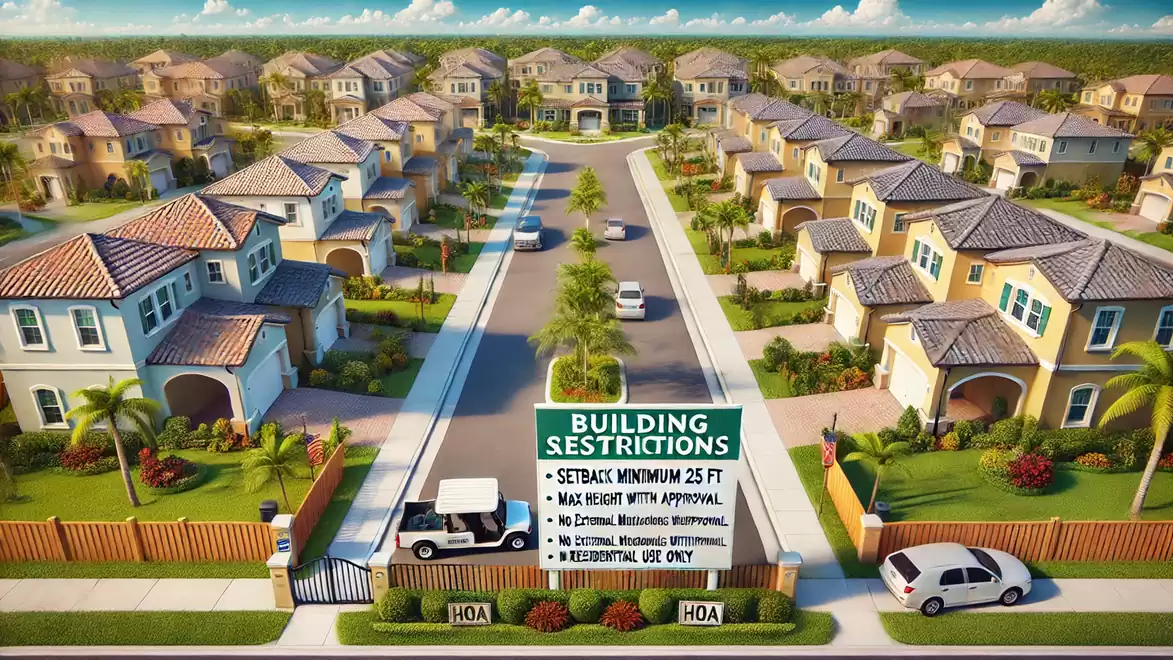
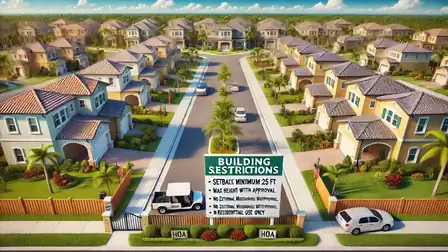
Aerial view of a modern residential neighborhood with uniformly arranged single-family homes, well-kept gardens, and a central street. A sign displays building restrictions.
AI generated

Building Restrictions – Legal or community-imposed construction limits

What are Building Restrictions?

Building Restrictions are rules and regulations that govern how, where, and what can be built on a property. These restrictions may come from zoning laws, municipal codes, homeowners’ associations (HOAs), or deed covenants.

Common types of restrictions

  • Limits on height, square footage, or lot coverage
  • Architectural guidelines such as roof style, paint color, or fencing
  • Setback requirements from property lines
  • Usage restrictions: residential only, no rentals, no commercial activity
  • HOA rules on modifications and aesthetics

Building restrictions in Florida

  • Many communities have strict HOA design rules
  • Coastal areas may have environmental regulations (e.g. mangrove or dune protection)
  • Important when planning additions, pool installations, or new construction

? Tip: Before buying or renovating property in Florida, always review the Building Restrictions to ensure your plans are legally permitted and align with local and community standards.

Modern architectural duplex with garage and palm trees, two-story house design.
AI generated

Built-over Area – Total covered footprint of a property

What is the Built-over Area?

The Built-over Area refers to the total surface area covered by permanent structures on a property. It includes not just the air-conditioned living space, but also garages, covered patios, lanais, carports, and entryways.

What does the Built-over Area include?

  • Living area (air-conditioned space)
  • Garage (attached or detached)
  • Covered lanai, patio, or terrace
  • Covered entryway or breezeway
  • Utility or storage rooms under roof

Built-over Area vs. Living Area

  • Living Area: Interior space with climate control
  • Built-over Area: Entire footprint of roofed or enclosed structures

? Tip: In Florida, always verify whether square footage refers to Living Area or Built-over Area. The difference can impact valuation, comfort, and rental pricing.

Three people in a modern living room with large windows looking at plans on a table. The room is elegantly furnished with plants and a cozy couch.
AI generated

Buyers Agent – Real estate agent representing the buyer in Florida

A Buyers Agent is a licensed real estate professional who exclusively represents the buyer’s interests during a property purchase. In Florida, it is common for buyers to work with a Buyers Agent to find the right property, schedule viewings, and navigate the purchase process professionally.

The Buyers Agent helps with price negotiations, understands the local market, and offers valuable insights, contacts, and data-driven guidance. Good to know: The commission is usually paid by the seller, so buyers benefit from this service at no direct cost.

? Tip: Make sure your Buyers Agent does not have a dual agency role and truly represents only your interests.

A modern house with many windows, a 'Sold' sign in the yard, and a list of closing costs on a clipboard, along with a calculator displaying 'SOLD'.
AI generated

Buyers Closing Costs – Additional expenses for homebuyers in Florida

Buyers Closing Costs refer to the extra costs paid by the buyer at the time of closing a real estate transaction in Florida. These may include title insurance, appraisal fees, recording fees, escrow charges, property taxes, and lender fees.

The total amount typically ranges between 2% and 5% of the purchase price, depending on location, contract terms, and property type.

? Tip: Always request a detailed closing cost estimate (Closing Disclosure) from your title company or real estate agent early in the process.

C

Luxurious waterfront house with pool, palm trees, and private dock, perfect for relaxing vacations.
AI generated

Canal View – Waterfront property view over residential canals

What is a Canal View?

A Canal View refers to a property that offers a direct or partial view of a waterway or man-made canal. In cities like Cape Coral and Fort Lauderdale, canal views are highly desirable for homeowners, investors, and vacation renters alike.

Typical features of Canal View homes

  • Waterfront views from patios, pools, or balconies
  • Often located on canal-front lots
  • May include private dock access or navigable water rights

Advantages of Canal View properties

  • Higher property value compared to inland homes
  • Increased rental appeal for vacation rentals
  • Scenic atmosphere with boating or fishing potential

Florida-specific insights

  • Many canals in Florida offer Gulf access or freshwater boating
  • Not all canal views guarantee boat access—verify zoning and water depth
  • Sailboat Access means no bridges – ideal for larger boats

? Tip: If you're considering a Canal View property in Florida, evaluate the water access, sun exposure, dock options, and how it may enhance investment value or rental income.
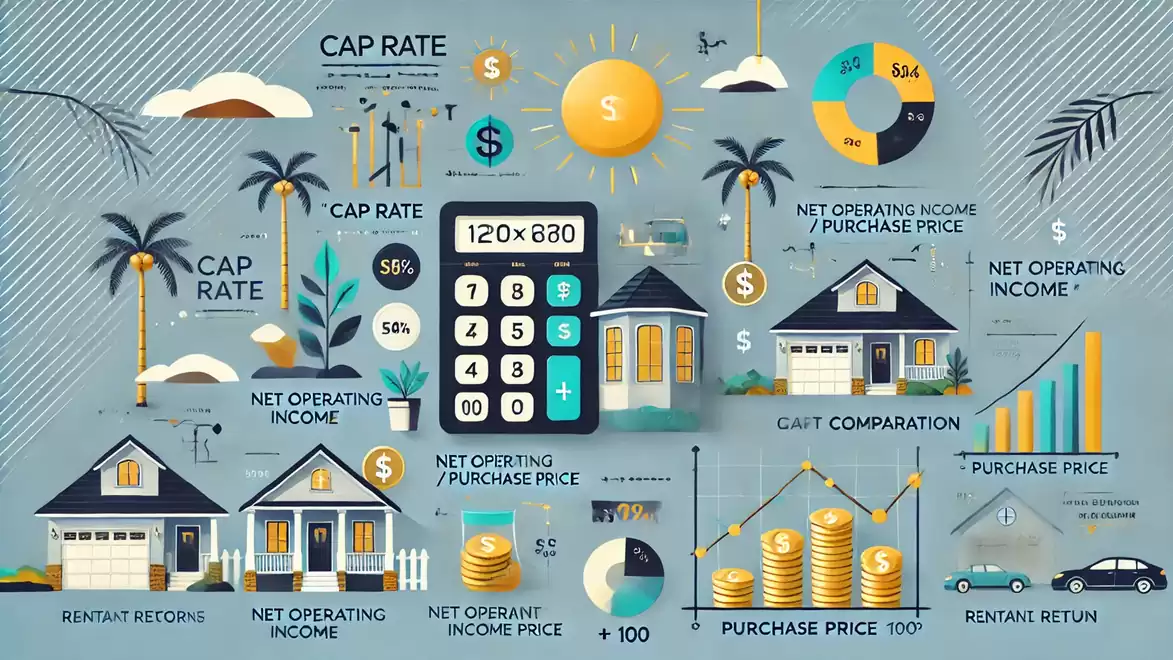
Illustration of real estate calculations with charts, houses, and a calculator, depicting cap rate and other financial concepts.
AI generated

Cap Rate – Gross rental yield for real estate investors

What is Cap Rate?

The Cap Rate (Capitalization Rate) is a key metric used to evaluate the profitability of an investment property. It measures the expected return based on the property's net income and purchase price.

The formula is: net annual income / purchase price × 100. For example, a property generating $30,000 annually on a $500,000 investment has a 6% Cap Rate.

How is Cap Rate used?

Investors use the Cap Rate to compare properties, assess investment potential, or estimate a property's market value. In Florida, vacation rentals often show Cap Rates between 4% and 8%, depending on location and occupancy.

? Tip: The Cap Rate is a useful first indicator, but it should be complemented by a full cash flow analysis, including expenses, vacancy, and tax impacts.

Modern suburban neighborhood with palm trees and single-family homes at sunset, with a desk in the foreground featuring documents and a calculator.
AI generated

Capital Contribution – One-time fee when entering a homeowners association

A Capital Contribution is a one-time fee that may be charged when purchasing a property within a Homeowners Association (HOA) or residential community in Florida. It is used to fund reserves or support the community’s operating budget.

This payment is separate from regular HOA dues and is usually paid at closing by the buyer. The amount varies depending on the community and may be a flat fee or a percentage of the purchase price.

? Tip: Always ask about the Capital Contribution amount when buying in an HOA, and ensure it’s included in your Closing Disclosure.
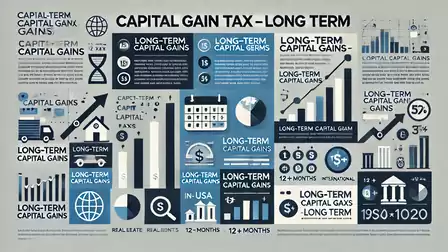
Infographic on long-term capital gain tax with charts and icons illustrating figures and concepts.
AI generated

Capital Gain Tax – Long-term profits from U.S. asset sales

Long-Term Capital Gain Tax applies to profits from selling assets such as real estate or stocks held for more than one year. These gains generally benefit from lower federal tax rates compared to short-term capital gains in the U.S.

The exact rate depends on the seller’s income level and tax filing status. Foreign sellers of U.S. property may also be subject to FIRPTA withholding and additional requirements.

? Tip: Holding property long-term can lead to significant tax savings. Still, it’s best to consult a tax expert before selling.

Illustration of a short-term tax in the USA with a house, charts, a clock, and graphics about capital gains tax.
AI generated

Capital Gain Tax – Short-term profits from asset sales

Short-Term Capital Gain Tax applies when an asset such as real estate, stocks, or land is sold after being held for less than one year. In the U.S., these profits are taxed as ordinary income based on your personal tax bracket.

This tax category is especially relevant for investors or property owners engaging in quick flips or short-term holdings. The tax rate can be significantly higher than for long-term gains.

? Tip: Before making a short-term sale, calculate your effective tax impact—particularly if you’re in a high-income bracket.

An informative infographic about capital gains tax in the USA, featuring various charts and symbols explaining short-term and long-term capital gains.
AI generated

Capital Gain Tax – Tax on profits from asset sales in the U.S.

Capital Gain Tax is the tax applied to profits made from selling assets such as real estate, stocks, or land. The U.S. distinguishes between Short-Term Capital Gains (held less than one year) and Long-Term Capital Gains (held more than one year).

Long-term gains typically receive preferential tax rates, while short-term gains are taxed at ordinary income rates. The final tax rate depends on income level, filing status, and the type of asset sold.

Foreign sellers are also subject to U.S. taxation. In Florida, a FIRPTA withholding often applies and is withheld directly at closing.

? Tip: To avoid unexpected liabilities, consult a tax advisor early when planning to sell U.S. property—especially for international transactions.

Graphic about capital gain taxation with a house, bundles of money, charts, and 'Sold' sign.
Licensed by: Adobe

Capital Gain – Profit from the sale of an asset

A Capital Gain is the profit realized from selling an asset such as real estate, stocks, or land. It is calculated as the difference between the original purchase price and the final selling price, and it is subject to capital gains tax in the U.S.

There are two types of Capital Gains: Short-Term (held for less than a year) and Long-Term (held for more than a year). Long-Term Capital Gains typically benefit from lower tax rates.

? Tip: If you plan to sell U.S. property, consult a tax advisor to understand potential liabilities, exemptions, or withholding rules—especially if you're a non-resident seller.

Infographic about capitalization rate with charts and city skyline in the background.
AI generated

Capitalization Rate – Key metric for real estate investment analysis

What is the Capitalization Rate?

The Capitalization Rate, or Cap Rate, is a core indicator used to measure the profitability of an investment property. It expresses the expected net income as a percentage of the purchase price.

Formula: Net annual income / Purchase price × 100. The Capitalization Rate is used to compare rental properties and assess potential returns.

Cap Rate vs. Gross Yield

Unlike gross rental yield, the Capitalization Rate accounts for operating expenses and vacancy risks, providing a more accurate view of the property's net return.

? Tip: Higher Cap Rates may suggest better returns, but can also indicate higher risk or less desirable locations. Always compare similar property types.
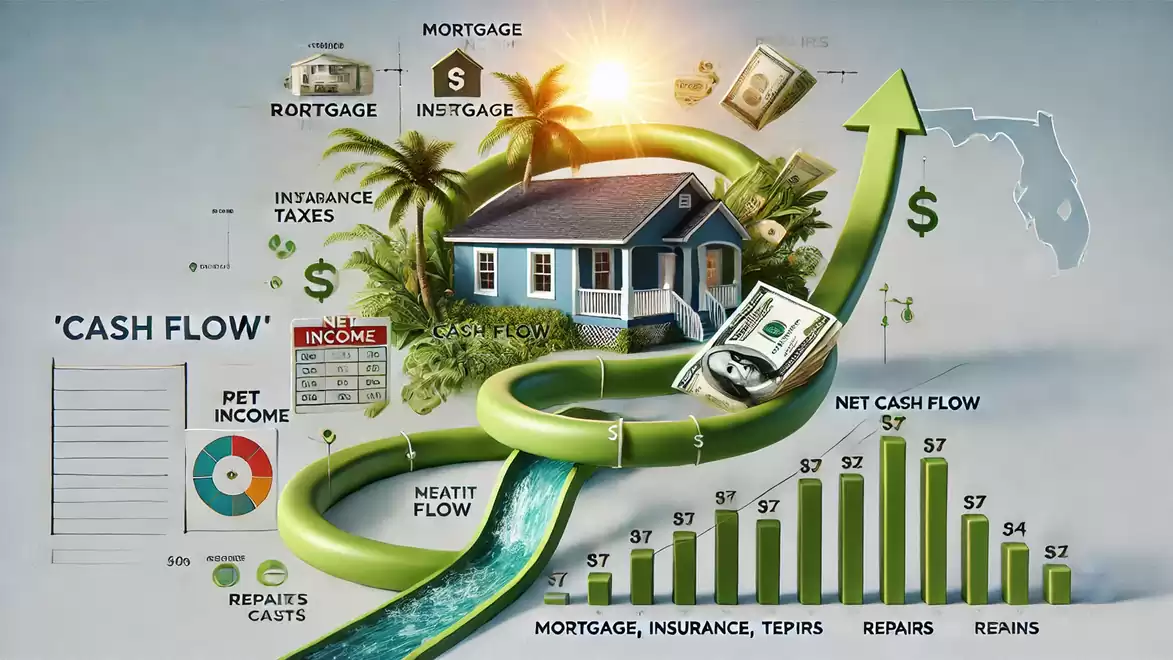
Diagram of a financial flow with a house in the center, surrounded by money bills, arrows, and charts. Symbols for mortgages, insurance, and taxes are visible.
AI generated

What does Cash Flow mean in real estate?

Cash Flow refers to the net amount of cash generated by a rental property after all operating expenses, mortgage payments, taxes, and maintenance have been deducted from rental income.

A positive Cash Flow means the property earns more than it costs to operate. A negative Cash Flow indicates that the investment requires additional funds to cover its costs.

Why is Cash Flow important?

Strong Cash Flow ensures financial stability and profitability. It's a key metric for evaluating real estate investments—especially for long-distance or international investors buying vacation rentals in Florida or the U.S.

? Tip: Always account for vacancy periods, maintenance reserves, and management fees to ensure your Cash Flow remains reliable and realistic.

Illustration of a man with a magnifying glass in front of a house for sale at sunset. A document titled 'Caveat Emptor' is visible in the foreground.
AI generated

What does Caveat Emptor mean?

Caveat Emptor is a Latin legal doctrine meaning “let the buyer beware.” In real estate, it implies that the buyer is responsible for investigating the property and its condition before purchase.

Is Caveat Emptor valid in Florida?

Yes, Florida generally follows the Caveat Emptor principle, though sellers must disclose known material defects that affect the value or safety of the property. Still, the burden of due diligence lies with the buyer.

What does this mean for buyers?

Buyers should always conduct a thorough home inspection and ensure that contingencies and rights to cancel are included in the contract.

? Tip: Don’t rely on appearances or verbal statements—read all disclosures carefully and consult a legal expert when in doubt.
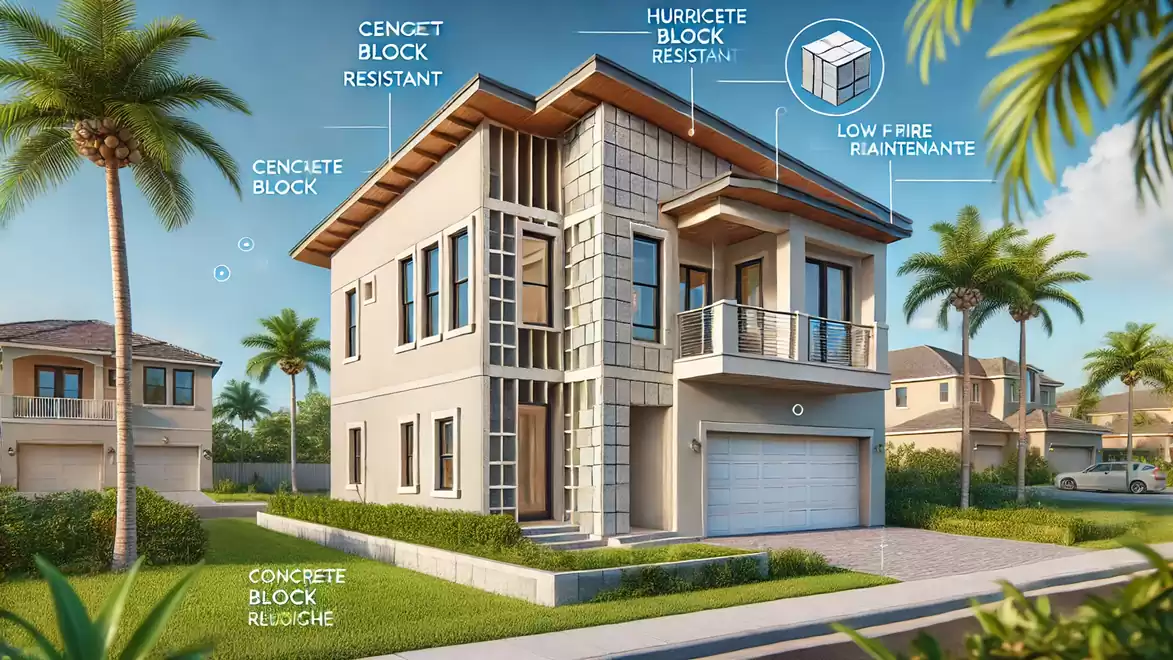
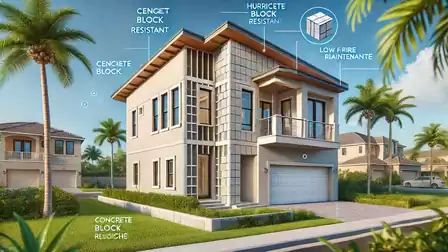
Modern two-story house with a white facade, surrounded by palm trees, marked with details about various durable building materials.
AI generated

Cement Block and Stucco (CBS) – Concrete block home construction with stucco finish

What does CBS mean?

Cement Block and Stucco (CBS) refers to a common construction style in Florida, where homes are built with concrete masonry unit (CMU) walls and finished with stucco on the exterior. This structure offers excellent durability against heat, moisture, and storms.

Advantages of CBS construction

  • Superior wind and hurricane resistance
  • Lower fire risk compared to wood-framed homes
  • Low maintenance and long-lasting structure
  • Better insulation and noise protection when built properly

Typical CBS features

  • Walls made of 8-inch concrete blocks (CMU)
  • Exterior coated with cement-based stucco
  • Usually topped with a wood-framed roof structure

? Tip: In Florida, CBS homes are in high demand due to their strong resale value and lower insurance premiums compared to wood-frame properties.

A modern two-story new build is being inspected by an assessor. In the foreground, there is a certificate of occupancy.
AI generated

What is a Certificate of Occupancy?

A Certificate of Occupancy (CO) is an official document issued by local authorities stating that a building is safe and compliant with zoning, building codes, and regulations. It confirms that the property can be legally occupied.

When is a CO required?

Certificates of Occupancy are required for new constructions, major renovations, and changes in use. In many U.S. jurisdictions, including Florida, a property cannot be legally occupied or rented without a valid CO.

Why is it important for buyers?

When purchasing a property, make sure a valid Certificate of Occupancy is available. If not, you may face legal issues, insurance problems, or delays in using the property. It's also often a requirement for short-term rentals like Airbnb.

? Tip: Always request a copy of the CO during closing and verify that it matches the intended use (e.g., residential, multi-family, or commercial).
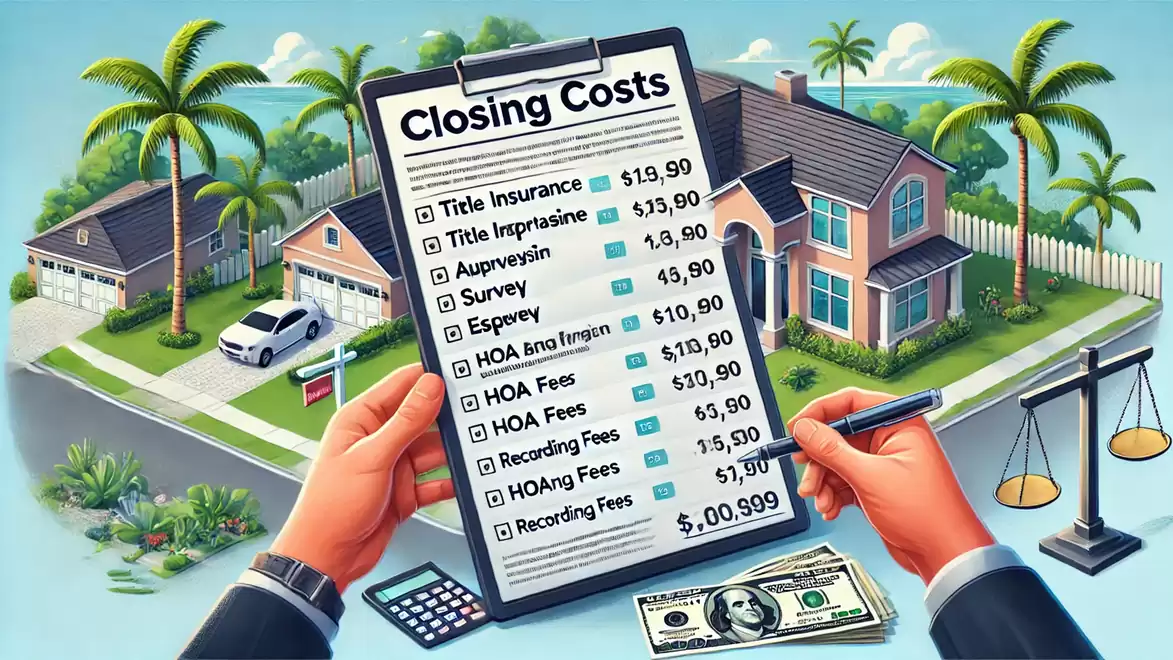
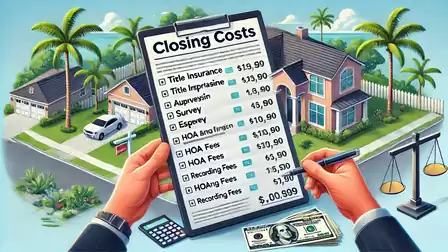
Illustration of hands holding a clipboard with closing costs, next to a house and a scale.
AI generated

Closing Costs – Transaction-related fees due at real estate closing

What are Closing Costs?

Closing Costs are the fees and expenses due at the final stage of a real estate transaction. These costs cover legal, governmental, and service-related items and are typically paid at the time of ownership transfer.

This is a method to determine the market value of a property. Comparable data from real estate transactions (within the past 12 months) is analyzed to align with current market conditions.

Common components of Closing Costs

  • Title insurance
  • Attorney and notary fees
  • Documentary stamps and transfer taxes
  • Recording fees (public record registration)
  • Escrow fees for handling funds and documents
  • Appraisal and survey fees if applicable
  • HOA transfer or setup fees if in a managed community

Who pays the Closing Costs?

  • Responsibility is negotiable but varies by region
  • In Florida, seller often pays title insurance; buyer pays most other fees
  • Mortgage transactions include lender and processing fees

? Tip: In Florida, buyers should budget around 2%–5% of the purchase price for closing costs. You’ll receive a detailed estimate early on (Loan Estimate) and a final summary at closing (Closing Disclosure).
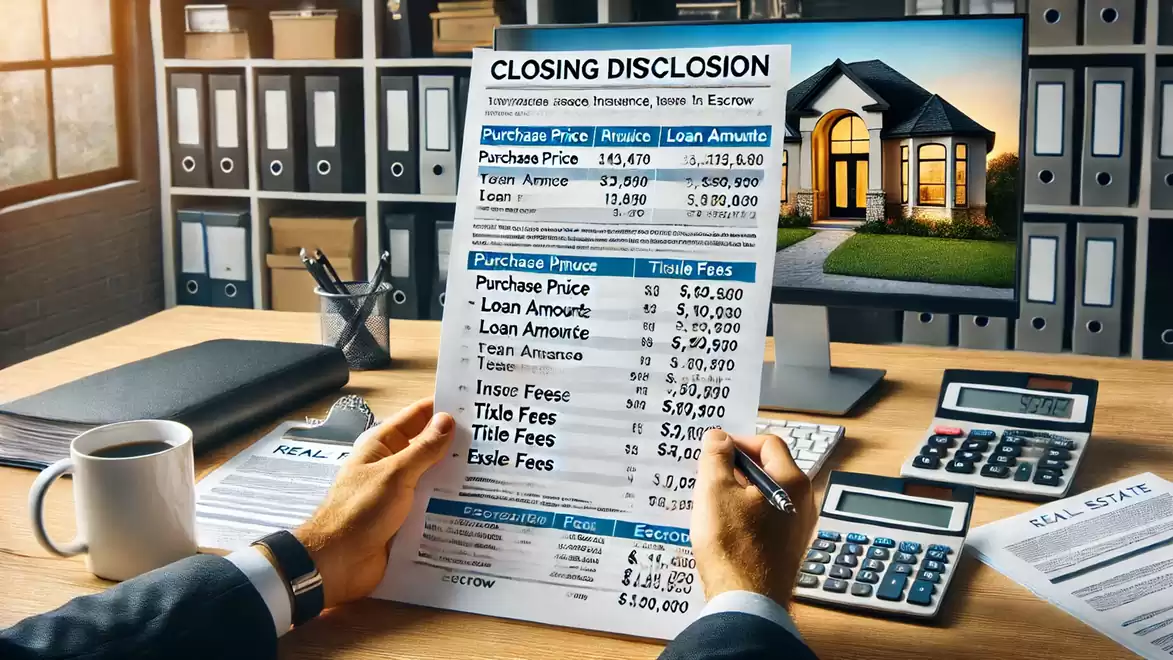
A desk with real estate financing documents, a computer screen showing a house, and office supplies like calculators.
AI generated

Closing Disclosure – Breakdown of all closing costs in a real estate transaction

What is the Closing Disclosure?

The Closing Disclosure is a federally required document that outlines all final loan terms and closing costs in a real estate transaction. It must be provided to the buyer at least three business days before closing and ensures full transparency.

What does the Closing Disclosure include?

  • Purchase price and down payment
  • Loan amount, interest rate, and term
  • Taxes, insurance, and fees
  • Title insurance, recording fees, and escrow costs
  • Total amount due at closing

Florida-specific insights

  • The Title Company or Closing Agent prepares the document
  • In Florida, the Closing Disclosure is legally binding—changes after signing are rare
  • Often used alongside the more detailed ALTA Settlement Statement

? Tip: Always review your Closing Disclosure carefully for accuracy and hidden fees, and make sure you understand each line item before proceeding to final signature.

Business people in an office discussing and signing a contract. A closing statement document is on the table in the foreground.
AI generated

Closing Statement – Final breakdown of all real estate transaction costs

What is a Closing Statement?

A Closing Statement is a detailed summary of all financial transactions related to a real estate closing. It includes purchase price, taxes, credits, commissions, and all closing fees for both the buyer and seller.

It serves as the official settlement of the purchase agreement, where both parties must clearly disclose their financial responsibilities. All payments and adjustments are made on the day of closing. Important: Buyers are entitled to receive the Closing Statement at least 24 hours before closing.

Who prepares the statement?

The document is typically issued by a Title Company or Escrow Agent. It acts as the official financial record of the property transaction and must be reviewed and signed at closing.

What does it contain?

Common entries include: Purchase Price, Earnest Money, Title Charges, Lender Fees, HOA Dues, Insurance, Taxes, and other related costs.

? Tip: Always review the Closing Statement line by line and ask your real estate agent or attorney to explain unclear charges before signing.

Image of a modern office where businessmen are negotiating the sale of a house. A model of the house is on the table. American influence is visible through a USA flag.
AI generated

Closing – Final step in the U.S. real estate purchase process

What does Closing mean?

Closing is the final stage of a real estate transaction in the United States. On this day, the purchase contract is completed, ownership and funds are transferred, and the buyer receives the keys to the property.

What steps are involved in the Closing process?

Before closing, all contract conditions must be met—such as home inspection, financing, title check, and insurance. On closing day, all funds, fees, and documents are processed by the title company or escrow agent.

What happens at Closing?

Both parties sign the final documents. The buyer pays the purchase price and closing costs, while the seller receives the proceeds. The ownership is then officially recorded with the county.

? Tip: Always review your Closing Statement and final documents at least 24 hours before closing. International buyers should work with a local expert to ensure a smooth process.

Image of a modern house with a dark roof under a threatening cloud, in the foreground a document with the words 'Title' and 'UNHEILAR'.
AI generated

Cloud on Title – Legal defect or claim that affects property ownership

What is a Cloud on Title?

A Cloud on Title refers to a legal issue or uncertainty that affects a property's chain of ownership. It may prevent or delay a clean title transfer and is often discovered during a Title Search prior to a sale or refinance.

Common causes of title clouds

  • Unreleased liens or old mortgages
  • Missing signatures in prior deeds
  • Ownership disputes or inheritance claims
  • Clerical errors or duplicate records

Impact and resolution

  • Property cannot be sold or refinanced until cleared
  • Resolution may require a Quiet Title Action, affidavits, or title corrections
  • Title insurance can help protect against related financial loss

Florida-specific notes

  • Clouds on Title are common in older homes, foreclosures, and inherited properties
  • A skilled Title Agent or Real Estate Attorney is essential for resolution

? Tip: In Florida, always conduct a thorough Title Search and have it professionally reviewed. Any Cloud on Title must be cleared before closing to avoid legal and financial risk.

Illustration of a house with a lock in the foreground symbolizing financial security. Percentage symbols and a dollar bill roll are visible in the background.
AI generated

Collateral – Property or assets pledged as loan security

What is Collateral?

Collateral refers to assets pledged by a borrower to secure a loan. In real estate, the property being financed typically serves as the collateral for a mortgage or loan.

How is Collateral used?

In mortgage lending, the property acts as the lender’s security. If the borrower fails to repay the loan, the lender can foreclose and sell the property to recover the outstanding balance.

Why is it important?

Borrowers must understand that defaulting on a loan can result in the loss of the collateral. A responsible repayment strategy and clear understanding of loan terms are crucial for long-term stability.

? Tip: International buyers should work with a financial advisor to understand how collateral works in U.S. real estate financing.

Modern shopping center with a medical clinic and real estate office, surrounded by palm trees and parked cars.
AI generated

Commercial Property – Real estate used for business and income generation

What is Commercial Property?

Commercial Property refers to real estate primarily used for business purposes and profit generation. Unlike residential properties, these buildings are intended for retail, office, industrial, or hospitality use.

Common types of Commercial Properties

  • Office buildings and business parks
  • Retail stores, shopping centers, and restaurants
  • Warehouses and distribution facilities
  • Hotels and vacation resorts
  • Multifamily buildings with 5+ units (classified as commercial in the U.S.)

Key considerations for buyers

  • Check zoning regulations and permitted uses
  • Analyze existing leases and income
  • Commercial loans may require higher down payments and credit standards
  • Evaluate liability exposure and insurance requirements

? Tip: Commercial property offers strong income potential, but requires due diligence on location, demand, and financial performance. Expert guidance is highly recommended.

Two businessmen in suits finalize an agreement. A screen in the background displays a house in Florida with a commission rate of 5%.
AI generated

Commission – Real estate agent fee at property sale

What is a Commission?

A Commission is the fee paid to a real estate agent when a property is successfully sold. In Florida and most U.S. states, the total commission is split between the seller’s and buyer’s agents.

What is the typical rate?

The standard rate is usually 5% to 6% of the final sale price, paid by the seller. This amount is outlined in the Listing Agreement and confirmed in the Closing Statement.

What should buyers and sellers know?

Sellers should understand exactly what services are included in the commission (e.g., marketing, showings, negotiation). Buyers typically don’t pay commission directly but benefit from the services of a Buyers Agent.

? Tip: Check for any additional broker fees or incentives. These must be clearly disclosed in the final transaction documents.

Two hands shaking over a desk with loan documents, model houses, calculators, and charts indicating real estate financing.
AI generated

Commitment – Loan approval confirmation from the lender

What is a Commitment in real estate?

A Commitment refers to the formal loan approval issued by a bank or lender. It confirms that the borrower has successfully passed underwriting and the loan will be issued, subject to listed conditions.

Why is a Commitment important?

The Commitment provides assurance to the seller, title company, and agents that the buyer’s financing is secure. It’s often required before scheduling the closing date.

What does a Commitment Letter include?

The Commitment Letter outlines the loan amount, interest rate, repayment term, conditions, and any requirements the borrower must fulfill prior to closing.

? Tip: Carefully review your commitment terms, especially if you are an international or first-time buyer. The letter forms the legal foundation of your mortgage agreement.

Modern residential complex with digitally connected building services like water, utilities, and Wi-Fi in an urban setting.
AI generated

What are Common Utilities?

Common Utilities refer to utility services shared by multiple units in a residential complex or HOA. These typically include water, sewer, trash removal, electricity for common areas, and shared internet in amenities like clubhouses or gyms.

Where do they apply?

They are most common in condominium buildings, gated communities, and homeowner associations. Costs are usually covered by monthly HOA fees or charged separately per unit.

What should buyers be aware of?

Before purchasing property within an HOA or multi-unit complex, confirm which Common Utilities are included in the fees and which are billed individually.

? Tip: Not all communities include the same services. Reviewing what's covered can help you avoid unexpected utility costs.
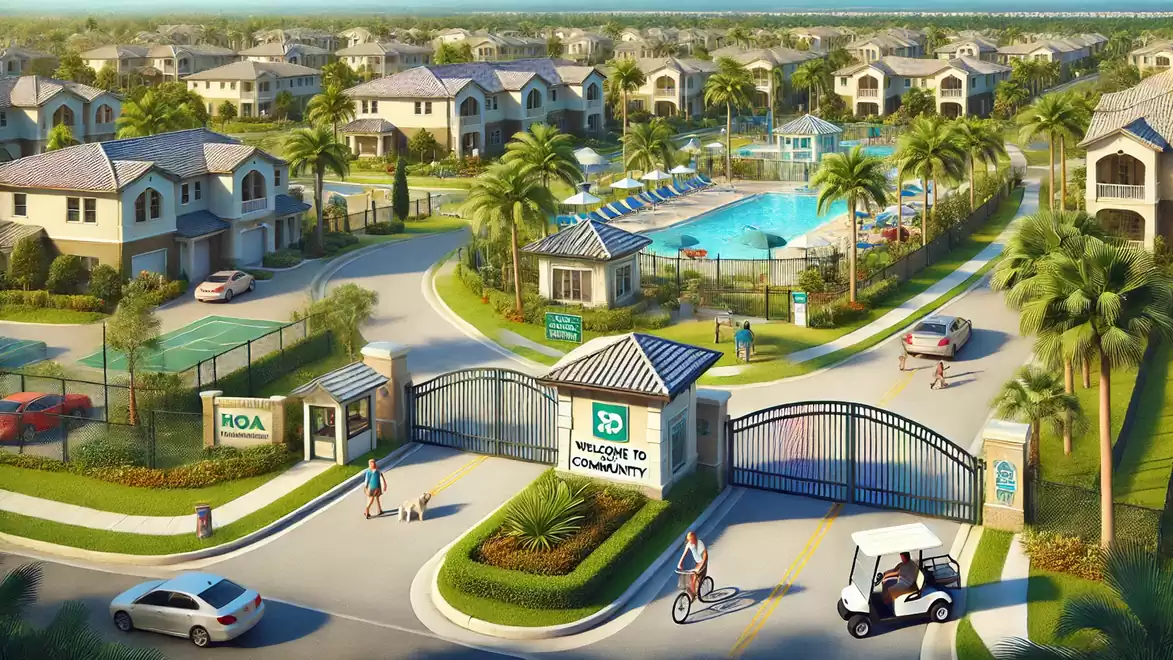
Gated community with modern houses, tennis court, and pool surrounded by palm trees.
AI generated

Community – Residential neighborhood with shared amenities and rules

What does Community mean in real estate?

In the U.S., a Community refers to a planned residential neighborhood that offers shared amenities and is typically governed by a Homeowners Association (HOA). Communities can range from simple subdivisions to luxury gated developments with resort-style features.

A larger parcel of land is subdivided and developed by one or more developers, then sold to individual owners. These owners become members of the community, which is a legally defined entity with binding rules (Restrictive Covenants).

Common features of a Community

  • Shared infrastructure: roads, clubhouse, pool, tennis courts
  • Rules and restrictions: architectural guidelines, usage rules
  • HOA management: dues, maintenance, enforcement
  • Security: gated entrances or community patrol

Advantages of living in a Community

  • Well-maintained environment
  • Amenities without individual upkeep
  • Appealing to families, retirees, and second-home owners

? Tip: In Florida, always check if a home is in a community—and review the HOA fees, bylaws, and use restrictions before buying.

People in a modern office analyzing real estate data on multiple screens.
AI generated

Comparables – Recently sold properties used to determine market value

What are Comparables?

Comparables, also known as comps, are similar properties in the same area that have recently sold and are used to estimate the market value of another property. They help determine a realistic listing or offer price.

How are Comparables selected?

Ideal comparables are similar in location, size, condition, age, and features. The most accurate comps are those sold within the past 3–6 months in the same neighborhood or subdivision.

Who uses Comparables?

Real estate agents, appraisers, lenders, and buyers all rely on comparables for price validation. Lenders use them in appraisals for loan approvals.

? Tip: Public data is helpful, but always consult a local agent or appraiser to interpret comparables in context.

Businessman analyzing market analysis data on a laptop in front of a row of modern houses and palm trees.
AI generated

Comparative Market Analysis (CMA) – Real estate valuation based on comparable sales

What is a CMA?

A Comparative Market Analysis (CMA) is a pricing tool used by real estate agents to estimate a property’s value by reviewing recent sales of comparable homes in the same area.

This is a method to determine the market value of a property. Comparable data from real estate transactions (within the past 12 months) is analyzed to align with current market conditions.

What factors are included in a CMA?

  • Location (neighborhood, waterfront, school zones, etc.)
  • Living area, lot size, year built
  • Condition and upgrades (pool, garage, renovations)
  • Recent sale prices of comparable homes (typically 3–6 months)

How CMA differs from an appraisal

  • CMA: Performed by real estate agents, often complimentary
  • Appraisal: Conducted by licensed professionals, required for loans

? Tip: In Florida, a CMA is a crucial tool for sellers, buyers, and investors to price properties accurately—especially in dynamic markets like Cape Coral or Naples.

A modern residential building with a pool in the foreground. A group of people sit together at a table for a condo association meeting. Palm trees and well-maintained landscaping in the background.
AI generated

Condo Association – Elected board managing shared condominium property

What is a Condo Association?

A Condo Association (short for Condominium Association) is the governing body of a condominium complex. It is elected by the unit owners and is responsible for maintaining and managing the shared areas and services within the property.

Der Beirat, der von den Eigentümern der Eigentumswohnungen gewählt wird. Die Condo Association ist für die Betreuung und Verwaltung der gemeinschaftlich genutzten Einrichtungen und für den laufenden Unterhalt zuständig.

Common responsibilities

  • Maintenance of shared amenities such as pools, elevators, gyms, and landscaping
  • Managing monthly HOA fees and setting the annual budget
  • Enforcing community rules and regulations
  • Arranging insurance, repairs, and service contracts

Florida-specific notes

  • Governed by the Florida Condominium Act
  • Annual meetings are held for electing board members
  • Transparency and owner communication are legally required

? Tip: When buying a condo in Florida, review the Condo Association's financials, rules, and monthly dues—these can significantly affect your ownership experience and property value.

Modern residential complex with multiple condominiums, a large pool, and well-maintained green areas, ideal for comfortable living.
AI generated

Condominium – Individually owned unit within a managed residential complex

What is a Condominium?

A Condominium, or Condo, is a type of real estate in which individual units are owned privately while common areas like hallways, pools, gyms, and landscaping are jointly owned and maintained by all unit owners through a homeowners association (HOA).

How is a Condo different from a single-family home?

In a condominium, owners share responsibility for common property and amenities. Unlike standalone houses, condo owners pay monthly HOA fees to cover maintenance and management services.

What should buyers consider?

Before buying a condo, carefully review HOA rules, financial reserves, and any rental restrictions. Also inquire about upcoming special assessments that may require additional payments from owners.

? Tip: Ask for the Declaration of Condominium, recent HOA meeting minutes, and financial statements before making an offer.

Construction project with approved permit, material list, construction workers and machinery at the site.
AI generated

Construction Costs – Total expenses for building a property in the U.S.

What are Construction Costs?

Construction Costs refer to the total expenses associated with building a property. These include materials, labor, permits, design fees, infrastructure, insurance, and sometimes financing charges.

What types of costs are involved?

Costs are usually categorized into Hard Costs (e.g., structure, plumbing, materials) and Soft Costs (e.g., architect fees, permits, legal, loan interest). In Florida, prices vary depending on location, home type, and builder.

What should owners and investors consider?

Having a detailed construction budget is essential. Unclear contracts, incomplete scope, or lack of contingency funds can lead to major overruns and delays.

? Tip: Always request a comprehensive cost estimate with contingency before signing any builder agreement – especially in weather-sensitive areas like Florida.

A construction site scene with a house under construction and a successful loan application in an office.
AI generated

Construction Loan – Short-term loan for financing new home construction

What is a Construction Loan?

A Construction Loan is a short-term loan used to fund the building of a new property. It is disbursed in stages based on construction progress, usually paid directly to the contractor.

How does it work?

During construction, the borrower only pays interest on the portion of the loan that has been disbursed. After completion, the loan is either converted into a long-term mortgage (Construction-to-Permanent) or repaid in full.

What do lenders require?

Lenders will review blueprints, a detailed budget, timeline, and builder credentials. In Florida, construction loans are common for building on private lots or when customizing a new home.

? Tip: Expect more paperwork and inspections than with a traditional mortgage—so work with an experienced lender familiar with construction financing.

Illustration of the consumer price index with symbols for money, percentages, houses, cars, trucks, and graphs.
AI generated

Consumer Price Index (CPI) – Key inflation indicator for economic health

What is the Consumer Price Index?

The Consumer Price Index (CPI) measures changes in the price level of a basket of goods and services purchased by households. It is one of the most widely used indicators for tracking inflation in the U.S.

What does the CPI include?

The CPI is based on a representative basket that reflects typical household spending. It includes:

  • Housing (e.g., rent, mortgage interest)
  • Food and beverages
  • Transportation (e.g., gas, vehicles)
  • Medical care
  • Recreation, clothing, and education

Why does CPI matter in real estate?

A rising CPI often signals inflationary pressure and may lead to interest rate hikes by the Federal Reserve. This directly impacts mortgage rates, investor returns, and affordability.

? Tip: Real estate is often seen as a hedge against inflation. Monitoring CPI trends can help you make better long-term decisions.
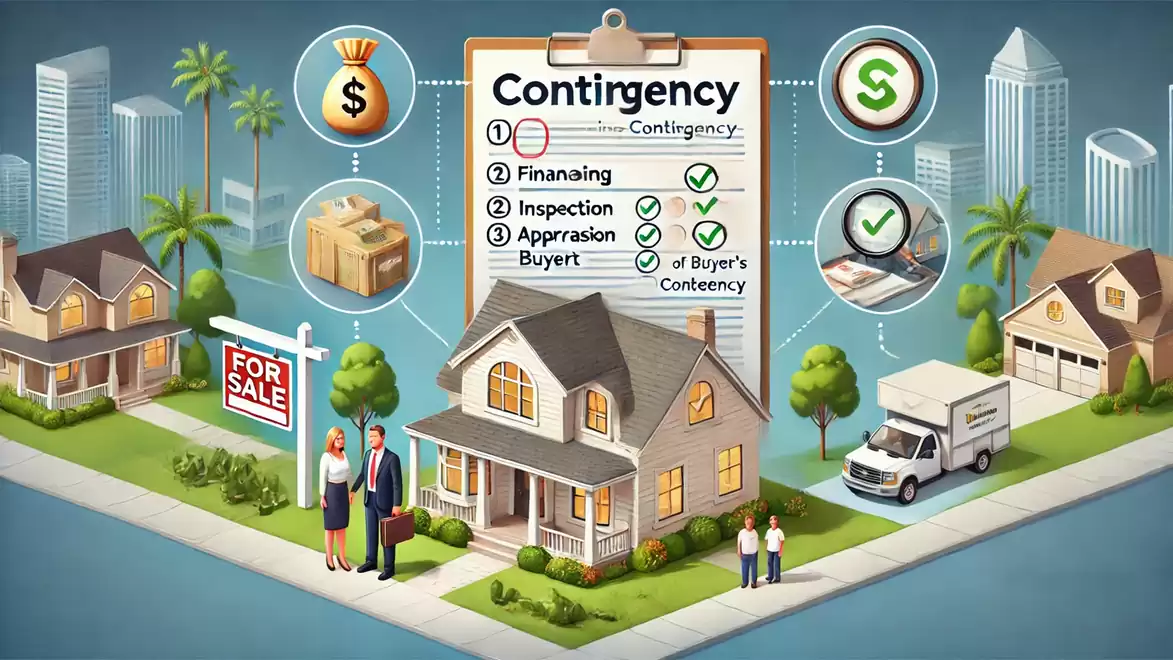
Illustration of a house sale with checklist showing financing, inspection, appraisal, and buyer contingencies.
AI generated

Contingency – Contract clause making a purchase conditional

What is a Contingency?

A Contingency is a contractual condition that must be fulfilled for a real estate purchase agreement to become binding. Common contingencies include mortgage approval, home inspection results, property appraisal, or the sale of the buyer’s existing home.

Common types of contingencies

  • Financing Contingency: Buyer must secure a loan
  • Appraisal Contingency: Property must appraise at or above purchase price
  • Inspection Contingency: Satisfactory results from a home inspection
  • Sale Contingency: Purchase depends on selling another property

Florida-specific notes

  • Standard contracts in Florida include predefined contingency clauses
  • Contingencies protect the buyer and allow contract cancellation if unmet
  • Strict deadlines apply—missing them may waive the contingency

? Tip: In Florida, make sure your contingencies are clearly written, time-bound, and tailored to your transaction needs.

Real estate agent and couple signing a real estate contract in a modern office.
AI generated

Contract (for sale and purchase) – Legal agreement between buyer and seller of real estate

What is a Contract for Sale and Purchase?

A Contract (for sale and purchase) is a legally binding agreement between a real estate buyer and seller. It outlines all terms and conditions of the transaction, including price, timelines, contingencies, and closing arrangements.

Common components of the contract

  • Purchase price and payment terms
  • Closing date
  • Finance contingency or cash terms
  • Earnest money deposit
  • Inspection period and termination options
  • Allocation of costs (e.g., taxes, title insurance)

Florida-specific notes

  • The FAR/BAR contract is the standard form used in Florida
  • Buyers may submit either cash offers or finance-contingent offers
  • Any changes require a written Addendum

? Tip: In Florida, never enter a real estate contract without proper guidance from a licensed Realtor or real estate attorney—the terms define your legal and financial position.

Construction scene with a worker examining plans in front of a wooden house under construction, and a laptop showing contractor details. Various tools and plans are visible.
AI generated

Contractor – Licensed construction or service provider in U.S. real estate

What is a Contractor?

A Contractor is a licensed individual or company hired to perform construction, remodeling, or repair work on a property. In Florida, many services (e.g., roofing, plumbing, electrical) require state licensing and permits.

Types of Contractors

Real estate and construction projects may involve:

  • General Contractor (GC): Oversees the entire project and manages subcontractors
  • Subcontractor: Specialized provider for a specific trade (e.g., HVAC, painting)
  • Licensed Contractor: Verified by the state and insured to perform regulated work

What should you verify?

Before hiring, ensure the contractor:

  • has a valid license (checkable via Florida DBPR database)
  • carries proper insurance (liability and workers' comp)
  • provides a written contract outlining scope, timeline, and payment terms

? Tip: Always get multiple quotes, check online reviews and references, and confirm that the contractor is legally qualified for the work.

Modern residential complex in Florida with palm trees and people on a terrace.
AI generated

Cooperative (Co-Op) – Shared ownership housing structure

What is a Cooperative?

A Cooperative (Co-Op) is a type of shared ownership housing where residents do not own their individual units outright. Instead, they own shares in a corporation that owns the entire property. In return, shareholders receive a proprietary lease to occupy a specific unit.

Key features of a Co-Op

  • No individual deed—ownership is through shares
  • Board approval required for selling or renting a unit
  • Monthly fees cover maintenance, taxes, insurance, and operations

Difference from a Condo

  • Co-Op: You lease a unit via your shares in the building corporation
  • Condo: You own your unit plus a share of the common areas
  • Financing a Co-Op can be more complex than financing a condo

Florida-specific insights

  • Common in retirement communities and older buildings
  • Many Co-Ops are located near the water in areas like Miami Beach and Fort Lauderdale
  • Typically governed by a Board of Directors with strict application rules

? Tip: If you're considering a Co-Op in Florida, review the bylaws, approval process, and monthly costs carefully—financing and resale terms may differ from traditional property purchases.

Interior of a US court archive in Florida with shelves full of files, computers, and American flags.
AI generated

Court of Records – Official public record court for property and legal filings

What is a Court of Records?

A Court of Records is a government court that maintains permanent, publicly accessible legal documents. In real estate, this includes filings related to property ownership, liens, and legal judgments.

What does it record?

In the U.S. (especially Florida), a Court of Records keeps official documents such as:

  • Property deeds and transfers
  • Mortgages and liens
  • Wills and probate filings
  • Foreclosures and court rulings

Why does it matter in real estate?

Before closing, a Title Search is performed to check for legal issues tied to the property. This search relies on public records held by the County Court of Records.

? Tip: In Florida, use the official website of the county's Clerk of Court to access or verify recorded real estate documents.

An image depicting a financial concept with a credit score report, cash bills, a pen, a calculator, and small model houses.
AI generated

Credit – Borrower’s creditworthiness in U.S. real estate financing

What does Credit mean in real estate?

Credit refers to a buyer’s creditworthiness and ability to repay a loan. It is a key factor in mortgage approval and interest rate determination in the U.S. lending system.

What determines your Credit Score?

Credit is measured using a Credit Score (typically 300–850), based on a borrower’s credit history. Key factors include:

  • Payment history and timeliness
  • Credit utilization (amount used vs. available credit)
  • Types and mix of credit accounts
  • Length of credit history
  • Recent credit inquiries

Why does it matter for real estate?

A high Credit Score helps secure lower interest rates and better loan terms. A lower score may limit your financing options or result in higher monthly payments.

? Tip: If you're an international buyer with no U.S. credit history, ask about non-traditional credit programs or alternative documentation options.

D

A desk with documents, a damaged toy house, a gavel labeled 'Damages', cash bills, and two men in the background in an office or construction site.
AI generated

Damages – Legal compensation claims in real estate and rental disputes

What does “Damages” mean in real estate?

Damages refer to monetary compensation awarded to cover losses or harm caused by another party’s actions or contract breach. In real estate, this often involves property damage, rental issues, or construction delays.

Types of Damages

Common categories include:

  • Actual Damages: Direct, measurable financial losses
  • Consequential Damages: Indirect losses (e.g., lost rental income)
  • Liquidated Damages: Pre-agreed sums specified in the contract
  • Punitive Damages: Fines imposed for willful misconduct or fraud

When do Damages apply?

Real estate scenarios where damages may be claimed:

  • A tenant causes structural damage to the property
  • A buyer backs out of a contract without legal grounds
  • A contractor fails to complete work or uses defective materials

? Tip: If damages are disputed, resolution often involves insurance claims, mediation, or court proceedings. Clear contracts and documentation are key.

Illustration of a suburban area with a modern house, focusing on financial documents for debt service, calculators, and writing tools on a table in the foreground, while a couple is viewing the house in the background.
AI generated

Debt Service – Ongoing loan payments for real estate financing

What is Debt Service?

Debt Service refers to the total amount of money required to repay a loan, typically through monthly installments that include both interest and principal. It represents the borrower’s ongoing financial obligation.

What does Debt Service include?

For real estate financing, debt service usually consists of:

  • Interest payments on the outstanding loan balance
  • Principal repayments reducing the loan amount
  • Escrow contributions for taxes and insurance (if required)

Why is Debt Service important?

Debt service is a key metric in assessing whether a property or investment is financially sustainable. Lenders use the Debt Service Coverage Ratio (DSCR) to measure how easily a property’s income can cover the debt obligations.

? Tip: Always build in reserves for vacancies or unexpected costs. A healthy DSCR is crucial for loan approval and long-term success.

Office workspace with financial documents and calculator; in the background, a computer monitor displaying a house picture.
AI generated

Debt Service – Total loan payments for real estate financing

What is Debt Service?

Debt Service refers to the total amount of money required to repay a loan over a specified period. In real estate, it includes both interest and principal payments, usually calculated monthly or annually.

What does it include?

  • Interest portion of the loan
  • Principal repayment
  • May also include escrow payments for taxes and insurance

Why it matters in real estate

  • Key factor in cash flow analysis for rental properties
  • Used to calculate the Debt Service Coverage Ratio (DSCR)
  • Helps evaluate if rental income can cover financing costs

Florida-specific considerations

  • Important for vacation rentals and investment properties
  • Regularly reviewed by lenders during underwriting
  • A large debt service burden can negatively impact ROI

? Tip: In Florida real estate investing, always analyze your Debt Service in relation to your net operating income. A healthy DSCR is typically 1.2 or higher. Conservative projections are best for short-term rental properties.

Illustration of a real estate contract with a house model, two figures, and a signature.
AI generated

Deed of Trust – Three-party agreement to secure real estate loans

What is a Deed of Trust?

A Deed of Trust is a legal document used to secure a real estate loan. It is used instead of a traditional mortgage in some U.S. states (but not in Florida). It creates a lien on the property and defines the loan terms.

Who is involved in a Deed of Trust?

This is a three-party agreement

  • Borrower – the person receiving the loan
  • Lender – the financial institution providing the loan
  • Trustee – a neutral third party who holds legal title in trust

What happens in case of default?

If the borrower defaults, the Trustee may initiate a non-judicial foreclosure, which is faster and less costly than court proceedings. This only applies in states where Deeds of Trust are recognized.

? Tip: Always ask whether your property is secured by a mortgage or deed of trust—especially if you’re buying in states like California or Arizona.

A desk with deed restriction documents, including blueprints, a miniature house model, and a sign reading 'No Pets Allowed'.
AI generated

Deed Restriction – Legal limitation on property use recorded with the title

What is a Deed Restriction?

A Deed Restriction is a binding legal condition written into the property’s deed that limits how the property may be used or modified. These restrictions often remain in effect regardless of ownership changes.

Common types of Deed Restrictions

Examples include limitations on:

  • Architectural design (color, height, roofing materials)
  • Usage rules (no short-term rentals, owner-occupancy only)
  • Pet regulations (number or type of animals allowed)
  • Commercial activity (prohibiting business operations from the home)

Who creates them?

Deed restrictions are often established by developers, HOAs, or municipalities. They are legally binding and apply to all future owners unless formally removed by legal process.

? Tip: Always request a full copy of any Deed Restrictions before buying property—especially if you plan to rent it out or modify its structure.

A desk in an office featuring several documents and books on legal topics such as Warranty Deed and Quit-Claim Deed.
AI generated

Deed – Legal document that transfers property ownership

What is a Deed?

A Deed is the official document that transfers legal ownership of real estate from seller to buyer. It is signed at closing and legally proves that the buyer is the new rightful owner.

Common types of Deeds

Different types of deeds offer different levels of protection:

  • General Warranty Deed: Full ownership guarantee including past title issues
  • Special Warranty Deed: Guarantees only issues during the seller’s ownership
  • Quitclaim Deed: Transfers ownership without any warranties – often used between family members

What happens after closing?

Once signed, the Deed is recorded with the County Clerk or Recorder’s Office. The recorded Deed becomes a public document confirming the new legal owner.

? Tip: Always keep a certified copy of your Deed in a safe place. It is the most important proof of property ownership.

Silhouette of a contemplative man in a dimly lit room, surrounded by default notices and a model house. Symbol for financial issues and debt management.
AI generated

Defaults – Loan defaults and mortgage contract breaches

What is a Default?

A Default occurs when a borrower fails to meet the obligations of a loan agreement. In real estate, this typically refers to missed mortgage payments but can include other violations as well.

Common types of Defaults

  • Missed loan payments (principal or interest)
  • Failure to pay property taxes or insurance
  • Unauthorized sale or rental of the property
  • Neglect of property maintenance affecting collateral value

What are the consequences?

If a borrower defaults, the lender may impose penalties, accelerate the loan, or initiate foreclosure proceedings. Usually, a formal Notice of Default is sent first, giving the borrower time to cure the default.

? Tip: If you’re facing financial hardship, contact your lender early. Many offer loan modifications, forbearance, or repayment plans to help avoid foreclosure.

A house with a 'Defective Title' warning sign. People discussing documented issues with house and car titles. Warning notices hanging in the background.
AI generated

Defective Title – Unclear or flawed property ownership record

What is a Defective Title?

A Defective Title refers to a property title that is not legally valid or clear. It indicates that the seller may lack full authority to transfer ownership, or that other parties could have legal claims to the property.

Common causes of a Defective Title

  • Unresolved inheritance issues or missing heir consent
  • Outstanding liens or unpaid mortgages
  • Clerical errors in previous transfers
  • Fraudulent documents or forged signatures
  • Pending lawsuits involving ownership disputes

What are the consequences?

A defective title may prevent closing or lead to future legal challenges. That’s why a thorough title search is essential in any real estate transaction.

? Tip: Always purchase Title Insurance to protect against financial loss due to unknown title defects.

Illustration of security deposits in real estate with symbols like a house, a contract, and banknotes.
AI generated

Deposit – Earnest money or security payment in real estate transactions

What does Deposit mean in real estate?

A Deposit is a monetary payment made as a sign of commitment or security. It can apply to both purchase agreements and rental contracts.

Types of Deposits

  • Earnest Money Deposit: A buyer’s good-faith payment during a property purchase
  • Security Deposit: A rental guarantee to cover damages or unpaid rent
  • Reservation Deposit: A fee to hold a property, often in new construction or vacation rentals

How is the Deposit handled?

For purchases, the earnest money is held in an escrow account and applied to the closing. For rentals, the security deposit is refunded after move-out, minus any justified deductions for damages.

? Tip: Always review the deposit terms in the contract—including refund conditions and deadlines—especially when dealing with international or long-distance transactions.

Two people in a modern office working at a table with a laptop. Charts and posters on depreciation are displayed on the walls. Large windows provide views of tropical palm trees and a city skyline.
AI generated

Depreciation – Tax deduction based on property wear and useful life

What is Depreciation?

Depreciation refers to the gradual reduction in value of a building for tax purposes due to age and use. In real estate, it allows owners to deduct a portion of the building’s value each year—even if the market value increases—resulting in lower taxable income.

Depreciation timelines in the U.S.

  • Residential real estate: depreciated over 27.5 years
  • Commercial real estate: depreciated over 39 years
  • Land value is not depreciable; only the building and improvements are

Why depreciation matters

  • Reduces rental income taxes for property owners
  • Provides a major tax advantage for investors
  • Requires accurate allocation of building vs. land value

Florida-specific notes

  • Commonly used for vacation rentals and long-term income properties
  • Cost segregation reports can accelerate deductions
  • Upon sale, depreciation recapture taxes may apply

? Tip: Florida real estate investors should leverage depreciation to reduce tax liability—ideally with the help of a qualified tax advisor or CPA familiar with real estate strategy.

Aerial view of a modern construction site in a residential area with excavators, trucks, and construction workers, surrounded by existing houses and power lines under a blue sky.
AI generated

Development Costs – Expenses related to property development and construction

What are Development Costs?

Development Costs refer to all expenses incurred when planning, preparing, and building a property project. These include site acquisition, infrastructure, permits, design, and construction, and are critical for evaluating project profitability.

Typical components of development costs

  • Land acquisition (purchase, surveys, environmental studies)
  • Site infrastructure: roads, water, sewer, power, internet
  • Permits, impact fees, and compliance costs
  • Architectural and engineering services
  • Construction costs and project management

Florida-specific considerations

  • Impact fees and zoning rules vary by county or city
  • Raw land often requires significant development work
  • Utility connections can involve substantial upfront fees

? Tip: If you plan to develop in Florida, assess your Development Costs carefully and consult local zoning and permitting offices early. Miscalculating these costs is a common cause of budget overruns and project delays.

Aerial view of a modern residential area with palm decoration, detached houses, and access to a wide road under bright sunshine.
AI generated

Development – Planning and construction of real estate projects

What does Development mean in real estate?

Development refers to the entire process of creating a real estate project—from land acquisition to design, permitting, construction, and marketing. Projects may include residential communities, commercial centers, mixed-use buildings, or resorts.

Typical phases of development

  • Land acquisition and feasibility studies
  • Zoning, planning, and permitting
  • Construction management with budgeting and scheduling
  • Sales or leasing of finished units

Florida-specific insights

  • Many developments are part of master-planned communities
  • Environmental compliance and hurricane codes play key roles
  • Attractive for international developers and investors

? Tip: For any Florida development project, work with experienced local professionals—from engineers to brokers—to ensure legal compliance, profitability, and long-term success.

A focused man sitting at a table discussing documents with an older couple, with a pool and house in the background.
AI generated

Disclosure – Seller’s legal duty to disclose property conditions

What does Disclosure mean?

In real estate, Disclosure refers to the seller’s legal obligation to inform the buyer of any known material defects or issues with the property that could affect its value, usability, or safety.

Typical items disclosed

  • Structural problems or prior water damage
  • Roof, plumbing, or electrical issues
  • Mold, pest infestations, or hazardous materials
  • Legal concerns: boundary disputes, code violations, HOA disputes

Disclosure laws in Florida

  • Sellers must provide a Seller’s Property Disclosure Form for resale properties
  • As-is contracts do not exempt the seller from disclosure obligations
  • Failure to disclose can lead to legal action, contract rescission, or damages

? Tip: In Florida, sellers should disclose all known facts in writing, even if they seem minor. Buyers should review all disclosures carefully and consider an independent inspection.

Modern townhouses with palm trees and parked cars in a sunny residential area.
AI generated

Duplex – Residential property with two separate living units

What is a Duplex?

A Duplex is a two-unit residential building where each unit functions as a fully independent home. The units may be arranged side by side or one above the other, and each has its own entrance, kitchen, and utilities.

Key characteristics

  • Two distinct living spaces in one building
  • Each unit has its own kitchen, bathroom, and living area
  • Can be owner-occupied and rented, or fully rented out
  • Often includes separate meters for utilities

Advantages of a Duplex

  • Rental income potential from the second unit
  • Ideal for multigenerational living or investment
  • Usually more affordable than buying two separate homes

Duplex in Florida

  • Popular in urban areas and coastal cities
  • Often used for long-term rental or seasonal short-term rental
  • Always check zoning and permit requirements before purchase

? Tip: A Duplex in Florida offers a great way to combine living and income. Analyze each unit's rental potential and verify local land use regulations before investing.

E

A young couple sits in a modern office, handing over an earnest money check to a realtor. In the background, an escrow account and real estate documents are visible.
AI generated

Earnest Money – Buyer’s deposit to show commitment in a real estate offer

What is Earnest Money?

Earnest Money is a deposit made by the buyer when submitting a purchase offer on a property. It serves as a good faith gesture to demonstrate serious intent to complete the transaction.

Key features

  • Typically 1%–5% of the purchase price
  • Held in an escrow account by a Title Company or agent
  • Applied toward the final purchase amount at closing
  • Refundable or forfeited depending on contract terms

When is it forfeited?

  • If the buyer backs out without a valid contractual reason
  • If the buyer misses deadlines or fails contingencies

Earnest Money in Florida

  • Handled according to the FAR/BAR Standard Residential Contract
  • Escrow agent is usually a Title Company or real estate attorney
  • Disputes may require mediation or legal resolution

? Tip: In Florida real estate, ensure Earnest Money terms are clearly defined in your contract. Choose a trusted escrow holder and follow all deadlines to protect your deposit.
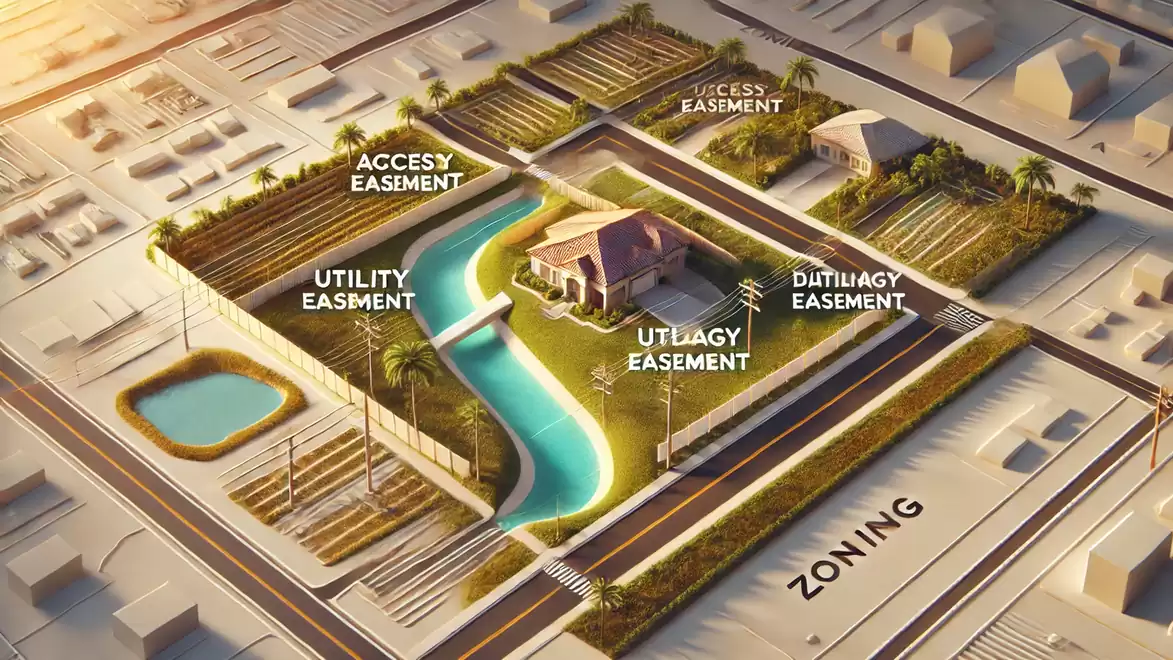
Illustration of a modern development featuring easements such as utility and access rights, as well as landscaping including a river flowing through the area.
AI generated

Easement – Legal right to use another person’s land for a specific purpose

What is an Easement?

An Easement is a legal right granted to a third party to use a portion of someone else’s land for a defined purpose, without owning it. Easements are common in U.S. real estate law and can affect how a property is used, accessed, or developed.

Common types of easements

  • Utility Easement: For power, water, sewer, or telecom lines
  • Access Easement: Right-of-way for ingress and egress, e.g., for neighbors
  • Drainage Easement: For stormwater runoff or flood control
  • Conservation Easement: Protects natural areas; often limits construction

Important for property buyers

  • Easements are usually recorded in the deed or survey
  • They may be permanent or temporary
  • They can limit building options or usage of the land

? Tip: In Florida, always request a title search and property survey to identify any easements—especially when buying waterfront land or planning new construction.
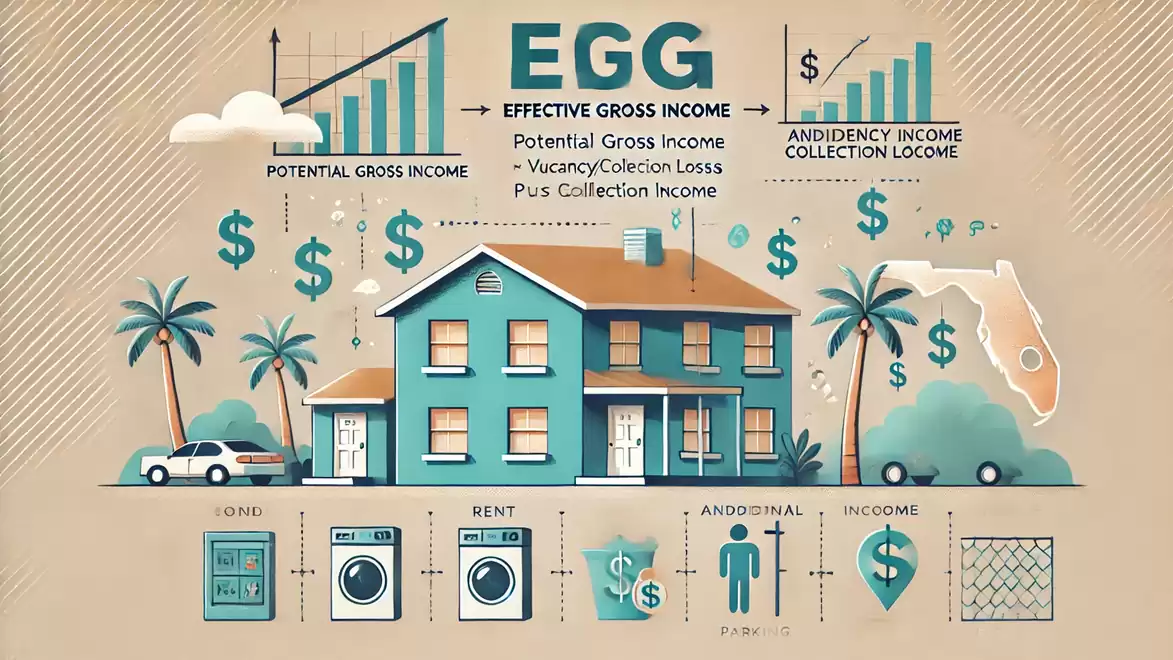
Infographic of a house showing different income types and graphs illustrating effective gross income.
AI generated

Effective Gross Income – Realistic gross rental income after vacancy loss

What is Effective Gross Income?

Effective Gross Income (EGI) is the estimated total income a rental property generates annually, after deducting vacancy and collection losses and adding other income such as parking, laundry, or pet fees.

EGI calculation

  • Potential Gross Rental Income
  • – Vacancy & Credit Loss
  • + Other income (amenities, services, etc.)

Why EGI matters

  • Forms the basis for calculating Net Operating Income (NOI)
  • Used in valuation models like the Cap Rate
  • Key to realistic cash flow forecasting for investors

Florida-specific insights

  • Short-term rental properties must consider seasonality and turnover
  • Typical vacancy assumptions range from 10–15%

? Tip: For Florida investors, the Effective Gross Income should be based on local rental trends and property-specific data. Reassess your EGI annually to account for market shifts or property upgrades.

Illustration of a man with a contract standing in front of a fenced house while excavators and construction workers operate in the background. The house has signs saying 'Not for Sale' and 'Eminent Domain'.
AI generated

Eminent Domain – Government's right to acquire private property for public use

What is Eminent Domain?

Eminent Domain is the legal power of the government (federal, state, or local) to take private property for a public use, provided the owner receives just compensation. This right is based on the Fifth Amendment to the U.S. Constitution.

Examples of public use

  • Construction of roads, highways, or rail systems
  • Development of public schools, parks, or hospitals
  • Expansion of utilities such as water, sewer, or electric systems
  • Occasionally for urban redevelopment projects

Legal requirements for taking property

  • Public necessity must be demonstrated
  • Fair market compensation must be provided to the owner
  • Judicial review is available if the property owner contests the taking

Eminent Domain in Florida

  • Strictly regulated under Florida statutes
  • Private developers may not exercise eminent domain authority
  • Property owners have the right to independent appraisals and legal counsel

? Tip: If your Florida property is subject to an Eminent Domain action, consult with a real estate attorney and certified appraiser to protect your rights and ensure fair compensation.
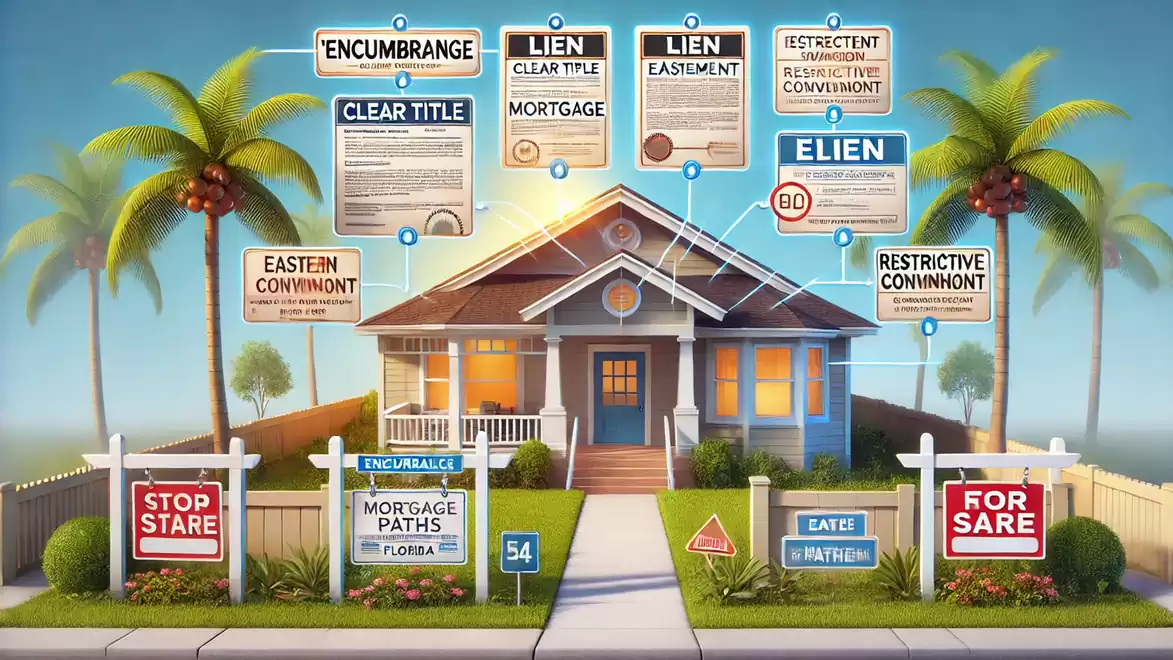
Illustration of a house with signs about mortgages and encumbrances. Palm trees in the background.
AI generated

Encumbrance – Legal or financial claim limiting property rights

What is an Encumbrance?

An Encumbrance is a legal or financial burden on a property that can limit its use, transfer, or value. Encumbrances are typically recorded in the public records and may remain even if ownership changes.

Common types of encumbrances

  • Mortgages
  • Easements (e.g., utility or access rights)
  • Lease agreements
  • Liens (e.g., tax or mechanic’s liens)
  • Restrictive covenants set by HOAs or prior owners

Why it matters in real estate

  • Encumbrances must be identified through a title search before purchase
  • They can affect the market value or legal use of the property
  • Title insurance protects against some hidden encumbrances

Florida-specific insights

  • Common in HOA-regulated communities
  • May involve environmental restrictions near protected areas or shorelines

? Tip: In Florida, work with a trusted title company or real estate attorney to review any encumbrances before closing. Some can be resolved or negotiated—others may be permanent.

Modern houses with financial data including property value, mortgage, and equity.
AI generated

Equity – Owner’s financial stake in a property

What is Equity?

Equity in real estate refers to the portion of a property’s value that the owner truly owns, free of any mortgage debt. It is calculated as the difference between the market value of the property and the outstanding loan balance.

How to calculate Equity

  • Current market value of the property
  • – mortgage balance
  • = Equity

Why Equity matters

  • Used for refinancing, home equity loans, or cash-out options
  • Represents property appreciation and wealth-building potential
  • Can be leveraged for additional real estate investments

Florida-specific insights

  • Equity tends to grow faster in high-demand areas like Cape Coral, Naples, or Fort Myers
  • Crucial for resale value and borrowing capacity
  • Key component in investment strategies and long-term ownership

? Tip: Florida property owners should track their equity regularly—especially before selling, refinancing, or acquiring new properties. Equity growth can be a powerful tool for wealth creation.

Contemporary residential buildings with rising graph lines depicting the concept of increasing real estate value, surrounded by economic terms and statistics.
AI generated

Escalation Clause – Price adjustment clause in contracts for rent, purchase, or loans

What is an Escalation Clause?

An Escalation Clause (also known as an “escalator clause”) is a contract provision that allows the automatic adjustment of prices, rent, or interest rates based on specific triggers or formulas. It is commonly used in rental agreements, purchase offers, and loan contracts.

Typical applications and examples

  • In rental or lease contracts: Allows rent increases based on:
    • (a) Fixed increase: Scheduled raises by a percentage or fixed amount, regardless of market conditions
    • (b) CPI (Consumer Price Index): Adjustments linked to cost-of-living or inflation indices
    • (c) Direct expense: Increases tied to actual rising costs, such as taxes or maintenance
  • In mortgage agreements: Defines a variable interest rate based on a publicly published index (e.g. Prime Rate)
  • In purchase contracts: Enables a buyer to automatically outbid competing offers by a set amount, up to a maximum cap

Advantages and considerations

  • Strategic leverage in competitive home purchases
  • Income protection for landlords via rent indexing
  • Predictable adjustments in variable loan terms

? Tip: In Florida, escalation clauses are commonly used in multi-offer real estate scenarios and long-term commercial leases. Always review how the clause is calculated and what caps apply before signing.

A financial advisor explains the concept of escrow accounts to clients in a modern office overlooking a house.
AI generated

Escrow Account – Trust account for secure real estate transactions

What is an Escrow Account?

An Escrow Account is a third-party trust account used in U.S. real estate transactions to securely hold funds and documents until all terms of the sale are met. In Florida, it's standard practice to use an escrow agent or title company to manage these transactions.

Common uses

  • Holding earnest money from the buyer
  • Collecting the purchase price, fees, and taxes prior to closing
  • Paying insurance or mortgage installments post-closing (lender escrow)

Florida-specific insights

  • Title companies typically serve as escrow agents
  • Sellers receive funds only after official title transfer
  • Provides security for both parties during complex transactions

? Tip: In Florida, always work with a licensed escrow provider to ensure your real estate transaction is legally compliant and financially secure.

Business professionals discussing an escrow account in a modern office with charts on the wall.
AI generated

Escrow Closing – Real estate transaction completed through escrow account

What is Escrow Closing?

Escrow Closing refers to a real estate closing process in which an independent third party (the escrow agent) manages funds and legal documents to ensure that all contractual obligations are fulfilled before disbursing payments or recording ownership changes.

Abschluss einer Immobilientransaktion, bei welcher zwar alle Urkunden ausgestellt und übergeben werden, jedoch die Bezahlung auf ein “escrow account” erfolgt bis die Urkunden eingetragen und der “abstract” auf den neuesten Stand gebracht worden ist; danach wird die Kaufsumme an den Verkäufer ausgezahlt.

How an escrow closing works

  • Buyer deposits the funds into an escrow account
  • Seller signs and submits all closing documents
  • Escrow agent verifies all legal and financial conditions
  • Documents are recorded at the local clerk’s office
  • Funds are released to the seller after confirmation

Advantages of escrow closing

  • Neutral handling of money and documents
  • Protects both buyer and seller
  • Common practice in Florida and most U.S. states

? Tip: In Florida, escrow closings are standard. Make sure to work with a reputable title company or escrow officer to ensure all legal and financial steps are handled properly.

Office scene with two employees working on computers. Surrounded by documents and diagrams about escrow accounts and financial transactions.
AI generated

Escrow Costs – Fees for escrow services in a U.S. property transaction

What are Escrow Costs?

Escrow Costs refer to fees charged by escrow agents or title companies for managing funds and documents during a real estate transaction. In Florida and many U.S. states, real estate closings typically involve an escrow account.

What do Escrow Costs cover?

These fees usually include:

  • Setting up and managing the escrow account
  • Holding earnest money and purchase funds
  • Disbursing funds during closing
  • Coordinating payments to all parties involved
  • Finalizing and archiving transaction documents

Who pays Escrow Costs?

Responsibility varies by state and agreement. In Florida, buyers often pay the majority of escrow costs unless negotiated otherwise in the sales contract.

? Tip: Escrow Costs are part of the total Closing Costs. Always request a preliminary Settlement Statement to see a full cost breakdown in advance.

A desk with real estate transaction documents and a small house model displaying ESCROW INSTRUCTIONS documents.
AI generated

Escrow Instructions – Binding directions for completing a real estate transaction

What are Escrow Instructions?

Escrow Instructions are formal written directions provided to the escrow agent, detailing how the real estate transaction should be carried out. They outline the steps, timelines, and conditions for disbursing funds and transferring title.

What do they include?

  • Purchase price and payment schedule
  • Deadlines for signatures, loan funding, and closing
  • Conditions for releasing funds
  • Obligations of both buyer and seller
  • Allocation of closing costs
  • Instructions for title transfer and recording

Who prepares them?

Escrow Instructions are typically drafted by the escrow or title company with input from realtors, attorneys, and lenders. Both buyer and seller must review and sign them before the escrow process begins.

? Tip: Review every detail carefully—Escrow Instructions are legally binding and govern the entire real estate closing procedure.

Illustration of escrow accounts with money, a scale, real estate, and documents. People shaking hands over a desk.
AI generated

Escrow – Secure holding of funds and documents during a property transaction

What is Escrow?

Escrow is a neutral third-party service used to safely hold funds and documents during a real estate transaction. A title company or real estate attorney typically acts as the escrow agent until all contract terms are met.

Common uses in real estate

  • Holding the buyer’s earnest money deposit
  • Managing the purchase funds until closing
  • Coordinating closing documents (deed, loan paperwork, title policy)
  • Releasing funds to seller and third parties upon completion

Escrow in Florida

  • Managed primarily by licensed title companies
  • FAR/BAR contract defines escrow responsibilities and deadlines
  • Disputes over escrow funds may require mediation or court resolution

? Tip: In Florida, only use a licensed escrow provider and ensure all instructions are clearly documented in the purchase agreement. Always request written confirmation of fund receipts and releases.

Image of a lawyer with estate planning documents. A scale, a house model, and a gavel symbolize legal aspects.
AI generated

Estate Planning – Planning for asset transfer and real estate distribution

What is Estate Planning?

Estate Planning involves the legal and financial steps to manage and transfer assets, such as real estate, upon the death or incapacitation of an individual. The aim is to minimize taxes, simplify the transfer process, and ensure that the individual’s wishes are honored.

Key components of Estate Planning

  • Wills: Specifies how assets are distributed after death
  • Trusts: Transfers assets to beneficiaries under specific conditions
  • Power of Attorney: Designates someone to make financial and medical decisions
  • Gifts and Inheritances: Planning for gifts to minimize estate taxes

Why is Estate Planning important?

  • Avoids inheritance taxes through strategic asset transfers
  • Streamlines probate process and prevents lengthy court procedures
  • Protects family members and ensures personal wishes are followed

Florida-specific insights

  • Florida has special rules for Homestead Property that protect it from creditors
  • Living Trusts and Irrevocable Trusts are commonly used for real estate transfers
  • Florida offers tax benefits for homeowners in estate planning

? Tip: Completing your Estate Plan in a timely manner helps not only minimize taxes but also ensures your real estate is passed on according to your wishes while protecting your family.
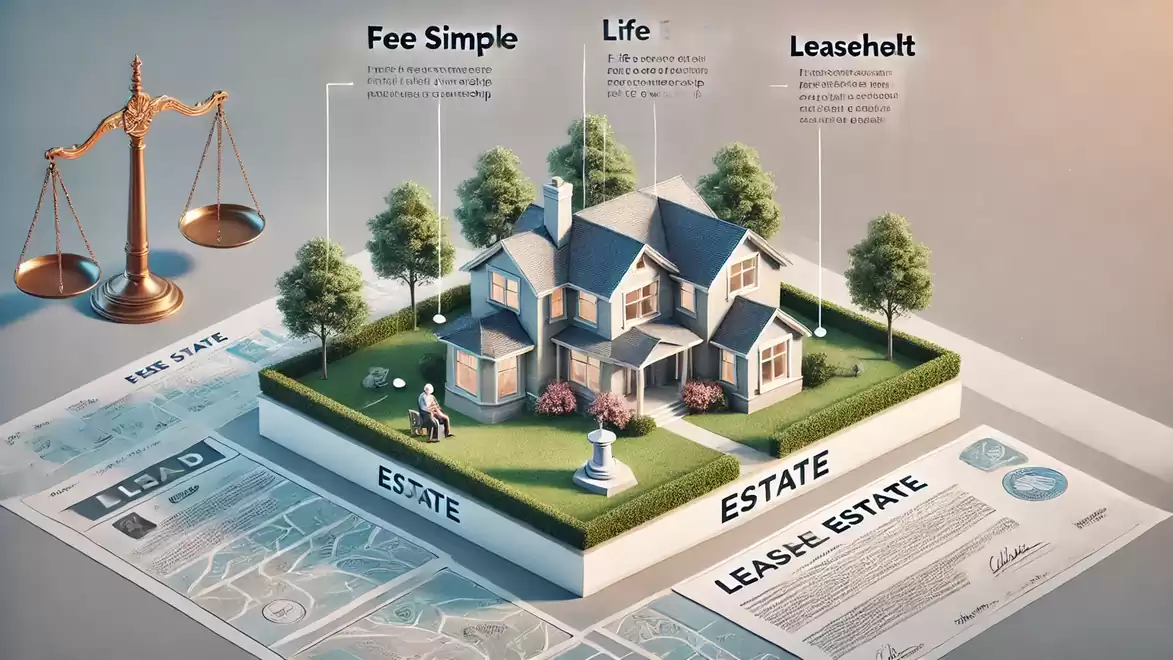
Graphic illustrating different types of property ownership, including Fee Simple, Life, and Leasehold, featuring a model house and legal documents.
AI generated

Estate – Legal interest or right in real property

What does “Estate” mean in real estate?

In U.S. real estate law, an Estate refers to the ownership or possessory interest someone holds in a property. It defines the degree, nature, and duration of the individual’s rights to use or control the land.

Types of “Estates in Land”

  • Fee simple: Full ownership with maximum rights and inheritable interest
  • Life estate: Ownership or use for the duration of one’s lifetime
  • Life estate pur autre vie: Use or possession for the lifetime of another person
  • Leasehold estate: Right to occupy or use land for a set period (e.g. rental)

Why it matters

  • Determines control over sale, inheritance, and use of property
  • Impacts financing, probate, and estate planning
  • Essential in wills, trusts, and legal transfers

? Tip: In Florida, most properties are owned in fee simple. If you encounter a life estate or other non-standard ownership, consult with a real estate attorney to fully understand your rights and obligations.

F

A group of people sitting in an office discussing the Fair Housing Act. In the foreground, a model house is on a table.
AI generated

Fair Housing Act – U.S. federal law prohibiting housing discrimination

What is the Fair Housing Act?

The Fair Housing Act is a U.S. federal law enacted in 1968 that prohibits discrimination in the sale, rental, or financing of housing. Its purpose is to ensure equal access to housing opportunities for all individuals.

Protected classes under the Fair Housing Act

  • Race or color
  • Religion
  • Sex
  • National origin
  • Familial status (e.g., with children)
  • Disability (physical or mental)

Examples of violations

  • Denying housing based on a protected class
  • Offering different terms or conditions for certain applicants
  • Falsely claiming a property is unavailable

? Tip: In Florida real estate, all agents and landlords must fully comply with the Fair Housing Act. Violations can lead to fines, lawsuits, or loss of license—even if unintentional.

A businessman in a sleek suit examines real estate market analyses next to a luxurious coastal house, surrounded by palm trees and a marina overlooking the sea at sunset.
AI generated

Fair Market Value – Estimated price in an open and competitive real estate market

What is Fair Market Value?

Fair Market Value (FMV) is the estimated price a property would sell for on the open market between a willing buyer and a willing seller, both fully informed and under no pressure. It reflects current market conditions and is based on comparables, location, and property features.

Why FMV is important

  • Used to determine asking prices in sales
  • Applies to appraisals, tax assessments, and insurance valuations
  • Basis for loan approvals and investment decisions

Factors influencing FMV

  • Location and neighborhood desirability
  • Size, upgrades, and condition of the property
  • Supply and demand in the local market

Florida-specific notes

  • FMV can fluctuate due to seasonal tourism trends
  • In areas like Cape Coral or Naples, waterfront access significantly affects FMV
  • Broker CMAs or certified appraisals are highly recommended

? Tip: In Florida, regularly review the Fair Market Value of your property—especially before selling, refinancing, or estate planning. A realistic FMV supports smarter pricing and faster closings.

A modern single-family home in a well-maintained residential area with a property deed in the foreground. The image features palm trees and clean streets in a sunny neighborhood.
AI generated

Fee Simple – Full and unlimited ownership of real estate

What is Fee Simple?

Fee Simple is the most complete form of property ownership in the United States. It grants the owner full rights to possess, use, sell, lease, transfer, or pass on the property—including both land and any buildings—indefinitely.

Key ownership rights

  • Right to use (reside, lease, develop)
  • Right to sell or transfer at any time
  • Right to encumber the property (e.g., with a mortgage)

Compared to other ownership types

  • More complete than Leasehold, which only grants time-limited use
  • Unlike a Condominium, Fee Simple includes full land ownership

Florida-specific considerations

  • Fee Simple is the standard form of ownership for single-family homes
  • Recorded in the public records of the county
  • May include encumbrances such as easements or liens

? Tip: Purchasing property in Florida under Fee Simple provides maximum control and flexibility. Still, always review existing encumbrances or HOA restrictions before buying.

Modern kitchen with two men, one looking at a tablet and the other on the phone, large windows showing a house and palm trees.
AI generated

Final Walk Through – Last property check before closing

What is a Final Walk Through?

The Final Walk Through is a final inspection by the buyer conducted shortly before closing on a real estate purchase. It ensures the property is in agreed-upon condition, repairs have been completed, and no new damages have occurred.

What to check during the walk through

  • Overall condition of the home
  • Functionality of appliances, HVAC, plumbing, lights
  • Completed repairs from inspection agreements
  • No new damage from weather, water, or vandalism
  • Vacancy and cleanliness (unless otherwise agreed)

Florida-specific notes

  • Usually scheduled 24–72 hours before closing
  • Not a second home inspection—only a condition check
  • Issues may delay closing or require escrow holdbacks

? Tip: In Florida, always conduct a Final Walk Through—ideally with your Realtor and a copy of the inspection report—to protect yourself before signing.

A miniature house with palm trees, a finance contract, and a calculator symbolizing real estate investments.
AI generated

Finance Contingency – Mortgage approval clause in a purchase contract

What is a Finance Contingency?

A Finance Contingency is a contract clause that protects the buyer in a real estate transaction. It states that the purchase is contingent upon securing a mortgage within a specified period. If financing is not obtained, the buyer may cancel the contract without losing the earnest money deposit.

Typical components of a Finance Contingency

  • Time frame for obtaining loan approval (e.g., 30 days)
  • Loan terms like rate, amount, and duration
  • Right to cancel if loan is denied
  • Obligation to apply in good faith

Florida-specific considerations

  • Standard FAR/BAR contracts include financing contingency options
  • If unchecked, the deal is considered a cash purchase without contingency
  • Sellers may favor non-contingent offers or those with shorter financing deadlines

? Tip: In Florida, a Finance Contingency should be clearly worded and time-bound. It gives buyers a legal exit if financing fails, while offering sellers defined expectations.

A modern office space with a desk full of financial documents, a laptop, a cup of coffee, and a calculator. Outside the window, a house with palm trees is visible.
AI generated

Finance Costs – Costs related to real estate loan financing

What are Finance Costs?

Finance Costs refer to all expenses incurred when obtaining a mortgage or other financing for real estate. These costs are separate from the purchase price and directly impact total investment and cash flow.

Common finance costs

  • Interest payments on the loan
  • Lender origination and processing fees
  • Discount points paid to lower the interest rate
  • Appraisal fees
  • Underwriting and document preparation charges
  • In some cases, tax and legal consultation fees

Florida-specific considerations

  • Lenders may charge application or commitment fees upfront
  • Some Finance Costs may be tax-deductible for rental properties
  • These costs are listed in the final closing disclosure (ALTA or HUD-1)

? Tip: In Florida, compare multiple mortgage offers to minimize Finance Costs. Even minor fees can significantly affect your overall return and monthly payments.

A couple sitting with a real estate agent at a table, surrounded by house plans, a calculator, and a model house, with a modern residential house visible in the background through a window with a garden view.
AI generated

Financial Statement – Formal summary of financial position and income

What is a Financial Statement?

A Financial Statement is a documented summary of an individual’s or entity’s finances, used to evaluate net worth, income, assets, and liabilities. In real estate, it is commonly requested for loan approvals, investments, or leasing high-value properties.

Key components of a financial statement

  • Balance Sheet: Overview of assets and liabilities
  • Income Statement: Record of income and expenses (cash flow)
  • Net Worth Statement: Assets minus debts = equity
  • Attachments: Bank statements, tax returns, pay stubs, etc.

Use in real estate

  • Required for mortgage underwriting and bank financing
  • Proof of financial stability for high-end rental applications
  • Used in investment vetting for partnerships and real estate deals

? Tip: In Florida, a complete and accurate personal financial statement can accelerate your loan approval or investor screening. Ensure all information is up-to-date and verifiable.

An illustration depicts a model house on a financial document with charts and icons for fixed expenses in real estate.
AI generated

Fixed Expenses – Recurring property costs that remain constant

What are Fixed Expenses?

Fixed Expenses are predictable, recurring costs associated with owning and operating a property. These expenses do not fluctuate with occupancy or income and are a key component of financial metrics like Net Operating Income (NOI).

Common Fixed Expenses in real estate

  • Property taxes
  • Insurance premiums (e.g. property, liability, flood)
  • Property management fees
  • HOA dues or licensing fees

Difference from variable expenses

  • Fixed Expenses: stay the same regardless of occupancy
  • Variable Expenses: depend on usage and operational activity

? Tip: In Florida real estate investment analysis, fixed expenses are critical for forecasting. Always ensure they’re realistically estimated and consistently updated.

Modern property affected by flooding with flood insurance documents in the foreground and sandbags to the side. Ominous clouds in the sky.
AI generated

Flood Insurance – Protection against property damage caused by flooding

What is Flood Insurance?

Flood Insurance is a specialized policy that covers damage caused by water intrusion from natural flooding. It is not included in standard homeowners or hazard insurance. In many parts of Florida—especially FEMA flood zones—it is required by lenders.

What does it cover?

  • Structural damage to the building caused by flooding
  • Damage to permanent fixtures such as flooring, drywall, and appliances
  • Optional contents coverage for personal belongings

Important notes

  • Often provided through the National Flood Insurance Program (NFIP)
  • Private insurers may offer higher limits and faster payouts
  • 30-day waiting period applies unless linked to a new purchase

? Tip: In Florida, always check the FEMA flood map before buying. Even properties in low-risk zones can flood—voluntary coverage is often affordable and wise.

3D model of a house on a 2D floor plan, showcasing details like living room, bedroom, and garden.
AI generated

Floor Plan – Visual layout showing room structure and flow

What is a Floor Plan?

A Floor Plan is a diagram of a property’s interior layout viewed from above. It illustrates the arrangement of walls, rooms, doors, and windows, often including dimensions and square footage. Floor plans are essential in real estate marketing and are widely used in listings, brochures, and builder documentation.

Types of Floor Plans

  • 2D Floor Plan: Simple overhead drawing with room outlines
  • 3D Floor Plan: More visual, often furnished and textured
  • Virtual Tours: Interactive add-ons for enhanced engagement

Why is a Floor Plan important?

  • Helps buyers and renters visualize the space
  • Aids in furniture planning and space evaluation
  • Useful for permits, remodeling, and new construction

? Tip: In Florida real estate listings, floor plans are especially helpful for remote or international buyers. High-quality 3D renderings often lead to faster sales and fewer questions.

Image of a house with multiple 'For Sale' signs in the front yard, surrounded by palm trees and clear sky. Depicts a pleasant residential neighborhood.
AI generated

For Sale By Owner (FSBO) – Property sold directly by the owner without an agent

What does For Sale By Owner mean?

For Sale By Owner means the owner sells the property without using a real estate agent in order to avoid paying commission. However, FSBOs are often poorly marketed because they are not listed on the MLS and therefore don't appear in online searches for most buyers.

Common FSBO characteristics

  • Owner handles marketing, showings, and negotiation independently
  • No MLS listing unless paying a flat-fee service
  • Limited visibility on real estate portals
  • Increased risk related to disclosures, contracts, and legal compliance

Florida-specific insights

  • Many FSBO sellers underestimate the effort and list below market value
  • Serious buyers prefer professional listings and transparency
  • Realtor networks and online exposure can significantly impact sales price and speed

? Tip: In Florida, even if you're selling as FSBO, consider hiring a real estate advisor or contract review service to avoid costly mistakes—agencies like Homewatch Cape Coral can help.

Illustration of a house with foreclosure signs, a courthouse labeled Real Estate, and a gavel in flight
AI generated

Foreclosure – Legal process of repossessing property due to mortgage default

What is Foreclosure?

Foreclosure is the legal or judicial process by which a lender repossesses a property after the borrower fails to make mortgage payments. The lender then seeks to sell the property to recover the unpaid loan balance.

It typically involves a declaration of default on the mortgage, usually through the courts, after the borrower fails to meet payment obligations. The result is often a forced sale of the home or transfer of ownership to the lender.

Foreclosure process in Florida

  • Begins with a notice of default after missed payments
  • Judicial foreclosure is required in Florida
  • Property is sold via court-ordered auction
  • May be purchased by a third party or reclaimed as REO (Real Estate Owned)

Impact on owners and buyers

  • Major credit damage for the homeowner
  • Loss of home and potential legal consequences
  • Buyers may acquire property below market value – but often with risks and limited warranties

? Tip: In Florida, the foreclosure process is court-based and can take 6 to 12 months or more. For buyers, foreclosures may offer investment opportunities, but a title check and property inspection are essential before bidding.

A man in a suit sits in a modern living room with large windows showing palm trees outside. On a table, there is a real estate purchase contract with the word 'FORFEITED' in large red letters. Next to it are a wallet with dollar bills and a pen.
AI generated

Forfeiture – Loss of rights due to breach of contract

What is Forfeiture?

Forfeiture refers to the loss of a contractual right or asset because of non-performance, breach of agreement, or legal violation. In real estate, it often involves deposits, leases, or property rights.

Common scenarios in real estate

  • Loss of deposit when a buyer defaults on a purchase agreement
  • Lease forfeiture if a tenant violates terms or fails to pay rent
  • Forfeiture of title under land contracts for missed payments

Florida-specific examples

  • Earnest Money may be forfeited if the buyer backs out without cause
  • Leases may include Forfeiture Clauses that trigger eviction upon default
  • Installment sale contracts often carry strict forfeiture provisions

Legal considerations

  • Forfeiture must be clearly stated in the agreement
  • Unfair or one-sided forfeiture terms may be challenged in court
  • Parties usually must be given notice and opportunity to cure

? Tip: In Florida real estate, always review forfeiture clauses carefully—they can determine whether you lose a deposit, a lease, or even property rights in case of dispute.

Sold house with palm trees in a sunny neighborhood and a 'Sold' sign in the foreground.
AI generated

Free and Clear – Property fully owned with no liens or mortgages

What does Free and Clear mean?

Free and Clear refers to a property that is completely paid off and not encumbered by any mortgages, liens, or legal claims. The owner holds 100% equity and full control over the asset.

Advantages of a Free-and-Clear property

  • Full control over use, sale, or rental of the property
  • Simplified closing process with no debt payoff involved
  • Lower risk in case of disputes or foreclosures

Florida-specific notes

  • A title search will confirm whether a property is free and clear
  • Highly attractive to cash buyers and real estate investors
  • Title insurance provides added protection against undiscovered claims

? Tip: Selling or buying a free and clear property in Florida often results in a faster and cleaner transaction, especially for cash deals and investment purchases.

A new, modern house in an idyllic residential area with a neat yard. In the foreground, tools and a document with a green checkmark are placed on the table.
AI generated

Free of Mechanics Liens – Property not encumbered by contractor claims

What does "Free of Mechanics Liens" mean?

Free of Mechanics Liens indicates that the property is clear of any legal claims filed by contractors, laborers, or material suppliers for unpaid work or materials provided during construction or renovation.

When is this status important?

  • During property sales or closings to ensure clean title
  • For new construction projects before disbursement of final payments
  • In title insurance review – policies may not cover unknown liens

Consequences of existing Mechanics Liens

  • Delays or blockage of property sale/refinance
  • Legal disputes with contractors or subcontractors
  • Risk of foreclosure if lien is enforced and unpaid

? Tip: In Florida, always request a clean title report and lien release documents before closing—especially for recently built or renovated homes.

G

Two people in an office discuss plans for a construction project with modern apartment buildings in the background.
AI generated

Gap Financing – Short-term loan to bridge funding shortfalls

What is Gap Financing?

Gap Financing refers to a temporary funding solution that covers the difference between available capital and the total amount needed for a real estate transaction or project. It is often used when long-term financing is delayed or pending.

Common use cases

  • Bridge between construction and permanent loan
  • Supplements equity or primary loan amounts
  • Short-term support until funds from a sale, grant, or refinance become available

Characteristics and risks

  • Often comes with higher interest rates
  • Short-term duration, typically a few months
  • Flexible terms, but not suitable for long-term financing

? Tip: In Florida real estate, gap financing is popular in development projects and flip deals. Have a clear exit strategy to avoid unexpected costs or delays in repayment.

Two business people stand in front of a house shaking hands. Documents, a calculator, and charts are on the table before them. Palm trees and houses are visible in the background.
AI generated

General Partnership – Business structure with shared control and unlimited liability

What is a General Partnership?

A General Partnership is a business arrangement where two or more individuals jointly operate a business, share profits and losses, and each partner has unlimited personal liability for the partnership's debts and obligations.

Key features of a General Partnership

  • No separate legal entity – partners are personally liable
  • Equal sharing of profits and losses unless otherwise agreed
  • No formal registration required unless operating under a trade name
  • Can be formed verbally or in writing

Risks and use in real estate

  • Each partner can legally bind the partnership
  • Unlimited liability extends to personal assets
  • Commonly used in real estate investing or development ventures

? Tip: In Florida, a General Partnership used for real estate should always have a detailed written agreement. Consider forming an LLC or LLP for liability protection depending on the scope of the venture.

Illustration of two men signing a contract for a house purchase. One man stands and shakes hands with the other, who is seated at a table. In the background, a modern house with palm trees is visible.
AI generated

General Warranty Deed – Highest level of title protection for real estate buyers

What is a General Warranty Deed?

A General Warranty Deed is the most comprehensive form of deed used in U.S. real estate transactions. It offers the strongest protection for the buyer (grantee), as the seller (grantor) guarantees clear title with no defects—past or present—and assumes full responsibility for defending the title.

Die beste Form der Eigentumsübertragung (Deed) für den Käufer (Grantee). Mit einem General Warranty Deed übernimmt der Verkäufer (Grantor) die Gewährleistung, dass er bis auf weiteres alle Forderungen von Dritten in Bezug auf Eigentum an der Immobilie auf eigene Kosten abwehrt.

Typical seller guarantees

  • Legal ownership of the property
  • No prior encumbrances or claims on the title
  • Full defense of title against any past claims or owners

Florida-specific insights

  • Commonly used in residential real estate transactions
  • Executed at closing and recorded with the County Clerk
  • Provides maximum buyer protection under Florida law

? Tip: When buying real estate in Florida, request a General Warranty Deed to ensure full title protection and peace of mind.

Table with a small model house, stacks of money, a calculator, and a hand filling out a document with financial data and loan costs.
AI generated

Good Faith Estimate – Preliminary cost disclosure for real estate transactions

What is a Good Faith Estimate?

A Good Faith Estimate (GFE) is a non-binding estimate provided by a lender that outlines the expected closing costs and associated monthly charges in a real estate transaction. Though no longer required under RESPA for most loans, it remains in use in some cases.

Kostenschätzung der Immobilientransaktion. Zusammenstellung der Kosten, die bei einem Kaufabschluss (Closing Costs) entstehen, (nach bestem Wissen und Gewissen). Ein Good Faith Esimate beinhaltet ebenfalls eine Schätzung der monatlichen Kosten, die im Zusammenhang mit einer Immobilientransaktion anfallen.

What’s included in a GFE?

  • Lender fees and underwriting charges
  • Taxes, insurance, and escrow contributions
  • Appraisal, title, and notary costs
  • Estimated monthly mortgage payment

Florida-specific insights

  • Common for mortgage-financed transactions
  • Often replaced by the Loan Estimate (LE) under TRID rules
  • Useful for comparing different loan offers

? Tip: In Florida, always review your Good Faith Estimate closely and compare it with the final Closing Disclosure—this can help you avoid unexpected costs at settlement.

Image of documents titled 'Clear Title' and 'Good Title', with a miniature house and key beside them, symbolizing real estate ownership and property rights.
AI generated

Good Title / Clear Title – Verified and marketable property ownership

What does Good Title or Clear Title mean?

A Good Title or Clear Title refers to ownership of real estate that is free of liens, legal disputes, encumbrances, or title defects. It guarantees that the seller has the full legal right to transfer ownership.

Characteristics of a Clear Title

  • No outstanding mortgages or liens
  • Free of tax claims, court judgments, or inheritance issues
  • Proper chain of title with recorded deeds and transfers

How is a Clear Title verified?

  • Through a professional title search
  • By purchasing title insurance to cover potential defects
  • Confirmed at closing with title documents

? Tip: In Florida, never purchase property without confirming a Clear Title. A licensed title agent or attorney will ensure you’re protected from future claims or undisclosed encumbrances.

Two men in suits shaking hands while closing a house sale agreement. On the table is a contract with a model house and a pair of keys.
AI generated

Grantee – Recipient of property in a real estate transfer

What is a Grantee?

A Grantee is the individual or legal entity that receives property rights through a deed. In real estate, the grantee is the buyer or transferee who gains legal ownership from the grantor (seller) through a recorded legal document.

Common grantee situations

  • Real estate purchase: The grantee becomes legal owner once the deed is recorded
  • Trust transfer: The grantee may be a designated beneficiary
  • Gifts or inheritance: The grantee is the named recipient of the property

Important considerations for grantees

  • Ensure the deed is legally executed and properly recorded
  • Conduct a title search to verify clean ownership history
  • Consider title insurance for legal and financial protection

? Tip: In Florida, legal ownership is established once the deed is officially recorded with the county, regardless of loan status or payment progress.

An illustration depicting legal concepts such as trust, documentation, and judicial symbolism, with a central businessman surrounded by various elements indicating a fiduciary relationship.
AI generated

Grantor – Person transferring property or establishing a trust

What is a Grantor?

A Grantor is the individual or entity that transfers ownership or legal rights to another party. In real estate, the grantor is typically the seller named in the deed; in trust law, it is the person who creates and funds the trust.

Common roles of a Grantor

  • Real estate transfer: The grantor conveys property title to a grantee via a deed
  • Trust creation: The grantor contributes assets and sets trust terms
  • Legal agreements: The grantor initiates the terms of property or trust arrangements

Legal implications

The grantor must have legal authority and clear title to the property being transferred. Signing the deed or trust document confirms a voluntary and intentional act of transferring ownership or control.

? Tip: In revocable living trusts, the grantor may also serve as the trustee and beneficiary, maintaining full control during their lifetime.

Aerial view of a luxurious canal with villas, pool, and passing boat.
AI generated

Gulf Access – Boating access to the Gulf of America / Gulf of Mexico

What does Gulf Access mean?

Gulf Access refers to a property's ability to reach the Gulf of America / Gulf of Mexico by boat via canals, rivers, or open water. It’s a highly sought-after feature in areas like Cape Coral, Fort Myers, and Naples.

Types of Gulf Access

  • Direct Gulf Access: No bridges or locks – immediate waterway access
  • Sailboat Access: No height restrictions, ideal for larger boats
  • Restricted Access: Limited by bridges, locks, or canal routes

Why it adds value

  • Higher property value and resale potential
  • Appeals to boat owners and water enthusiasts
  • Great for vacation rentals and lifestyle investments

? Tip: In Cape Coral, Gulf Access is a premium real estate feature. Always review bridge clearance, canal width, and time to open water to assess the true boating value of a property.

H

A technician working on a roof checks an air conditioning unit. Several houses with palm trees are visible in the background.
AI generated

Home Inspection – Licensed property evaluation before purchase

What is a Home Inspection?

A Home Inspection is a comprehensive assessment of a property’s condition conducted by a state-licensed inspector, typically before closing on a real estate transaction. The goal is to identify defects or safety issues that may affect the buyer’s decision.

What does it cover?

  • Roof, exterior, and foundation
  • Plumbing and electrical systems
  • HVAC systems
  • Windows, doors, garage, pool
  • Moisture, mold, and pest signs

Legal relevance

  • Findings may influence price negotiations
  • Significant issues may allow buyers to cancel the contract (if inspection contingency is included)

Florida-specific insights

  • Pay special attention to roof condition, moisture, termites, and AC systems
  • Additional reports often required: 4-Point Inspection and Wind Mitigation (for insurance)
  • Inspectors must be licensed by the Florida DBPR

? Tip: Always order a thorough Home Inspection in Florida—even for new or renovated homes. It’s a key step for buyer protection.

Illustration of a man with a checklist in front of a house in Florida, surrounded by palm trees and cars.
AI generated

Homeowner – Legal owner of residential real estate with responsibilities and rights

What is a Homeowner?

A Homeowner is an individual or legal entity who owns real estate, whether for personal use, vacation, or rental purposes. Homeowners are responsible for property maintenance, taxes, insurance, and compliance with local laws and HOA regulations if applicable.

Typical responsibilities

  • Paying property taxes
  • Maintaining homeowners insurance
  • Upkeep and repairs to preserve property value
  • Complying with HOA rules (if applicable)

Homeowner rights

  • Right to use and occupy the property
  • Right to rent out (subject to zoning or HOA restrictions)
  • Right to sell or transfer ownership
  • Tax benefits such as Florida’s Homestead Exemption

Florida-specific notes

  • Many Florida homeowners own second homes or rental properties
  • Absentee Owners often hire home watch services to protect vacant homes
  • Florida offers investor-friendly laws and tax structures

? Tip: If you're a homeowner in Florida, stay updated on property taxes, insurance requirements, and rental regulations—especially if you live abroad or rent out your home.

Illustration of a small single-family house on a green lawn, surrounded by palm trees and plants, with the text 'Homestead - the primary residence benefits'.
AI generated

Homestead – Tax and legal benefits for homeowners in Florida

What is Homestead?

Homestead in Florida refers to a legal and tax protection system that shields the value of a primary residence from creditors and provides significant property tax exemptions for homeowners.

Benefits of Homestead

  • Tax advantages: Homestead Exemption can lower property taxes by up to $50,000
  • Creditor protection: The value of the homestead is protected from foreclosure due to debt
  • Ownership protection: Homestead property is generally exempt from forced sale in case of bankruptcy

Florida-specific insights

  • Homestead applies only to primary residences—vacation or rental properties do not qualify
  • Maximum protection value for the Homestead Exemption is up to $50,000 in property tax relief
  • If the homestead is sold, the tax status does not automatically transfer to the new property

Homestead Exemption in Florida

  • Homestead Exemption: Provides tax relief up to $50,000 off the assessed value of your primary residence
  • Additional senior citizen exemptions are available for qualified homeowners

? Tip: Take full advantage of the Homestead Exemption in Florida by applying directly with the County Property Appraiser to enjoy tax benefits and creditor protection on your primary residence.

A home inspector stands with a tablet in front of a modern villa with a pool and palm trees, surrounded by a manicured garden.
AI generated

Homewatch – Property check service for absentee homeowners

What is Homewatch?

Homewatch is a routine property inspection service designed for homes that are vacant or seasonally occupied. It gives peace of mind to owners who are not living full-time in their Florida home.

At Home Watch Cape Coral, we specialize in these services – customized, trustworthy, and local.

Typical Homewatch services

  • Interior and exterior checks on a scheduled basis
  • Monitoring for leaks, pests, mold, and A/C issues
  • Mail collection and light activity simulation
  • Vendor coordination when repairs are needed
  • Emergency response and photo documentation

Homewatch vs. Property Management

  • Homewatch: Non-rental service focused on property safety during absence
  • Property Management: Full-service rental management with guest services, bookings, accounting

? Tip: In Florida, hiring a professional Homewatch provider like Home Watch Cape Coral means proactive care and protection for your home when you're away.

Woman cleaning with cleaning supplies and bucket, illustration of housekeeping.
AI generated

Housekeeping and house cleaning are essential services for vacation rental properties in Florida. A clean and well-maintained home is critical for guest satisfaction, positive reviews, and maintaining the property's value.

Typical Cleaning Services

  • Turnover cleaning after guest check-out
  • Cleaning of floors, kitchens, bathrooms, and bedrooms
  • Changing and preparing linens and towels
  • Window and glass cleaning
  • Dusting, trash removal, and restocking supplies

Key Considerations for Hosts

Professional housekeeping teams follow detailed checklists and often provide documentation with photos. Timing is crucial: cleaning is typically scheduled in the window between guest departure and arrival.

Recommended Provider in Cape Coral

HomewatchCapeCoral offers a comprehensive cleaning service for vacation homes. In addition to standard cleaning, they provide deep cleaning, spring cleaning, and emergency cleaning solutions when needed.

Close-up of a desk with a HUD statement, a model house, a calculator, and a hand signing a document.
AI generated

HUD-1 – Settlement statement detailing all closing-related financials

What is the HUD-1 Settlement Statement?

The HUD-1 is a standardized form issued by the U.S. Department of Housing and Urban Development. It provides a complete breakdown of all financial transactions involved in a real estate closing – including payments made by and to the buyer and seller.

What does the HUD-1 include?

  • Purchase price, loan amounts, prorations, taxes, fees, commissions
  • Line-by-line itemization of who pays what
  • Required for transactions not governed by TRID (e.g. cash deals, HELOCs)

When is HUD-1 used?

  • Cash purchases or certain refinancing transactions
  • Closings not covered by the TILA-RESPA Integrated Disclosure (TRID) rule
  • To document all credits, charges, and adjustments between the parties

? Tip: In Florida, you’ll often see a HUD-1 for cash closings or investment deals. Review each line carefully and ask your title company or closing attorney to explain any unclear charges before signing.
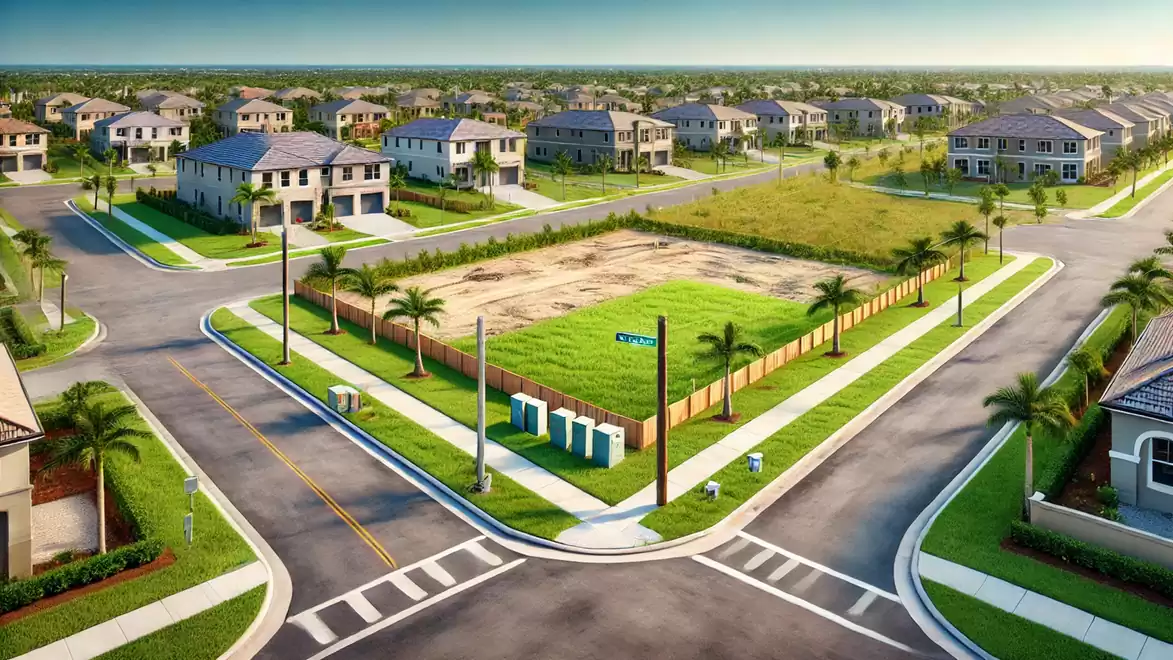
I

Aerial view of a modern residential area with new single-family homes, orderly streets, and green lawns.
AI generated

Improved Land – Lot with infrastructure or construction-ready features

What is Improved Land?

Improved Land refers to property that has been developed or enhanced with infrastructure or site preparation. Unlike Unimproved Land, it is typically ready for construction or use.

Common features of Improved Land

  • Access to water and electricity
  • Street access, curbs, or sidewalks
  • Sewer or septic system in place
  • Grading, drainage, or soil improvements
  • Zoning and building permit approvals

Why does it matter to buyers?

Improved land is typically more expensive but allows for faster development or construction. For investors and homebuilders, it reduces uncertainty and delays associated with raw land preparation.

? Tip: In Florida, always confirm which utilities are installed and paid for. Some lots may be marketed as improved but still carry unpaid assessments or incomplete infrastructure.

Modern house with solar panels and swimming pool in a sunny residential area.
AI generated

Improvements – Enhancements that increase the value or functionality of real property

What does "Improvements" mean in real estate?

Improvements refer to permanent additions or upgrades made to land or buildings that increase their value, utility, or lifespan. They are significant for property valuation, taxation, and investment planning.

Examples of Improvements

  • Construction of new buildings or extensions
  • Adding pools, fences, driveways, or patios
  • Upgrading plumbing, electrical, or HVAC systems
  • Major interior or exterior renovations

Difference from repairs

  • Improvements: Add long-term value and are capitalized for tax purposes
  • Repairs: Maintain existing condition and are typically deductible expenses

? Tip: In Florida, improvements affect property taxes, rental value, and depreciation. Always keep detailed records of costs and improvements for future resale or accounting purposes.

An office with a man in a suit signing documents in front of a computer screen displaying diagrams and a building model; text refers to LLC formations and the state of Florida.
AI generated

Incorporation – Legal process of forming a corporation or LLC

What is Incorporation?

Incorporation is the legal process of creating a separate legal entity, such as a Corporation (Inc.) or Limited Liability Company (LLC). Once incorporated, the business becomes distinct from its owners and can own assets, enter contracts, and be sued.

Why is incorporation important in real estate?

  • Liability protection: Personal assets of owners are shielded
  • Tax advantages: Flexible structuring with LLCs, S-Corps, etc.
  • Ownership clarity: Property is held under the entity, not individual names
  • Investment readiness: Easier to manage shares and succession

Basic steps to incorporate in Florida

  • Choose an entity type (LLC, Inc., etc.)
  • File articles of incorporation with the Florida Department of State
  • Apply for an Employer Identification Number (EIN) with the IRS
  • Create an operating agreement (for LLCs)

? Tip: In Florida, incorporation is a common strategy for investors and vacation home owners to limit liability and manage ownership—especially for international buyers. Legal and tax advice is strongly recommended.

Modern two-story house by the water, surrounded by palm trees with icons for different insurance types including home and storm protection.
AI generated

Insurance – Essential property coverage for owners and investors

What does Insurance mean in real estate?

Insurance refers to policies that protect real estate assets from financial loss due to damage, liability, or income disruption. It is a critical component for homeowners, landlords, and investors, especially in high-risk markets like Florida.

Common types of real estate insurance

  • Homeowners Insurance: Covers the structure, belongings, and personal liability
  • Landlord Insurance: Tailored for rental properties, including liability and loss of rent
  • Flood Insurance: Required in flood zones and not included in standard policies
  • Liability Insurance: Protection against third-party injury or property damage claims
  • Windstorm/Hurricane Insurance: Especially important in coastal Florida

Why is it important?

  • Protects property value and rental income
  • Often a mortgage requirement by lenders
  • Reduces financial risk in case of unexpected damage or legal claims

? Tip: In Florida, review your coverage annually. Check for updated rates, limits, and bundling options like combined Homeowners and Liability Insurance.

Illustration showing a house, graphs, calculator, and interest documents depicting mortgage rates.
AI generated

Interest Rate – Cost of borrowing money for real estate financing

What is an Interest Rate?

The Interest Rate is the percentage charged on borrowed money, typically applied to mortgages or real estate loans. It directly affects the monthly payment, total loan cost, and investment return.

Types of interest rates

  • Fixed Rate: Stays the same over the loan term
  • Adjustable Rate (ARM): Changes periodically based on market indices
  • Introductory Rate: Temporary low rate at the start of a loan

Why it matters in real estate

  • Impacts affordability for buyers and investors
  • Key factor in cash flow and ROI projections
  • Influenced by economic policy and Federal Reserve decisions

? Tip: In Florida, even a 0.5% difference in your interest rate can significantly affect your total borrowing cost. Always compare lenders and evaluate the APR, not just the nominal rate.
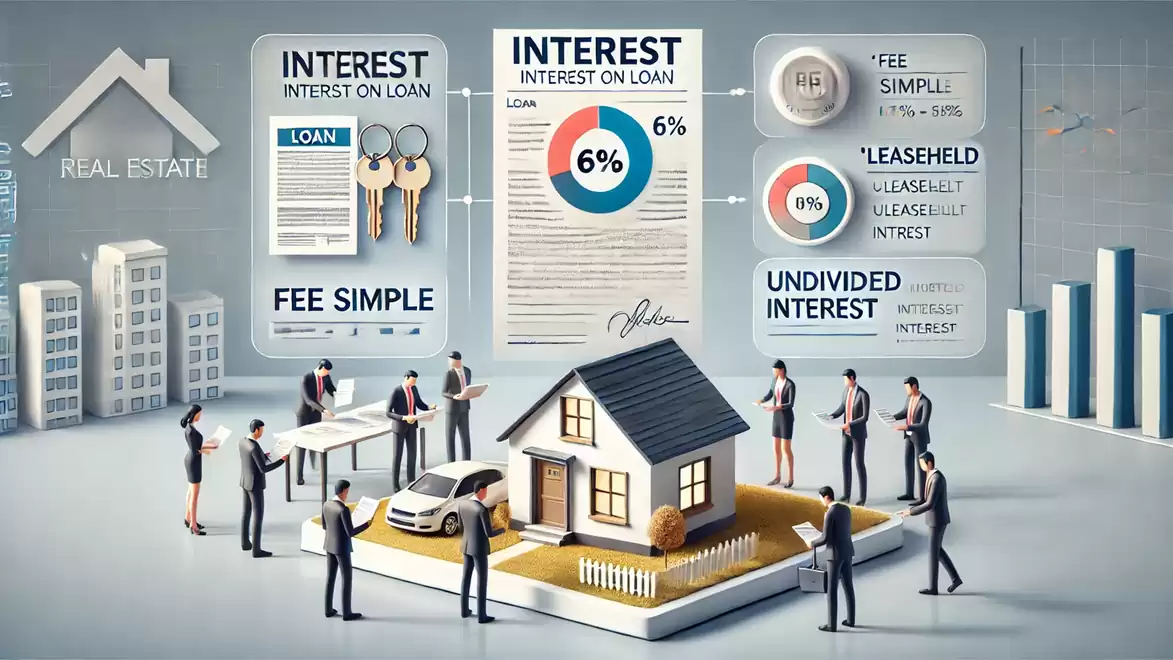
An illustration depicts different real estate financing models, including 'Fee Simple', 'Leasehold', and 'Undivided Interest', with a central house and business people discussing plans.
AI generated

Interest – Either loan interest or ownership share in a property

What does "Interest" mean in real estate?

The term Interest can refer to two main things in real estate:

1. Loan Interest

This is the cost of borrowing money, typically expressed as a percentage of the loan amount. It is the amount paid by the borrower to the lender in return for using the funds—especially relevant in mortgage financing.

2. Ownership Interest

Here, "Interest" refers to a legal share or stake in real property. This can include full or partial ownership, or rights to use or profit from a property under certain agreements.

Common types of Ownership Interest

  • Fee Simple Interest: Full ownership with maximum rights
  • Leasehold Interest: Temporary right to use a property
  • Undivided Interest: Shared ownership without physical division

? Tip: In Florida real estate, always verify what kind of "interest" is being transferred—especially in investment properties, trusts, or partnership deals.

A desk with a model house, a tax book labeled 'IRC', stacks of papers, a calculator, and an American flag in the background, along with the skyline of a city.
AI generated

Internal Revenue Code (IRC) – Federal tax law framework governing U.S. real estate taxation

What is the Internal Revenue Code?

The Internal Revenue Code (IRC) is the comprehensive body of federal tax law in the United States. It is administered by the Internal Revenue Service (IRS) and governs how income, gains, deductions, and credits are taxed—including rules directly affecting real estate ownership and investment.

Key IRC sections relevant to real estate

  • Section 1031: Tax-deferred exchange of investment properties (like-kind exchange)
  • Section 121: Exclusion of capital gains from sale of a primary residence
  • Section 168: Depreciation rules for real property and improvements (MACRS)
  • Section 267: Related-party transaction limitations

Why the IRC matters in real estate

  • Determines taxation of rental income, capital gains, and depreciation
  • Guides tax planning strategies for property owners and investors
  • Essential for foreign investors navigating U.S. tax compliance

? Tip: If you're investing in Florida or other U.S. markets, it's essential to understand the relevant IRC sections—especially for tax deferral or capital gains planning. Work with a qualified U.S. tax advisor (CPA) to stay compliant and optimize returns.

Illustration of tax documents, a small model house, coins, and a calculator, representing capital gains tax and IRS documents.
AI generated

IRS (Internal Revenue Service) – U.S. federal tax authority overseeing real estate taxation

What is the IRS?

The Internal Revenue Service (IRS) is the United States federal tax agency, responsible for administering and enforcing federal tax laws. This includes income tax, capital gains tax, and real estate-related taxation.

IRS involvement in real estate

  • Collects capital gains tax on property sales
  • Processes tax returns for rental income
  • Enforces FIRPTA on real estate sold by foreign owners
  • Issues ITINs (Tax ID for non-resident investors)

What foreign investors need to know

  • Foreigners must file U.S. tax returns for rental income and property sales
  • FIRPTA withholding may apply when selling real estate
  • Professional tax guidance is highly recommended

? Tip: If you own or sell property in Florida, understand your IRS obligations—especially for foreign nationals, rental income, and capital gains taxes.

J

Businessmen shaking hands in a modern office with a presentation screen to seal a joint venture.
AI generated

Joint Ventures – Strategic partnerships for real estate investment

What is a Joint Venture?

A Joint Venture (JV) is a formal partnership between two or more parties who collaborate to develop, acquire, or manage a real estate project. Each party contributes capital, resources, or expertise and shares profits and risks without merging their core businesses.

Common use cases in real estate

  • Development projects like condos or commercial buildings
  • Fix-and-flip investments combining investor and contractor roles
  • Buy-and-hold properties managed by multiple equity partners
  • International real estate ventures with local expertise

Legal structure

Most Joint Ventures in the U.S. are formed through an LLC or contractual agreement. A clear Joint Venture Agreement is essential to define ownership shares, decision-making processes, profit distribution, and exit strategies.

? Tip: Joint Ventures are ideal for leveraging strengths and reducing risk, especially when entering new markets or large-scale projects—but require strong legal documentation.

L

Digital concept for property management featuring virtual icons and a modern house in the background. Hands with keys symbolize transactions and maintenance services.
AI generated

Landlord – Owner who rents out residential or commercial property

What is a Landlord?

A Landlord is the legal owner of a property who rents it out to a Tenant in exchange for periodic rent payments. The term is widely used in both residential and commercial leasing in the United States.

Rights and responsibilities of a Landlord

  • Collecting rent as outlined in the lease
  • Maintaining the property in a habitable and safe condition
  • Making necessary repairs (e.g., HVAC, plumbing, roof)
  • Respecting tenant privacy with proper notice before entry

Florida-specific insights

  • Florida laws are generally landlord-friendly but require compliance with strict regulations
  • Includes rules on security deposits, eviction, habitability, and disclosure
  • Many landlords in Florida use property management services—especially for vacation homes

Difference from “Lessor”

  • Landlord is the common everyday term
  • Lessor is the legal term found in lease agreements

? Tip: As a Landlord in Florida, always use a well-drafted lease, stay up to date on tenant rights and local laws, and consider routine inspections to protect your investment.

A well-kept garden in front of a modern house with palm trees, green lawn, and colorful flowers. Automated irrigation systems are in use.
AI generated

Landscaping – Property value enhancement through exterior design and maintenance

What is Landscaping?

Landscaping refers to the design, installation, and maintenance of a property's outdoor areas. This includes lawns, flower beds, palm trees, shrubs, irrigation systems, and decorative elements such as rocks, mulch, or lighting.

Typical landscaping elements

  • Lawn installation and maintenance
  • Planting and trimming of trees and bushes
  • Sprinkler and irrigation systems
  • Landscape lighting and pathways
  • Decorative mulch, gravel, or privacy features

Benefits of professional landscaping

  • Increases property value and curb appeal
  • Improves rental potential—especially for vacation homes
  • Reduces pests and maintenance issues with proper care

Florida-specific notes

  • Florida landscaping often includes tropical elements and palm varieties
  • HOAs and city codes may require specific landscape standards
  • Frequent maintenance is essential due to year-round growing conditions

? Tip: In Florida, quality Landscaping is key to boosting home value, rental success, and first impressions. Consider using professional services for long-term upkeep.

A person trimming the lawn with a string trimmer, with the text 'Lawn Care' beside them.
AI generated

Lawn care is a key element of exterior maintenance for vacation properties in Florida. A well-kept yard enhances the visual appeal of the home and contributes to both property value and guest satisfaction.

Typical Lawn and Garden Services

  • Regular lawn mowing
  • Watering and fertilizing
  • Weed control and edging
  • Care of ornamental plants, hedges, and palms
  • Leaf removal and seasonal landscaping

Importance for Rental Properties

A neat and tidy yard is a major factor in positive guest reviews, especially for short-term vacation rentals. Lawn care is typically performed weekly or biweekly by specialized service providers.

Recommended Provider in Cape Coral

HomewatchCapeCoral offers professional lawn and garden maintenance services for vacation homes. Their services include everything from basic mowing to complete landscaping solutions.
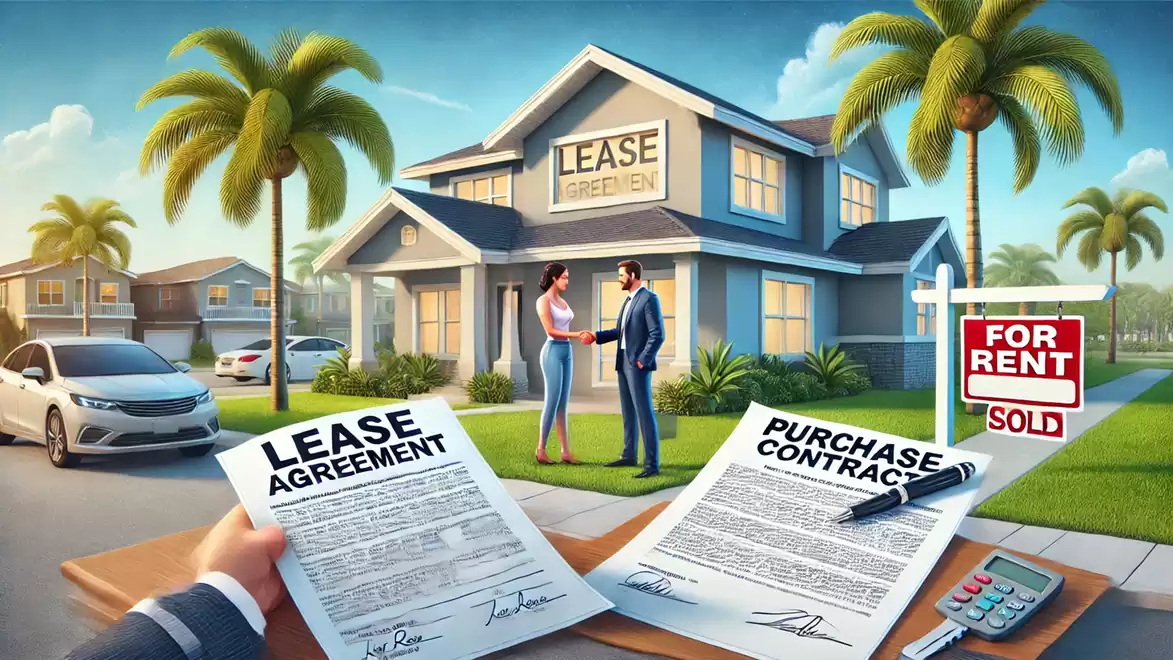
A couple stands in front of a modern house available for rent. A sign says 'For Rent'. In the foreground, there are options for a lease agreement and a purchase contract.
AI generated

Lease Purchase – Rental agreement with a binding obligation to buy

What is a Lease Purchase?

A Lease Purchase is a rent-to-own structure in which the tenant agrees to rent a property for a set period and is legally obligated to purchase it at the end of the lease term.

Key features of a Lease Purchase

  • Binding purchase agreement included with the lease
  • Pre-agreed purchase price
  • Option fee or down payment often required
  • Portion of rent may be credited toward the purchase price

Difference from Rent-to-Own

Unlike Rent-to-Own (where purchase is optional), a Lease Purchase includes a mandatory commitment to buy. It is a contractual obligation regardless of future financing challenges.

? Tip: In Florida, Lease Purchase agreements are best suited for buyers who are already pre-qualified or nearly mortgage-ready. Always seek legal review before signing.

A couple looks at a modern two-story house with a 'For Rent Option to Buy' sign in the foreground, framed by palm trees and a manicured garden at sunset.
AI generated

Lease with Option to Buy – Rental agreement with non-binding purchase right

What is a Lease with Option to Buy?

A Lease with Option to Buy is a rental contract that gives the tenant the exclusive right to purchase the property at a later date, but without the obligation to do so. The purchase price is usually pre-agreed or based on a formula.

Key features

  • Optional purchase – tenant is not legally required to buy
  • Option fee – non-refundable payment for the purchase right
  • Rent credits – part of rent may go toward the purchase price
  • Option period typically ranges from 6 to 36 months

How it differs from similar terms

  • Lease Purchase: Purchase is mandatory at the end of lease
  • Rent-to-Own: Often used interchangeably but may offer more flexibility

? Tip: In Florida, have the contract reviewed by an attorney to ensure the purchase option and timeline are clearly defined and legally enforceable.

Two people sit at a table with a lease agreement, a calculator, a cup of coffee, and a small house model.
AI generated

Lease – Legal agreement to rent residential or commercial property

What is a Lease?

A Lease is a binding contract that allows a tenant to use a property for a specified period in exchange for rent. It outlines the rights and obligations of both the landlord and tenant, and applies to residential and commercial real estate.

Common elements of a lease

  • Lease term (e.g., 12 months)
  • Monthly rent and payment schedule
  • Security deposit and utility responsibilities
  • Usage rules (e.g., pets, smoking, subletting)
  • Termination conditions and renewal options

Florida-specific notes

  • Leases can be written or verbal, but written leases are strongly recommended
  • Long-term leases are common for residential properties
  • Short-term leases are typical for vacation rentals and furnished homes

? Tip: In Florida, every lease agreement should be clear, documented, and legally reviewed, especially for long-term rentals or commercial spaces. A proper lease protects both tenant and landlord.

Illustration of a property plan featuring a house on a large plot, surrounded by water and vegetation, along with technical drawings and a hand drawing another plan.
AI generated

Legal Description – Precise and official definition of real property boundaries

What is a Legal Description?

A Legal Description is the formal, legally recognized definition of a property’s boundaries and location. Unlike street addresses, it identifies land accurately and uniquely for deeds, surveys, and legal documents.

Common formats in Florida

  • Lot & Block: Based on subdivision plat maps (e.g., “Lot 12, Block 2053, Cape Coral Unit 32”)
  • Metes and Bounds: Uses distances, angles, and landmarks—common in rural areas
  • Government Survey (Rectangular System): Section, Township, Range

Where is a Legal Description used?

  • Deeds and property transfers
  • Building permits and zoning applications
  • Mortgage documentation
  • Title insurance and title searches

Florida-specific insights

  • Every parcel in Florida has a registered Legal Description, often tied to a plat
  • Inaccuracies can jeopardize title or delay closing
  • Essential part of any Title Insurance Policy

? Tip: Always review the Legal Description carefully in Florida real estate deals—it’s more authoritative than a street address and crucial in boundary disputes or legal claims.

A business meeting in a modern office overlooking houses. A man and a woman sit at a table discussing real estate investment.
AI generated

Lender – Entity providing real estate financing

What is a Lender?

A Lender is an individual, bank, or financial institution that provides funding—typically for the purchase or refinance of real estate. The borrower agrees to repay the loan with interest, and the property usually serves as collateral.

Common types of lenders

  • Banks and credit unions
  • Mortgage brokers (intermediaries between borrower and lender)
  • Private lenders or hard money lenders
  • Insurance companies or institutional investors

Key responsibilities of a lender

  • Credit evaluation of the borrower
  • Property appraisal to determine loan risk
  • Loan terms structuring (rates, terms, repayment)
  • Disbursement and servicing of the loan

Florida-specific insights

  • Florida lenders often accommodate foreign buyers with special programs
  • Common options: Fixed-rate, ARM, and interest-only loans
  • Property serves as collateral; foreclosure may occur if borrower defaults

? Tip: When financing in Florida, compare multiple lenders and focus on interest rates, fees, prepayment terms, and service reputation.

A split image shows a woman in a pool in front of a luxurious house with palm trees on the left, and a businessman working in an office with large 'For Lease' signs on the right.
AI generated

Lessee – Tenant with contractual rights to use real estate

What is a Lessee?

A Lessee is the legal tenant who receives the right to use a property under a lease agreement with the Lessor (property owner). The lessee pays rent in exchange for the temporary use of the property.

Key rights and responsibilities of a Lessee

  • Right to occupy the property during the lease term
  • Timely rent payments as per the lease
  • Proper maintenance of the interior and reporting of issues
  • Compliance with lease conditions and community rules

Commercial lease considerations

  • In NN or NNN leases, the Lessee pays taxes, insurance, and maintenance
  • Leases are often long-term with renewal clauses and custom terms

Florida-specific insights

  • Vacation rental leases may have different tax and cancellation rules
  • Florida lessees are often responsible for minor maintenance tasks
  • Local jurisdictions may require lessee registration for short-term stays

? Tip: As a Lessee in Florida, always review lease terms carefully—especially clauses on deposits, repair obligations, and termination policies.

Illustration of a real estate agent working on a laptop in a tropical setting. Several 'For Lease' signs and a luxury house with a pool in the background.
AI generated

Lessor – Legal property owner who leases real estate to a tenant

What is a Lessor?

A Lessor is the legal owner of a property who grants the right of use to another party—the Lessee (tenant)—in exchange for rent. This term applies to residential, commercial, and industrial leases.

Common responsibilities of a Lessor

  • Delivering the property in good and usable condition
  • Maintaining major structural elements (e.g., roof, HVAC, plumbing)
  • Complying with local ordinances and building codes
  • Providing clear lease documentation and notices

Lessor role in NNN leases

  • In a Triple Net Lease, the tenant covers taxes, insurance, and maintenance
  • The Lessor receives net income with reduced operational involvement

Florida-specific insights

  • Disclosure laws apply—e.g., lead-based paint for older homes
  • Short-term rentals require licensing, taxation, and safety compliance
  • Many foreign owners in Florida operate as Lessor through property managers

? Tip: If you act as a Lessor in Florida, use professionally drafted lease agreements and ensure compliance with all legal obligations, especially in vacation rentals.

An office with two people working at a desk. One person is seated and signing a document labeled 'Letter of Attornment', while the other person stands watching. In the background, a building with the sign 'Real Estate' is visible.
AI generated

Letter of Attornment – Tenant’s confirmation of new landlord after property transfer

What is a Letter of Attornment?

A Letter of Attornment is a formal written statement by a tenant confirming that they recognize the new owner of a property as their legal landlord. It’s commonly used in the U.S. during the sale or foreclosure of leased properties.

Purpose and importance

  • Preserves the lease agreement after ownership changes
  • Clarifies obligations between the tenant and new landlord
  • Often paired with an SNDA Agreement (Subordination, Non-Disturbance, and Attornment)

What’s typically included?

  • Affirmation of the current lease terms
  • Acceptance of the new property owner as the landlord
  • Summary of rent terms, expiration date, and any obligations

? Tip: In Florida, a Letter of Attornment is often requested by buyers of commercial rental properties to verify lease status and tenant cooperation prior to closing.
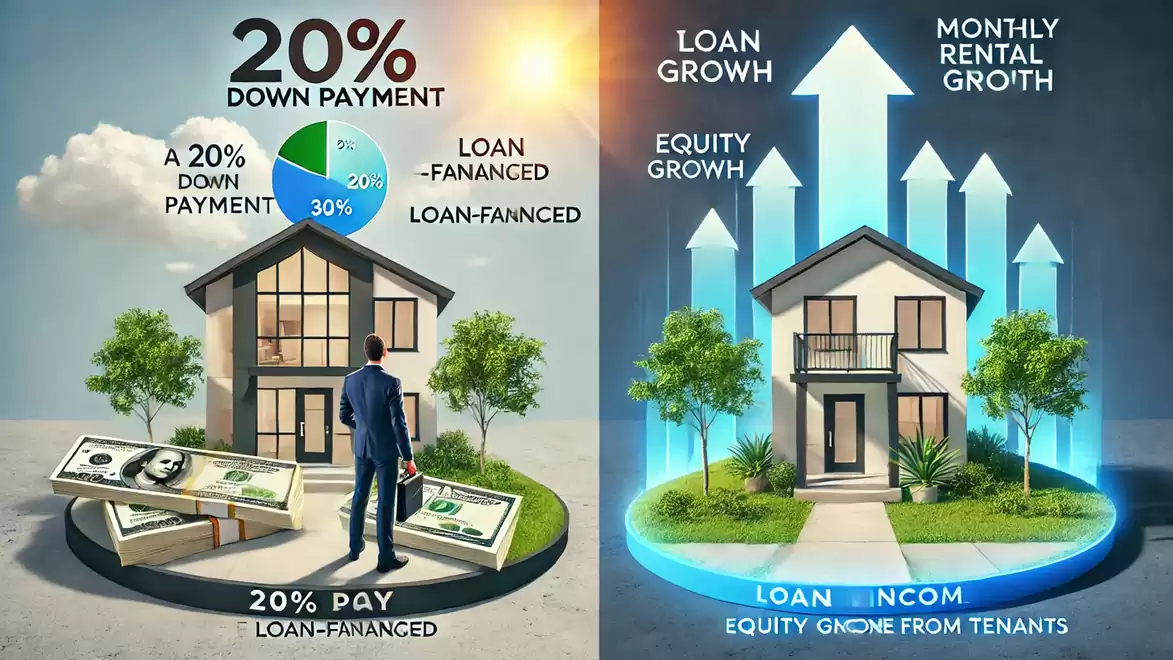
Illustration of two real estate financing strategies. Left with 20% down payment and right through loan and rental income growth.
AI generated

Leverage – Using debt to increase returns on real estate investments

What is Leverage?

Leverage refers to the use of borrowed capital to increase the potential return on an investment. In real estate, it allows investors to control larger assets with less equity and amplify their return on investment (ROI).

How leverage works

  • Investor provides 20?% equity, finances 80?% through a mortgage
  • Rental income or appreciation pays down the loan and builds equity
  • Returns on the invested capital are amplified due to limited upfront cash

Benefits and risks

  • Pros: Greater returns with less capital
  • Cons: Higher risk if property underperforms or interest rates rise

Florida-specific insights

  • Florida’s strong rental market makes leverage strategies highly attractive
  • Typical Loan-to-Value (LTV) ratios range from 60?% to 80?%
  • Foreign investors commonly use leverage to build U.S.-based equity

? Tip: When using leverage in Florida, calculate cash flow, reserve needs, and interest sensitivity carefully—the leverage works both ways.

Illustration of a man in a suit approaching a crying child on the sidewalk, while someone signs a liability insurance policy. A house and trees are visible in the background.
AI generated

Liability Insurance – Coverage against third-party injury and damage claims

What is Liability Insurance?

Liability Insurance provides financial protection against claims from third parties for bodily injury or property damage that occur on or because of the insured property.

Common uses in real estate

  • Rental property owners: Protection if tenants or guests are injured
  • Vacation rentals: Covers guest-related accidents or property damage
  • Construction sites: Protection from claims arising during development

What does it cover?

  • Medical costs and third-party damages
  • Legal defense fees if sued
  • Negligence-related claims like slip-and-fall incidents

? Tip: In Florida, liability insurance is essential for vacation rentals. Consider bundling it with homeowners or landlord insurance and ensure coverage limits are high enough to protect your assets.
Illustration of a lien with a form, a scale, a gavel, and a house symbolizing legal and financial aspects.
AI generated

Lien – Legal claim against real estate for unpaid obligations

What is a Lien?

A Lien is a legal right or interest in a property that serves as security for a debt or obligation. If the property owner fails to pay, the lienholder may have the right to enforce payment or initiate foreclosure.

Common types of liens in real estate

  • Mortgage Lien: Held by the lender until the loan is paid off
  • Tax Lien: Imposed for unpaid property taxes
  • Mechanic's Lien: For unpaid contractor or construction work
  • HOA Lien: For overdue homeowner association fees

Effects of a lien on property

  • Property cannot be sold or refinanced until lien is cleared
  • May damage credit score and limit owner rights
  • Can lead to foreclosure if unresolved

? Tip: In Florida, always request a title search before buying a property to ensure it is free of liens or legal claims.

Image of two businessmen, one in a suit and the other with a construction helmet, sitting at a table. In the background, construction cranes and charts illustrate the concepts of General Partner and Limited Partner.
AI generated

Limited Partner – Passive investor with limited liability in a partnership

What is a Limited Partner?

A Limited Partner is a non-managing investor in a Limited Partnership (LP). Their liability is limited to the amount of capital invested. They do not participate in day-to-day operations and cannot be held personally liable for business debts beyond their investment.

Key features of a Limited Partner

  • Capital contribution to the business or real estate venture
  • No decision-making authority or operational control
  • Entitled to profit shares as per the partnership agreement
  • Losses limited to the amount invested

Advantages of being a Limited Partner

  • Liability protection from business risks
  • Passive income opportunity
  • Popular structure for foreign real estate investors in Florida

Florida-specific insights

  • Florida law clearly defines the role and protections of a Limited Partner
  • Common in real estate syndications, development projects, and investment funds
  • Partnership must be registered with the Florida Department of State

? Tip: If you're investing as a Limited Partner in Florida, carefully review the partnership agreement—especially regarding profit allocation, liability limits, and exit provisions.

Image of a businessman and construction worker with blueprints and charts. Construction sites and modern buildings are visible in the background.
AI generated

Limited Partnership (LP) – Investment structure with limited liability for passive partners

What is a Limited Partnership?

A Limited Partnership (LP) is a business structure commonly used in real estate and investment ventures. It includes at least one General Partner with full liability and one or more Limited Partners whose liability is restricted to their capital contribution.

Structure of a Limited Partnership

  • General Partner: Manages operations, has full liability
  • Limited Partner: Passive investor, limited liability, no decision-making authority

Advantages for Limited Partners

  • Limited risk exposure tied to their investment
  • Passive income from distributions and profit shares
  • Potential tax benefits through depreciation and flow-through taxation

Florida-specific insights

  • LPs must be registered with the Florida Department of State
  • Frequently used in real estate developments and foreign investment structures
  • Not to be confused with a Limited Liability Partnership (LLP)

? Tip: If you're joining a Limited Partnership in Florida, review the partnership agreement carefully—pay attention to liability, profit distribution, and exit clauses.
Illustration of a purchase contract process with a man in a suit next to a model house, a gavel, and a scale. One man is thoughtful while another inserts a coin into the model house.
AI generated

Liquidated Damages – Pre-agreed compensation for contract breach

What are Liquidated Damages?

Liquidated Damages refer to contractually agreed monetary compensation set in advance in case one party—typically the buyer—fails to fulfill the agreement. It provides a predictable remedy for the seller without requiring proof of actual losses.

Example in a real estate context

  • Buyer backs out of the contract without legal justification
  • Earnest Money Deposit is forfeited as Liquidated Damages
  • Amount is predetermined (e.g. 3% of the purchase price)

Legal aspects in Florida

  • Liquidated Damages must be reasonable and not punitive
  • Seller may choose to enforce the clause or pursue specific performance
  • Standard FAR/BAR contracts include this as a selectable option

? Tip: In Florida real estate, always review if a Liquidated Damages clause is included in your purchase contract—it may define how disputes are resolved and limit further legal claims.

A laptop on a wooden desk displaying a real estate listing with a house image and price details. Daylight shines through a window in the background.
AI generated

Listing – Public property offering for sale or rent

What is a Listing?

A Listing is the official posting of a property for sale or rent, typically entered by a licensed agent into an MLS (Multiple Listing Service) or published on websites like Zillow, Realtor.com, or brokerage platforms.

What a listing typically includes

  • Property address and asking price
  • Photos, floor plans, and virtual tours
  • Detailed property description (features, year built, location)
  • Contact info for agent or seller

Types of listings

  • Active Listing: Property is available
  • Pending Listing: Under contract, closing pending
  • Sold Listing: Property has been sold
  • Exclusive Listing: One agent has full rights to market

? Tip: In Florida, a well-prepared listing with strong visuals and accurate data is key to attracting buyers—especially online. Consider drone shots or video walkthroughs for maximum impact.

Modern three-story villa with open floor plan, outdoor terrace, and swimming pool, surrounded by palm trees.
AI generated

Living Area – Climate-controlled interior space of a property

What is Living Area?

Living Area refers to the heated and air-conditioned interior space of a property that is suitable for daily living. It is a key measurement used in real estate listings, appraisals, and contracts across the U.S., especially in Florida.

What is included in the Living Area?

  • Bedrooms, living rooms, and kitchen
  • Bathrooms, walk-in closets, and pantries
  • Any fully climate-controlled interior rooms

What is excluded from Living Area?

  • Garage space, even if finished
  • Lanai or screened-in porch
  • Unfinished or non-air-conditioned utility spaces

Florida-specific insights

  • Living Area is typically measured in square feet (sq ft)
  • Garages, pool areas, and lanais are listed separately
  • The Total Area is usually larger than the Living Area

? Tip: In Florida property listings, always compare Living Area with Total Area to better understand the usable living space versus exterior or non-livable square footage.
Visual representation of forming an LLC in Florida with documents, a laptop, and a model house on a table.
AI generated

LLC – Limited Liability Company – Entity structure offering liability protection and tax flexibility

What is an LLC?

A Limited Liability Company (LLC) is a flexible business structure in the U.S. that offers personal liability protection for its members while allowing pass-through taxation—meaning profits and losses pass directly to the owners.

Why real estate investors choose an LLC

  • Liability protection: Members’ personal assets are shielded from lawsuits
  • Tax advantages: Income is taxed only once at the individual level
  • Simpler setup and maintenance than a corporation
  • Ideal for foreign buyers seeking asset protection and anonymity

Common uses in Florida

  • Holding rental properties or vacation homes
  • Used for long-term investment strategies or portfolio diversification
  • Formed via the Florida Division of Corporations with an operating agreement

? Tip: In Florida, LLCs are widely used for property ownership and management. Foreign investors should seek tax and legal guidance before setting up an LLC.

A desk with a real estate loan agreement, model house, laptop with Florida map, and calculator.
AI generated

Loan Agreement – Legally binding contract defining loan terms and conditions

What is a Loan Agreement?

A Loan Agreement is a legally enforceable document between a lender and a borrower that outlines the terms and conditions of a loan. In real estate, it governs the terms of a mortgage or other property-related financing.

Key components of a Loan Agreement

  • Loan amount (principal)
  • Interest rate (fixed or adjustable)
  • Repayment schedule and loan term
  • Collateral – typically a lien on real property
  • Default clauses and lender remedies

Real estate-specific clauses

  • Often signed together with a mortgage or deed of trust
  • Outlines borrower obligations like insurance, taxes, and maintenance
  • Provides legal protection for lenders in case of default

? Tip: In Florida, it’s advisable to have a Loan Agreement reviewed by a real estate attorney, especially in large transactions or when dealing with private or alternative lenders.

Business meeting about loan agreements with miniature house model and contract document on the table.
AI generated

Loan Commitment – Lender’s binding approval for a mortgage loan

What is a Loan Commitment?

A Loan Commitment is a formal, binding document issued by a lender stating their agreement to fund a mortgage under specific terms. It is a key step in the home buying process and often required to satisfy financing contingencies in a purchase agreement.

What does a Loan Commitment include?

  • Approved loan amount and interest rate
  • Loan type and term
  • Property address tied to the approval
  • Conditions still required before closing (e.g. appraisal, insurance)

Why is it important?

  • Strengthens the buyer’s offer to the seller
  • Provides assurance of financing to all parties
  • Usually tied to a Loan Commitment Deadline in the contract

? Tip: In Florida, submit your Loan Commitment early to avoid delays or risk of default. It’s critical in contracts with a Financing Contingency Clause.

A man and a woman shaking hands in an office with calculated loan fees, money, and a house in the background.
AI generated

Loan Fee – One-time charge for processing and originating a loan

What is a Loan Fee?

A Loan Fee is a one-time payment made to a lender to cover the cost of underwriting, processing, and originating a mortgage. It is typically due at closing and is also known as an Origination Fee.

What does it include?

  • Processing and underwriting charges from the lender
  • Credit checks, documentation review, and risk analysis
  • Broker commissions (if applicable)

Typical cost of a Loan Fee

  • Usually 0.5% to 1.5% of the loan amount
  • May be negotiable depending on lender and loan size
  • Disclosed in the Loan Estimate and Closing Disclosure

? Tip: In Florida, it’s smart to compare loan offers from multiple lenders. A higher loan fee may sometimes come with lower interest rates or better loan terms overall.

Three people discussing home loans in a modern office with a large screen displaying information on different loan types.
AI generated

Loan – Borrowed funds used to finance real estate purchases

What is a Loan?

A Loan refers to borrowed money from a lender such as a bank or private institution, typically used to finance the purchase of real estate. In this context, it generally means a mortgage loan secured by the property being purchased.

Common types of real estate loans

  • Conventional Loan: Standard loan without government backing
  • FHA Loan: Government-insured loan for buyers with lower credit
  • VA Loan: Mortgage for U.S. veterans and active service members
  • Jumbo Loan: For high-value homes exceeding loan limits

Typical loan components

  • Principal amount and term length (e.g. 15 or 30 years)
  • Interest rate: fixed or adjustable
  • Repayment plan with monthly installments
  • Collateral: property serves as loan security

? Tip: In Florida’s competitive market, compare multiple lenders and consider using a mortgage broker to find favorable terms and rates for your real estate loan.

Illustration showing a 30-year mortgage chart on the left featuring a house with a garden and a long-term debts chart on the right with a businessman pointing at a rising graph.
AI generated

Long Term Debts – Financial obligations due in more than one year

What are Long Term Debts?

Long Term Debts are liabilities that are due beyond 12 months from the reporting date. They are a critical component of personal, corporate, and real estate financing, often tied to major investments and repayment schedules.

Examples of Long Term Debts

  • Mortgage loans for real estate
  • Construction or land development loans
  • Business loans with long repayment terms
  • Bonds or promissory notes

Why are they important?

  • Influence credit scores and lending decisions
  • Help structure capital and investment planning
  • Provide long-term stability in financing strategy

Florida-specific insights

  • In Florida mortgage applications, Long Term Debts impact the Debt-to-Income (DTI) ratio
  • Lenders closely evaluate these debts when assessing loan risk

? Tip: When applying for a mortgage or investment loan in Florida, organize and disclose all Long Term Debts clearly—this builds trust and improves approval chances.

A couple discusses buying a house with a real estate agent. There are contract documents, a model house, and a calculator on the table. A modern house is visible in the background.
AI generated

Long-term Financing – Mortgage-based real estate financing with extended repayment terms

What is Long-term Financing?

Long-term Financing refers to real estate loans that are repaid over an extended period—typically 10 years or more. It’s the most common form of mortgage financing used for primary residences and investment properties in the U.S.

Key features

  • Loan terms: 10, 15, 20, or 30 years
  • Interest types: fixed or adjustable (e.g., ARM loans)
  • Monthly payments include principal and interest
  • Usually secured by the property

Advantages for borrowers

  • Lower monthly payments due to long amortization
  • Financial predictability with fixed-rate options
  • Ideal for long-term property ownership or rentals

Florida-specific note

  • 30-year fixed mortgages are the norm
  • Commonly used with FHA, VA, or conventional loans

? Tip: In Florida, long-term financing is ideal for building equity over time. Be sure to compare loan terms, prepayment conditions, and rate structures before committing.

Two business people signing a 12-month lease agreement in a modern office with large windows.
AI generated

Long-term Lease – Rental agreement with extended fixed duration

What is a Long-term Lease?

A Long-term Lease is a rental contract lasting 12 months or more. In the U.S., this lease type is common for residential properties with year-long tenancies, as well as commercial leases that can span multiple years.

Key features of a Long-term Lease

  • Duration: Typically 12, 24, or 36 months, sometimes with renewal options
  • Fixed monthly rent for the lease period
  • Clearly defined termination rules and notice requirements
  • Often requires credit check and background screening

Benefits and considerations

  • Steady rental income for landlords
  • Security and stability for tenants
  • In Florida: Commonly used for annual rentals of single-family homes or condos

? Tip: In Florida, ensure that security deposits, maintenance responsibilities, and renewal clauses are clearly outlined in a signed lease agreement, ideally reviewed by a real estate attorney.
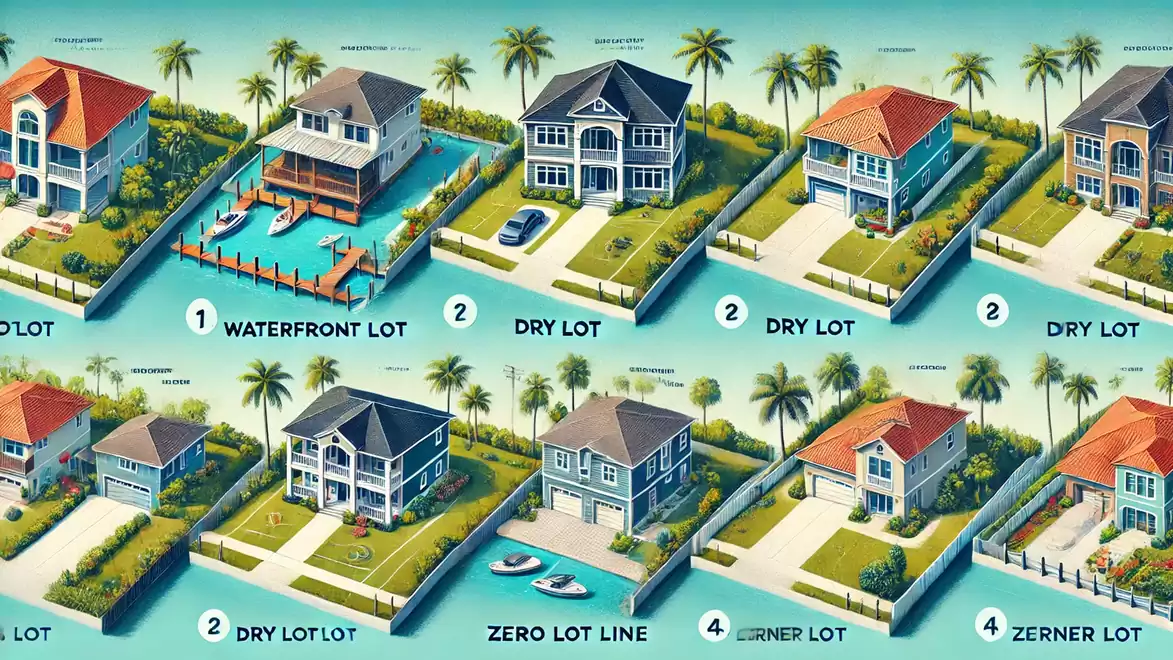
Illustration of eight different house lots in a coastal area, including waterfront and dry lots, surrounded by palm trees and greenery.
AI generated

Lot – Individually designated parcel of land for development or sale

What is a Lot?

A Lot refers to a specific parcel of land that is legally recorded and described within a subdivision or plat map. It represents an independent unit of property ownership and forms the legal basis for construction, taxation, and land use.

Key characteristics of a Lot

  • Lot Number for identification within a recorded subdivision
  • Defined dimensions and boundaries recorded in public records
  • Title and deed specific to that parcel
  • Zoning designation determines allowed land use

Common Lot types in Florida

  • Waterfront Lot: On a canal, river, lake, or coastline
  • Dry Lot: Not adjacent to water – generally more affordable
  • Corner Lot: Located at a street intersection
  • Zero Lot Line: Built with minimal setback from the lot boundary

Florida-specific notes

  • Lots in Cape Coral are described by Section, Township, and Range
  • Lot conditions (e.g. cleared, developed, tax history) impact permits and pricing

? Tip: When buying a lot in Florida, review zoning, FEMA flood zones, setbacks, utilities, and title history before closing.

M

A modern residential neighborhood with a central swimming pool, surrounded by palm trees and elegant houses. A maintenance worker is cleaning the pool. HOA office nearby.
AI generated

Maintenance Fee – Recurring property fee for upkeep of shared facilities

What is a Maintenance Fee?

A Maintenance Fee is a monthly or quarterly charge paid by owners of condos, vacation homes, or properties in managed communities. It covers the upkeep and repair of shared spaces and amenities.

What does it typically include?

  • Landscaping and lawn care
  • Pool, gym, and clubhouse maintenance
  • Community insurance coverage (e.g., exterior building insurance)
  • Trash removal and internal road upkeep
  • HOA or management fees

Key considerations for buyers

  • Fees vary based on amenities, location, and community size
  • They are typically mandatory and tied to the property
  • Some fees include reserves for major repairs or capital improvements

? Tip: In Florida, always review the HOA’s budget, reserve fund levels, and any pending assessments before purchasing.

A technician services air conditioning units in front of a house with palm trees and a swimming pool on a sunny day.
AI generated

Maintenance – Ongoing upkeep to preserve property condition and value

What is Maintenance?

Maintenance refers to the routine tasks and preventive measures taken to keep a property functional, safe, and valuable. It includes regular check-ups and servicing to avoid costly repairs and extend the life of systems and materials.

Typical maintenance tasks

  • HVAC servicing and filter replacement
  • Plumbing, electrical, and appliance checks
  • Roof and exterior inspections
  • Lawn, landscaping, and pool care
  • Minor fixes and general upkeep

Maintenance vs. Repairs

  • Maintenance: Preventative and ongoing care
  • Repairs: Addressing damage or malfunctions

Florida-specific insights

  • Florida’s humid climate demands regular moisture and mold control
  • Many owners—especially absentee owners—hire professional maintenance services
  • Pool, landscaping, and AC upkeep are essential for rental properties

? Tip: In Florida, a clear maintenance strategy is essential for preserving property value, avoiding damage, and ensuring guest satisfaction in vacation rentals.

Luxury beachfront house with Mediterranean design, surrounded by palm trees under a blue sky.
Licensed by: Adobe

Mansion – Luxury estate or high-end residence with premium features

What is a Mansion?

A Mansion is a very large and luxurious residential property, often situated on an expansive lot. In Florida, the term refers to ultra-premium homes with architectural distinction, top-tier finishes, and exceptional amenities—frequently found on the water, golf courses, or in gated communities.

Key features of a mansion

  • Living space of 5,000 sq ft or more
  • Multiple bedrooms and bathrooms with designer materials
  • Guesthouses, home theaters, gyms, wine cellars, elevators
  • Lavish outdoor areas with infinity pools, outdoor kitchens, private docks

Florida-specific insights

  • Popular among UHNWI as a primary or seasonal residence
  • Often located in Naples, Miami, Palm Beach, Sarasota, or along the Intracoastal Waterway
  • Seen as status symbol, long-term asset, or multi-generational estate

? Tip: When buying or selling a Mansion in Florida, focus on location, privacy, and custom features. These properties are one of a kind and often held in trusts or LLCs for privacy.

Modern residential complex with swimming pool and palm trees in the foreground, hand holding clipboard with market data.
AI generated

Market Value – Estimated price of a property under normal market conditions

What is Market Value?

Market Value is the estimated price a property would sell for on the open market between a willing buyer and a willing seller, with both acting in their own best interest and having reasonable knowledge of the property and conditions.

How is Market Value determined?

  • Sales Comparison Approach: Based on recent sales of similar properties
  • Income Approach: Used for rental properties, based on NOI
  • Cost Approach: Based on replacement cost minus depreciation

Key influencing factors

  • Location and neighborhood quality
  • Condition and features of the property
  • Lot size, square footage, year built
  • Local market trends and buyer demand

Florida-specific insights

  • Florida’s market is highly seasonal and demand-driven
  • There may be a gap between assessed tax value and true market value
  • Appraisers and Realtors often use CMAs (Comparative Market Analyses)

? Tip: Before buying or selling in Florida, get a current market value estimate—it's crucial for pricing, negotiation, and financing decisions.

Three business professionals in an office signing real estate contracts. One man is labeled as a buyer, while the others are marked as agents. On the table, there is a sign reading 'Florida Real Estate'.
AI generated

Marketable Title – Clear and insurable ownership title for real estate

What is a Marketable Title?

A Marketable Title refers to a clear and legally sound ownership title that allows the property to be transferred without legal concerns or future claims. It means the property is free from liens, encumbrances, disputes, or defects.

Key elements of a Marketable Title

  • No outstanding liens or unpaid mortgages
  • No unresolved code violations or back taxes
  • No ownership disputes or inheritance claims
  • Properly recorded deed with the county

Why it matters in real estate

  • Required by lenders for mortgage approval
  • Protects buyers from future legal challenges
  • Confirmed via title search and covered by title insurance

? Tip: In Florida, a title company or real estate attorney will verify the title’s marketability before closing. Any title defects must be cleared to avoid delays or legal risk.

Infographic on real estate prices in Florida featuring a 3D bar chart showing median price and sales data.
AI generated

Median Price – Middle value of all home sales in a given market

What is Median Price?

The Median Price represents the middle point of all home sales in a given time and area: half the properties sold for less, and half sold for more. Unlike the average price, the median is not skewed by extreme highs or lows, making it a more accurate reflection of typical market conditions.

Usage in real estate

  • Tracks market trends over time
  • Used in local and national housing reports
  • Helps determine fair pricing for buyers and sellers
  • Published by MLS systems, Realtor.com, NAR, and government agencies

Florida example

  • If the median home price is $450,000, this means 50% of sold homes cost less and 50% cost more
  • Useful to evaluate whether a listing is above or below market median

? Tip: Use the Median Price to evaluate property value and spot market shifts. Be sure to consider property types and local variations when interpreting this number.

Two men in a modern office look at a large digital real estate display board with graphics and images of houses.
AI generated

MLS (Multiple Listing System) – Central database for real estate listings and agent cooperation

What is the MLS?

The MLS (Multiple Listing System) is a cooperative platform used by real estate agents to share and access property listings. It is the primary tool for buying and selling homes in the U.S., particularly in competitive markets like Florida.

Benefits of the MLS

  • Maximum exposure: Listings are visible to all member agents
  • Faster transactions: through broad distribution and syndication
  • Reliable information: standardized property data and listing history

How it works

  • A Listing Agent submits the property to the MLS
  • The MLS feeds data to sites like Zillow, Realtor.com, Redfin
  • Buyer's Agents use the system to search for homes for their clients

? Tip: In Florida, most residential transactions are driven by the MLS. Sellers gain maximum exposure; buyers benefit from up-to-date and accurate market listings.

Three people in a modern office discuss mortgage options displayed on a screen. Palm trees are visible through the windows in the background.
AI generated

Mortgage Broker – Independent intermediary for real estate financing

What is a Mortgage Broker?

A Mortgage Broker is a licensed financial professional who acts as a middleman between borrowers and lenders. Unlike banks, brokers do not lend money directly—they shop the market to find the best mortgage options for their clients.

Key responsibilities

  • Gathering and comparing loan offers from multiple lenders
  • Advising clients on the best loan structure
  • Assisting with paperwork and application processes
  • Liaising with banks, title companies, and underwriters

Benefits for buyers

  • Access to more loan options than from a single bank
  • Potentially lower rates due to broker negotiations
  • Personalized advice based on financial profile and goals

Florida-specific insights

  • Brokers must be state licensed and registered via NMLS
  • Often used by international buyers or for complex transactions
  • Origination fees are disclosed in the Loan Estimate and paid at closing

? Tip: In Florida, a Mortgage Broker can help you navigate the financing process and secure better loan terms—especially if you’re buying from abroad or for the first time.

Illustration of home financing with charts on mortgage payments, monthly payments, and insurance.
AI generated

Mortgage Payments – Monthly payments on a real estate loan

What are Mortgage Payments?

Mortgage Payments are the monthly installments paid by a borrower to repay a home loan. These payments continue until the mortgage is paid off, typically over 15, 20, or 30 years.

Common components of a mortgage payment

  • Principal: Portion that reduces the loan balance
  • Interest: Cost of borrowing money
  • Taxes: Property taxes (often paid via escrow)
  • Insurance: Homeowners insurance coverage
  • Optional: HOA dues or Private Mortgage Insurance (PMI)

Types of payment structures

  • Fixed-rate mortgage: Stable interest rate and payments
  • Adjustable-rate mortgage (ARM): Rate changes after initial period

Florida-specific insights

  • Florida mortgages often include escrow accounts for taxes and insurance
  • Insurance premiums and property taxes can be higher than average

? Tip: In Florida, it’s crucial to understand the full breakdown of your Mortgage Payments—especially escrow items like property taxes and insurance. Always compare offers from multiple lenders.

A man and a woman are sitting at a table signing documents for a mortgage. In the background, a large window displays the words 'Mortgage Approval' with a check mark.
AI generated

Mortgage – Loan secured by real estate property

What is a Mortgage?

A Mortgage is a long-term loan used to purchase real estate. The borrower agrees to repay the loan in monthly installments, and the property serves as collateral. If the borrower defaults, the lender may initiate foreclosure and sell the property to recover the loan balance.

Key components of a mortgage

  • Principal: The original loan amount
  • Interest: Cost of borrowing the money
  • Term: Loan duration (commonly 15, 20, or 30 years)
  • Monthly Payments: Include principal, interest, taxes, and insurance
  • Collateral: The property being financed

Types of mortgages in Florida

  • Fixed-rate mortgage: Constant interest rate over the life of the loan
  • Adjustable-rate mortgage (ARM): Variable rate after an initial period
  • FHA, VA, and Conventional loans: Based on borrower profile

Florida-specific insights

  • Florida attracts many foreign buyers—special mortgage programs apply
  • Higher down payments often required for vacation or investment properties
  • Flood and windstorm insurance may be mandatory for approval

? Tip: If you plan to buy real estate in Florida with a mortgage, compare lenders, review all costs, and prepare documentation in advance—especially for international transactions.
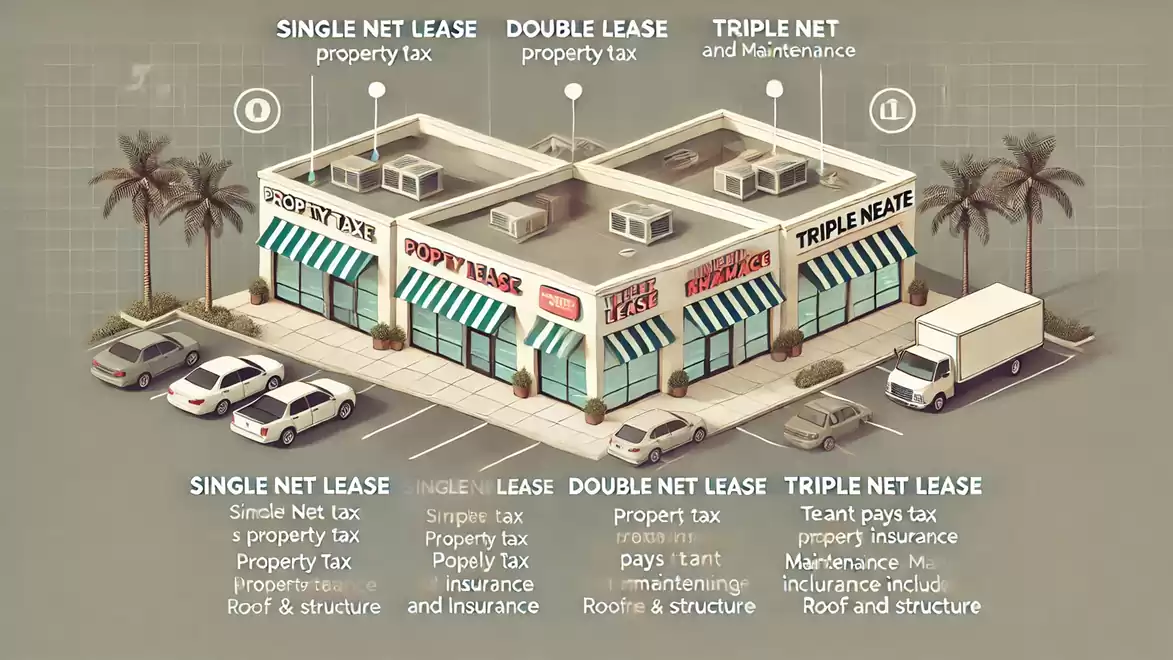
N

Illustration of a commercial building with different lease types: Single Net Lease, Double Lease, and Triple Net Lease. Each lease type includes specific costs like property tax, insurance, and maintenance. The image highlights the differences in tenants'
AI generated

Net Lease (NN, NNN) – Lease structure shifting expenses to the tenant

What is a Net Lease?

A Net Lease is a commercial rental agreement where the tenant agrees to cover some or all property-related expenses—such as taxes, insurance, and maintenance—on top of base rent. Net leases come in forms like N (Single Net), NN (Double Net), and NNN (Triple Net).

This lease structure involves an investment in a commercial property where the tenant pays a portion of the ongoing expenses directly, and the investor receives the remaining rent as net income. In a Double Net (NN) lease, the tenant pays for maintenance and property tax, while the landlord remains responsible for the building and roof. In a Triple Net (NNN) lease, the tenant additionally covers building and roof repairs. NNN leases are considered ideal for investors who want minimal involvement with the property.

Types of Net Leases

  • Single Net Lease (N): Tenant pays property taxes
  • Double Net Lease (NN): Tenant pays taxes and insurance
  • Triple Net Lease (NNN): Tenant covers taxes, insurance, and all maintenance, including roof and structure

Benefits for landlords

  • Predictable income with reduced liability for expenses
  • Lower operational burden on the property owner
  • Attractive long-term investment structure

Investor insights

  • Triple Net Leases are popular in Florida with national retail chains and corporate tenants
  • Long-term agreements with creditworthy tenants offer reliable cash flow

? Tip: For NNN investors in Florida, evaluate location, lease terms, tenant strength, and capital responsibilities before committing.
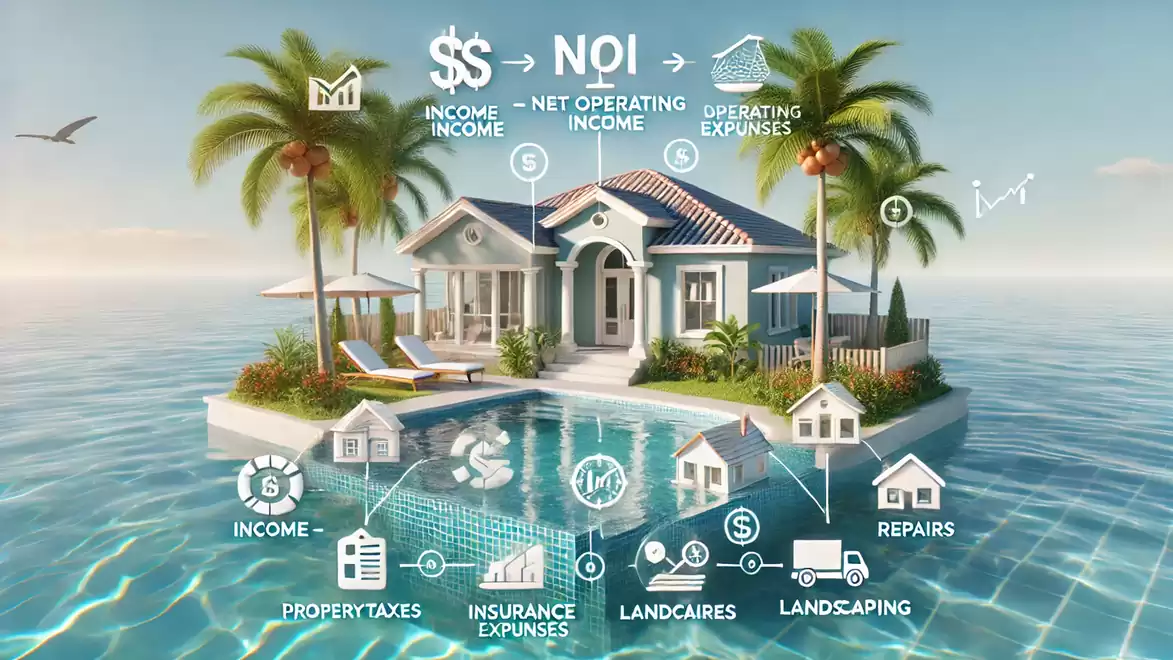
A tropical island with a luxurious house surrounded by water. Infographics about net income and operating expenses surround the scene.
AI generated

Net Operating Income (NOI) – Rental property's net income before debt and taxes

What is Net Operating Income?

Net Operating Income (NOI) is a key metric in real estate investing used to determine a property's profitability before financing and taxes. It reflects the annual income generated by a property after deducting operating expenses but before mortgage payments or depreciation.

How is NOI calculated?

  • NOI = Gross Rental Income – Operating Expenses
  • Operating expenses include property tax, insurance, repairs, HOA fees, landscaping, and management
  • Excludes mortgage interest and depreciation

What is NOI used for?

  • Evaluating investment performance
  • Calculating Cap Rate (Capitalization Rate)
  • Comparing income properties
  • Loan underwriting and asset valuation

Florida-specific insights

  • Vacation rentals should use realistic occupancy projections
  • Recurring costs like pool service, lawn care, HOA dues, and property management can significantly affect NOI

? Tip: For Florida investors, NOI is a crucial number to assess profitability and make sound buying decisions—ensure the expense breakdown is transparent and complete.
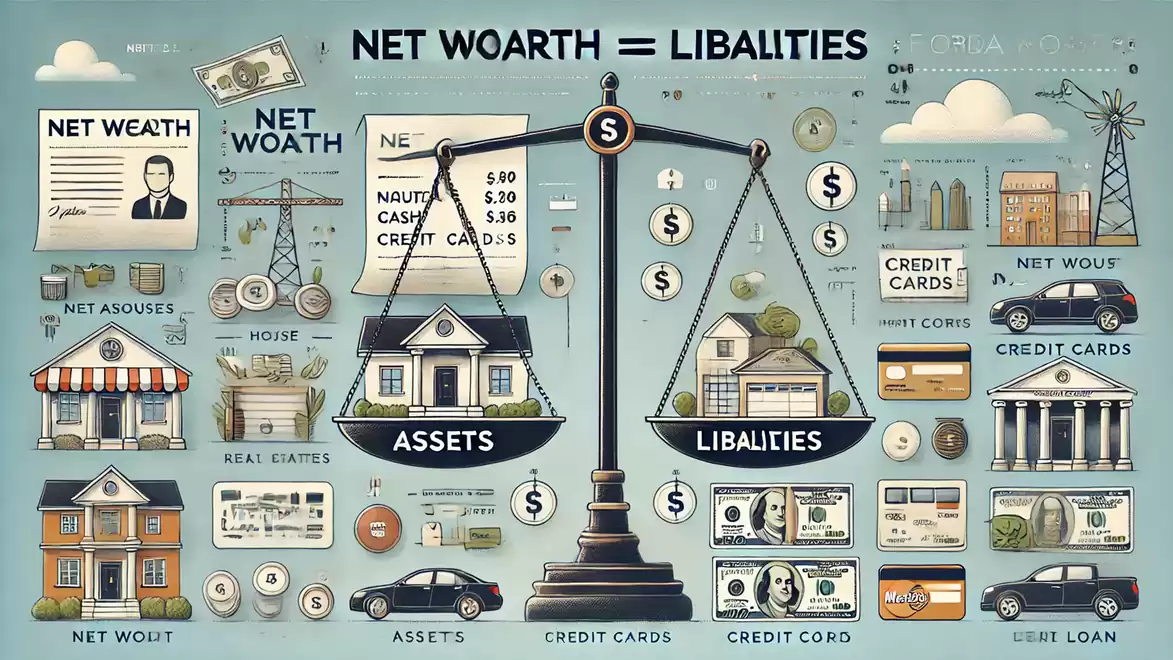
Illustration of a scale with assets on the left side and liabilities on the right side, representing net worth equality.
AI generated

Net Worth – Financial indicator for total assets minus liabilities

What is Net Worth?

Net Worth is the total value of an individual’s or entity’s assets minus all liabilitiesreal estate investing, mortgage approvals, tax planning, and wealth assessments.

Net Worth formula

  • Net Worth = Total Assets – Total Liabilities
  • Example: $1,200,000 assets – $500,000 debts = $700,000 net worth

Typical assets

  • Real estate holdings (based on market value)
  • Cash, stocks, investment accounts
  • Vehicles, valuables, business interests

Typical liabilities

  • Mortgages
  • Credit card debt
  • Auto loans, personal loans

Florida-specific insights

  • A strong net worth improves mortgage approval chances
  • Often required for investor visas, financing, or high-value transactions
  • Plays a role in asset protection and estate planning

? Tip: In Florida, keep your Net Worth statement up to date—it's essential for investment strategy, credit evaluation, and financial planning.

A young man in a suit with a notary document sits at a desk. In the background, another man is visible in an office.
AI generated

Notary Public – Officially commissioned officer for document authentication

What is a Notary Public?

A Notary Public is a state-authorized official who verifies the identity of signers, witnesses signatures, and helps prevent fraud in legal documents. Notaries are commonly required in real estate closings for deeds, affidavits, and loan documents.

Key responsibilities

  • Verifying identities of individuals signing documents
  • Witnessing and notarizing signatures
  • Administering oaths and affirmations
  • Maintaining impartiality and public trust

Florida-specific note

Florida allows Remote Online Notarization (RON), meaning documents can be notarized via secure video call—especially useful for international or out-of-state buyers.

? Tip: Ensure the notary is commissioned in the correct state and experienced with real estate transactions for a smooth closing process.

Close-up of a contract signing in an office setting with a model house, figurines, and various financial documents.
AI generated

Note – Legal promise to repay a real estate loan

What is a Note in real estate?

A Note—more specifically a Promissory Note—is a binding legal document in which the borrower agrees to repay a mortgage loan under agreed terms. It outlines the loan amount, interest rate, repayment schedule, and penalties.

Key components of a Note

  • Principal loan amount
  • Interest rate (fixed or adjustable)
  • Term and payment schedule
  • Payment method and frequency
  • Default terms and remedies

Difference: Note vs. Mortgage

  • The Note is the borrower's promise to repay
  • The Mortgage secures the loan with the property as collateral

Florida-specific notes

  • The Note is not recorded publicly but remains legally enforceable
  • It is a required component of all mortgage loan packages in Florida
  • If the borrower defaults, the Note serves as the basis for legal action such as foreclosure

? Tip: If you finance a property in Florida, review the Note carefully—it defines your personal liability and repayment terms.

A man looks worriedly at a violation notice while an inspector checks a house in the background.
AI generated

Notice of Violation – Official notice of code or zoning violation

What is a Notice of Violation?

A Notice of Violation (NOV) is a formal notice issued by a government authority (typically city or county) indicating that a property is not in compliance with applicable laws such as building codes, zoning regulations, or land use rules.

Common reasons for a Notice of Violation

  • Unauthorized construction or alterations without permits
  • Zoning violations such as operating a business in a residential area
  • Neglected maintenance or unsafe property conditions
  • Illegal short-term rentals without proper licensing

Consequences for property owners

  • Mandatory correction within a specified timeframe
  • Daily fines or penalties if not resolved
  • Potential lien placement on the property
  • Closing delays or legal complications if not cleared before sale

? Tip: In Florida, title companies often require a property to be free of open violations before closing. Always check with the local code enforcement office before listing or buying.

O

A businessman in a suit is talking to a woman in a modern living room. He is showing her an offer document.
AI generated

Offer – Formal purchase proposal in a real estate transaction

What is an Offer?

An Offer is a formal proposal made by a buyer to purchase a property under specific terms. It includes the price, contingencies, closing date, and other conditions and becomes the basis for negotiation or contract formation.

What does an Offer include?

  • Proposed purchase price
  • Method of payment (cash or financed)
  • Deadlines for acceptance, inspections, and closing
  • Contingencies such as financing, appraisal, or home inspection

What happens after submission?

  • The seller may accept, reject, or issue a counter offer
  • Upon acceptance, a Purchase and Sale Agreement is signed
  • An Earnest Money Deposit is typically required

? Tip: In Florida, having your Offer prepared by a licensed Realtor can protect your interests and improve your chances in competitive markets.
A modern two-story house with multiple open house signs. A group of people approaches the entrance.
AI generated

Open House – Public showing event for a property listed for sale

What is an Open House?

An Open House is a scheduled public viewing of a property on the market. Prospective buyers can tour the home without an appointment, ask questions, and speak directly with the listing agent or seller.

Benefits and objectives

  • Increases exposure and buyer interest
  • Showcases the home in its best condition
  • Enables face-to-face interaction with interested parties
  • Helps gather immediate feedback from the market

Tips for sellers

  • Ensure the home is clean, bright, and decluttered
  • Provide flyers or property information sheets
  • Have a professional realtor host the event and manage visitor flow

? Tip: In Florida, Open Houses attract spontaneous walk-in traffic—especially seasonal residents. Promote them online (e.g., via Zillow or social media) to maximize visibility.

Illustration of a house with worker, ladders, and landscaping, surrounded by palm trees and property management vehicles.
AI generated

Operating Expense – Recurring costs for maintaining income properties

What are Operating Expenses?

Operating Expenses are ongoing costs necessary to keep a property functional, compliant, and rentable. These expenses are incurred regardless of whether the unit is currently occupied.

Common types of operating expenses

  • Property taxes
  • Insurance (hazard, flood, liability)
  • Maintenance and repairs
  • Lawn care, pool service, pest control
  • Property management fees
  • HOA dues (for condo or gated communities)
  • Utilities if paid by the owner (e.g. water, trash)

What is excluded from Operating Expenses?

  • Mortgage principal or interest payments
  • Capital expenditures (e.g. new roof, HVAC system)
  • Depreciation for accounting purposes

Florida-specific insights

  • Vacation homes tend to have higher operating expenses due to pools, landscaping, and year-round climate control
  • Accurate expense tracking is essential for cash flow and cap rate analysis

? Tip: In Florida, make sure to track and manage your Operating Expenses closely—this directly impacts your profitability, taxes, and long-term property value.
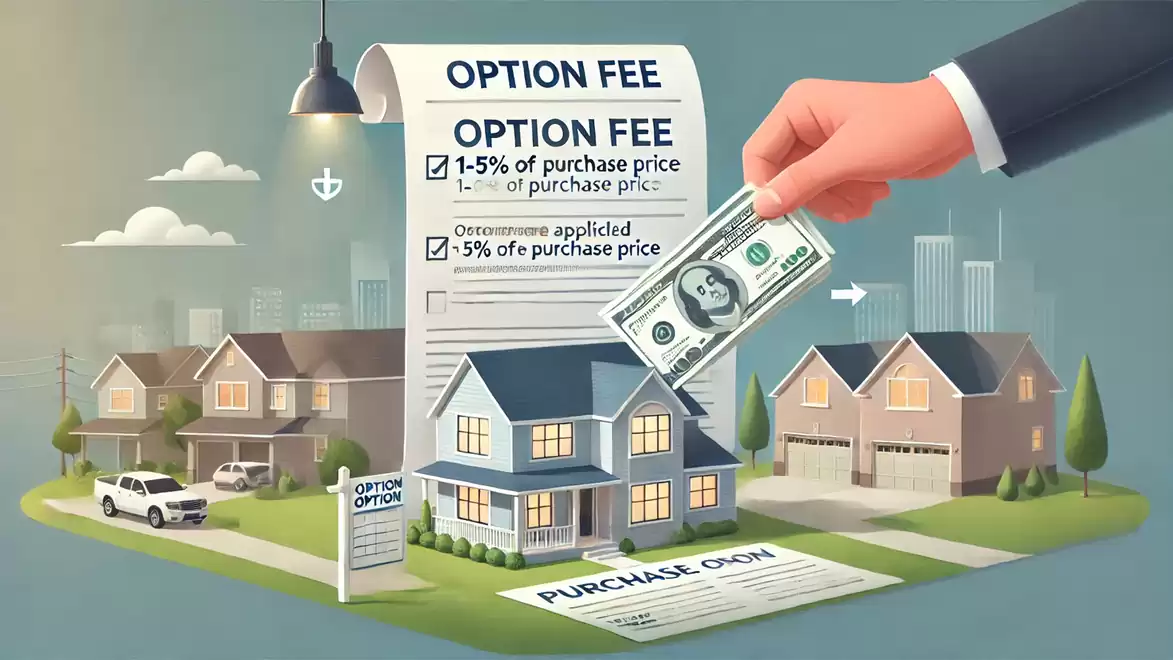
Illustration of a housing block with a purchase option contract and a hand handing over money.
AI generated

Option Fee – Non-refundable payment for exclusive purchase right

What is an Option Fee?

An Option Fee is a non-refundable payment made by a potential buyer to secure the exclusive right to purchase a property within a specified time period, often in a Purchase Option or Rent-to-Own agreement.

Key characteristics of an Option Fee

  • Paid upfront when the option agreement begins
  • Typically 1–5% of the property price
  • Non-refundable, even if the buyer doesn’t exercise the option
  • Often credited toward the purchase price if the sale occurs

Why is it required?

The fee compensates the seller for taking the property off the market and granting exclusive buying rights. It shows the buyer’s serious intent and commitment.

? Tip: The Option Fee terms should be clearly detailed in writing—especially regarding expiration, application to purchase, and legal enforceability.

A desk with documents and a laptop displaying a mortgage origination fee. In the background, two people shake hands in front of a sunny window with palm trees.
AI generated

Origination Fee – One-time fee for processing a mortgage loan

What is an Origination Fee?

An Origination Fee is a one-time charge paid by the borrower to a lender or mortgage broker for the setup and processing of a home loan. It is usually calculated as a percentage of the total loan amount and is paid at closing.

Typical origination fee range

  • Usually 0.5% to 1% of the loan amount
  • Example: $300,000 loan → 1% = $3,000
  • Itemized under Closing Costs

What does it cover?

  • Loan underwriting and risk assessment
  • Document preparation
  • Communication and coordination between parties

Florida-specific notes

  • Origination Fees may be higher for foreign buyers or complex transactions
  • Always review in the Loan Estimate and Closing Disclosure
  • Fees can sometimes be negotiated based on borrower profile

? Tip: In Florida real estate transactions, carefully review your Origination Fee—it directly affects your total loan costs. Get multiple quotes if possible.

A modern office with several people working at desks in front of large screens. There are various infographics about real estate and finances on a wall.
AI generated

Overhead – Indirect costs in real estate operations and construction

What is Overhead?

Overhead refers to general business expenses that are not directly tied to a specific property, project, or service. These are necessary operational costs that support real estate businesses, construction firms, and property managers.

Typical overhead costs in real estate

  • Administrative expenses: Office rent, staff salaries, accounting software
  • Insurance: Liability, property, errors and omissions
  • Marketing and sales: Listings, advertising, website management
  • General utilities and supplies: Electricity, phone, internet, office supplies

Overhead in construction

  • Includes project management, supervision, and support staff
  • Often calculated as a percentage of total construction cost
  • Essential for accurate project budgeting by developers and contractors

Florida-specific notes

  • In Florida, overhead is especially relevant for vacation rental operators, flippers, and builders
  • Clear disclosure of overhead builds trust with clients and investors

? Tip: When investing or managing real estate in Florida, include realistic overhead calculations and look out for hidden fees in proposals or budgets.

P

Two businessmen discussing a real estate contract in a modern office. On the table are stacks of money and a payoff letter, with a luxurious house in the background.
AI generated

Pay-off Letter – Official loan payoff statement from the lender

What is a Pay-off Letter?

A Pay-off Letter is a formal document issued by a lender that states the exact amount required to fully satisfy a loan balance as of a specific date. It includes principal, interest, fees, and payment instructions, and is critical in real estate closings or refinancing transactions.

What does it include?

  • Total payoff amount including interest up to a specified date
  • Per diem interest calculation (daily interest)
  • Wire instructions or address for sending the final payment
  • Expiration date (usually valid for 7–14 days)

When is a Pay-off Letter needed?

  • During a home sale: To clear the mortgage at closing
  • During refinancing: To replace an existing loan
  • For early repayment: To calculate the final balance owed

? Tip: In Florida, the title company or closing attorney typically requests the pay-off letter directly. Make sure it is received in time to avoid delays during closing.

Modern commercial building for lease with large glass windows and stylish outdoor seating at sunset.
AI generated

Percentage Lease – Commercial lease with rent tied to sales revenue

What is a Percentage Lease?

A Percentage Lease is a commercial lease agreement in which the tenant pays a base rent plus a percentage of their gross sales. This leasing structure is common in retail businesses, restaurants, and shopping centers.

How it works

  • Base Rent: Fixed monthly amount (e.g., $2,000)
  • Percentage Rent: A portion of sales above a certain threshold (e.g., 5% over $50,000/month)
  • Aligns landlord and tenant interests—landlord benefits from tenant success

Benefits

  • Tenant: Lower fixed costs during slow periods
  • Landlord: Participates in upside when business grows

Florida-specific notes

  • Common in malls, restaurant leases, and high-traffic commercial zones
  • Leases often require monthly reporting and sales verification
  • Auditing rights and clear sales definitions are typically included

? Tip: In Florida, always review the terms of a Percentage Lease carefully—especially revenue definitions, reporting obligations, and thresholds. Legal review is highly recommended.

Businessman signing performance guarantee contract for construction project with model house, crane, and blueprints.
AI generated

Performance Guarantee and Cure – Contractual assurance with correction period

What is Performance Guarantee and Cure?

Performance Guarantee and Cure refers to a contract clause ensuring that agreed-upon obligations are properly fulfilled. If a party fails to perform, a defined Cure Period allows them to correct the breach before the contract is terminated or penalties apply.

Key elements of a performance guarantee

  • Commitment to timely and full performance of contract obligations
  • Guarantee backed by the contractor, builder, or a surety
  • Common in construction, development, and real estate contracts

What is a Cure Period?

  • A defined timeframe to fix breaches or deficiencies
  • Typically ranges from 7 to 30 days
  • If corrected within the period, the contract remains enforceable

Florida-specific insights

  • Widely used in construction agreements, lease contracts, and property sales
  • Helps avoid legal disputes and termination risks
  • Enforceability depends on clear language and reasonable deadlines

? Tip: In Florida, always ensure your contracts include a Performance Guarantee with a clear Cure Period—it safeguards your investment and promotes accountability and quality.

Person spraying pesticides on lawn for pest control at a house.
AI generated

Pest control and prevention are essential parts of property care in Florida, where the warm and humid climate promotes the presence of insects, rodents, and other pests that can pose health risks and cause property damage.

Common Pest Control Services

  • Routine inspections and monitoring
  • Indoor and outdoor treatments for ants, cockroaches, spiders, etc.
  • Termite control using specialized methods
  • Rodent prevention and trapping
  • Sealing of entry points

Prevention Is Key

Preventative strategies such as sealing, cleanliness, waste management, and moisture control are critical in avoiding infestations. For vacation homes that remain vacant between rentals, professional pest management is highly advisable.

Recommended Services

Many licensed pest control companies in Florida offer reliable service plans with documented results. In Cape Coral, HomewatchCapeCoral can help coordinate these services as part of their overall property management solutions, even if they don’t directly perform pest control.

Financial scene with business people discussing mortgages. A man holds a discount point sign, while banknotes and a calculator are on the table.
AI generated

Points – Upfront fees to reduce mortgage interest rates

What are Points?

Points (also called Mortgage Points or Discount Points) are optional fees paid upfront to a lender at closing in order to lower the mortgage interest rate. One point typically equals 1% of the total loan amount.

Types of Points

  • Discount Points: Lower the interest rate permanently
  • Origination Points: Cover lender’s processing fees – do not reduce interest

Example calculation

  • Loan amount: $300,000
  • 1 Discount Point = $3,000
  • One point might lower the rate by about 0.25%, depending on the lender

Florida-specific notes

  • Often used in temporary or permanent rate buydowns
  • Discount points may be tax deductible under certain conditions
  • Useful for buyers planning to hold the property long-term

? Tip: In Florida, buying Points can be a smart move for buyers who want lower monthly payments. Consult a mortgage advisor or tax professional to evaluate the long-term benefit.

A man cleans a pool using a skimmer. A van labeled 'Pool Care' is in the background, surrounded by pool cleaning tools.
AI generated

Pool care refers to the ongoing maintenance and servicing of private swimming pools, commonly found at vacation homes in Florida. The state's subtropical climate and frequent guest use make professional upkeep essential.

Key Pool Maintenance Tasks

  • Regular testing of pH and chlorine levels
  • Cleaning of the pool and filtration system
  • Servicing of pool equipment including pumps, heaters, and timers
  • Shock chlorination after heavy use
  • Preventing and treating algae growth

Importance for Rental Properties

For owners who offer short-term rentals, reliable pool care is a critical quality factor. It enhances guest satisfaction and helps protect the property from damage. Professional pool service providers typically visit on a weekly basis.

Florida Regulations

Florida enforces specific pool safety and sanitation regulations for vacation properties. Requirements include barriers such as fencing or screen enclosures and compliance with hygiene standards. Homeowners must ensure these rules are followed to avoid legal liability.

Recommended Provider in Cape Coral

A trusted local service provider is HomewatchCapeCoral. They offer complete pool maintenance for vacation homes in Cape Coral – including water testing, equipment checks, and regular cleaning.

Modern residential complex with futuristic graphics and financial data overlay.
Licensed by: Adobe

Potential Gross Income – Maximum possible income from a fully leased property

What is Potential Gross Income?

Potential Gross Income (PGI) represents the maximum annual rental income a property could generate under ideal conditions—meaning 100% occupancy and market-level rents with no concessions or vacancies.

What does PGI include?

  • Full rent revenue assuming no vacancies
  • Other income such as parking, vending machines, signage fees
  • Market rent levels, not actual in-place rents

Why is PGI important?

  • Used in property valuation and investment projections
  • Starting point for calculating Net Operating Income (NOI)
  • Helps assess the earning potential of underperforming assets

? Tip: PGI reflects a property's potential—not its reality. Smart investors compare PGI to actual income and expenses to evaluate performance and risk.

An office with three people in formal attire. One person is signing a power of attorney at a table with a model house and a plant. In the background, two other people are discussing documents.
AI generated

Power of Attorney – Legal authorization to act on someone’s behalf in real estate matters

What is a Power of Attorney?

A Power of Attorney (POA) is a legal document that grants one person (the agent or attorney-in-fact) the authority to act on behalf of another (the principal) in legal or financial matters. In real estate, it allows the agent to buy, sell, or sign documents if the principal is unavailable.

Types of POA in real estate

  • General POA: Broad authority including real estate and financial matters
  • Limited (or Special) POA: Narrow scope, often used for a single real estate transaction
  • Durable POA: Remains valid even if the principal becomes incapacitated

Florida-specific considerations

  • Must be notarized and witnessed, and sometimes recorded with the county
  • Real estate POAs often require precise language and clear intent
  • Title companies and banks may reject outdated or overly broad POAs

? Tip: If you're buying or selling property in Florida remotely, work with a real estate attorney to create a valid, transaction-specific POA that meets local legal requirements.

A contemplative man sits at a table with documents about prepayment penalties, calculators, and a modern home in the background.
AI generated

Prepayment Penalty – Fee for paying off a loan earlier than agreed

What is a Prepayment Penalty?

A Prepayment Penalty is a fee charged by lenders when a borrower pays off all or part of a loan ahead of schedule. It compensates the lender for lost interest income due to early repayment.

When does it apply?

  • Full loan payoff before the term ends
  • Large lump-sum payments beyond regular installments
  • Refinancing the loan with another lender

Common types in the U.S.

  • Hard Prepayment Penalty: Applies to both sale and refinance
  • Soft Prepayment Penalty: Applies only to refinancing, not to selling

? Tip: Not all loans in Florida include a prepayment penalty. Review your loan agreement carefully and try to negotiate removal—especially for long-term or investment loans.

Three people seated in a modern office with large windows and plants, discussing a loan payment plan. Money is on the table in the foreground.
AI generated

Principal & Interest – Core components of a mortgage payment

What is Principal & Interest?

Principal & Interest (P&I) refers to the two main portions of a monthly mortgage payment:

  • Principal: The part of the payment that reduces the original loan balance
  • Interest: The cost of borrowing, based on the remaining balance

How does repayment work?

  • Early payments consist mostly of interest
  • Over time, a larger portion goes toward principal
  • Applies to fixed-rate amortized loans

P&I vs. total monthly housing cost

  • P&I does not include taxes, insurance, or HOA dues
  • Total payment = PITI: Principal, Interest, Taxes, Insurance

? Tip: In Florida, remember to include property taxes and insurance in your budget—especially in areas with higher flood or hurricane risk, where premiums may be significant.

Illustration of a probate court with a judge's chair, lawyers, documents, and scales of justice. Symbolic representation of a probate process.
AI generated

Probate – Court-supervised process for settling a deceased person’s estate

What is Probate?

Probate is the legal process through which a deceased person’s estate is administered by a court. It ensures that debts are paid and assets are distributed according to the will or state law if no will exists.

Common steps in Probate

  • Filing of the will with the probate court
  • Appointment of an executor or personal representative
  • Inventory and valuation of the estate
  • Payment of debts, taxes, and claims
  • Distribution of remaining assets to heirs or beneficiaries

Why does Probate matter in real estate?

Real estate that is not held in a trust typically must go through probate. This can cause delays, added costs, and legal complications, especially for international owners or multiple heirs.

? Tip: To avoid probate in Florida, consider a Revocable Living Trust or joint ownership with survivorship rights.

Beautiful single-family home with pool and palm trees, gardeners at work. Perfect summer day in a well-maintained neighborhood.
AI generated

Property Maintenance – Ongoing upkeep and care of real estate assets

What is Property Maintenance?

Property Maintenance refers to the ongoing upkeep, repairs, and servicing of a property to ensure it remains functional, safe, and valuable. In Florida, regular maintenance is especially critical due to humidity, heat, storms, and seasonal occupancy.

Typical property maintenance services

  • HVAC, plumbing, and electrical system checks
  • Cleaning and pest control
  • Landscaping and pool maintenance
  • Minor repairs (e.g. leaky faucets, damaged screens)
  • Storm preparation and post-storm inspections

Why property maintenance matters

  • Prevents costly long-term damage
  • Protects the property’s market value
  • Improves rental appeal and guest satisfaction

? Tip: Our team at Home Watch Cape Coral provides professional home maintenance services for seasonal owners, landlords, and investors in Cape Coral.

A businessman is sitting at a table signing documents with a pool and houses in the background. A woman stands nearby holding papers.
AI generated

Property Management Agreement – Contract for professional real estate administration

What is a Property Management Agreement?

A Property Management Agreement is a formal contract between a property owner and a management company. It outlines the scope of services, responsibilities, and fees for managing the property on the owner’s behalf.

Key components of a management agreement

  • Term of agreement and cancellation policies
  • Manager’s duties (e.g., tenant screening, rent collection, maintenance)
  • Compensation structure (management fee, reserves, reporting schedule)
  • Repair and emergency procedures including cost approvals
  • Permission to subcontract tasks (cleaning, repairs, landscaping)

Florida-specific insights

  • Property managers in Florida must hold a valid real estate broker license to manage rental agreements
  • Agreements often include short-term rental services such as vacation rental platforms
  • The contract should clearly specify reporting frequency and financial accountability

? Tip: Only sign a Property Management Agreement that outlines specific services, limits, and termination rights—ideally with transparent reporting and owner oversight.

Man working on laptop with property management graphics, modern house with pool and palm trees in the background.
AI generated

Property Management – Professional administration of real estate for income and upkeep

What is Property Management?

Property Management refers to the oversight and operation of real estate by a professional manager on behalf of the owner. The goal is to maximize income, ensure tenant satisfaction, and maintain or increase property value.

We at Home Watch Cape Coral specialize in property management services in Cape Coral, Florida, offering hands-on support and transparent service for owners and investors.

Key responsibilities of a Property Manager

  • Marketing and leasing of the property
  • Tenant communication and support
  • Maintenance coordination and vendor management
  • Accounting for income, expenses, and tax reporting
  • Emergency services and property inspections

Benefits of using a property manager

  • Time-saving for owners
  • Better occupancy rates and reviews in vacation rentals
  • Compliance with legal and tax obligations

? Tip: In Florida, working with local professionals like Home Watch Cape Coral ensures efficient property care and peace of mind for absentee owners and investors.
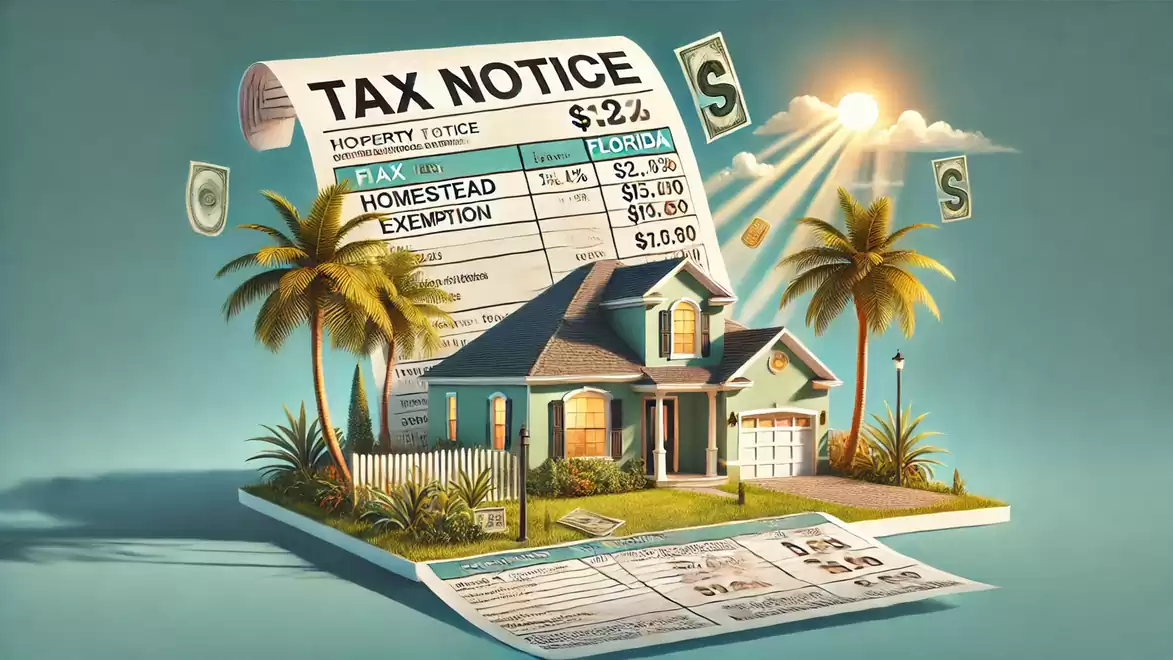
Illustration of a house with palm trees and a tax notice in the background. The tax notice refers to taxes in Florida.
AI generated

Property Tax – Annual real estate tax levied by local government

What is Property Tax?

Property Tax is an annual tax imposed on real estate by local counties or municipalities. The tax is based on the assessed (taxable) value of the property and a local millage rate.

How is Property Tax calculated?

  • Taxable Value: Assessed value minus any exemptions (e.g. Homestead Exemption)
  • Millage Rate: A percentage set by the county or city
  • Formula: Taxable Value × Millage Rate = Property Tax

Example – Florida

  • Typical Florida property tax rate: around 1% to 2% of market value
  • Annual billing, usually issued in November for the current year
  • Discounts apply if paid early (up to 4%)

? Tip: In Florida, review your annual TRIM Notice (mailed in late summer) to confirm the assessed value is accurate and check if you qualify for tax exemptions.
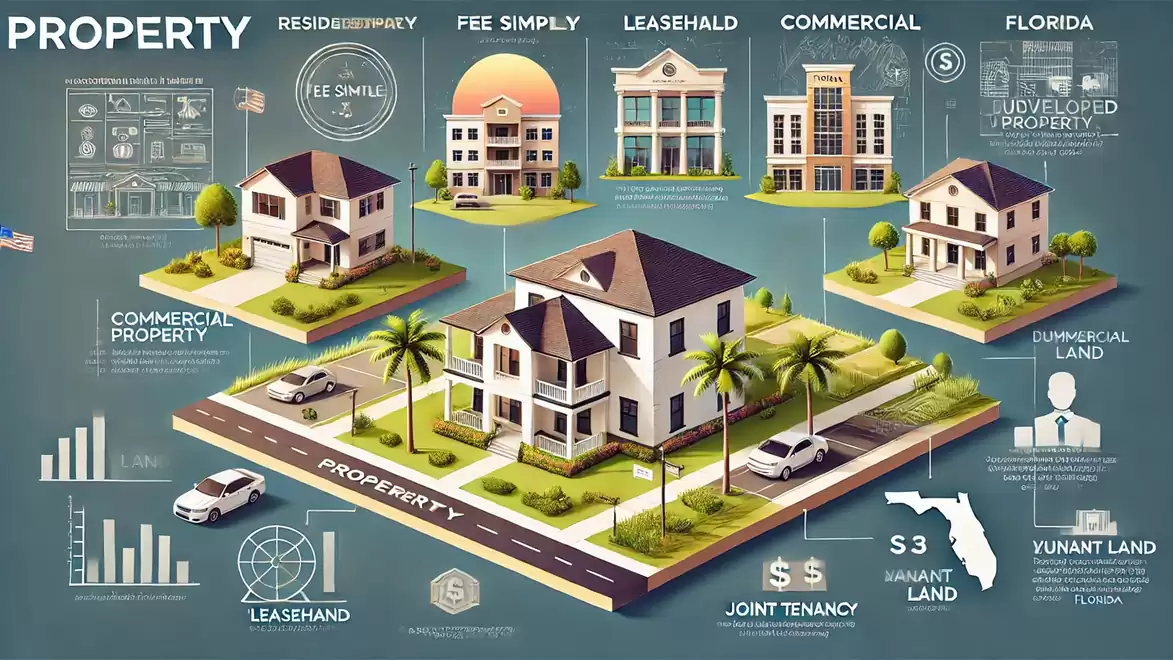
Graphic representation of property types with houses in different sections and information on homeownership, commercial properties, and land categories.
AI generated

Property – Legally recognized real estate asset

What does Property mean in real estate?

Property refers to a legally defined piece of real estate—land, buildings, or residential units—that is owned by an individual, entity, or trust. In the U.S., especially in Florida, the term includes residential, commercial, and undeveloped land.

Types of Property

  • Residential Property: Single-family homes, condos, townhouses, vacation rentals
  • Commercial Property: Offices, retail, warehouses, mixed-use buildings
  • Vacant Land: Undeveloped plots with potential for future construction
  • Rental Property: Income-producing real estate

Forms of ownership

  • Fee Simple: Full ownership with rights to transfer or inherit
  • Leasehold: Time-limited right to occupy or use land
  • Joint Tenancy / Tenants in Common: Shared ownership with varying rights

? Tip: In Florida, always verify the zoning, deed status, and restrictions (e.g. HOA rules, flood zones) before purchasing property. These factors impact value and usage rights.

Office setting with two men reviewing real estate documents; a laptop displays an image of a house.
AI generated

Prorations – Pro-rated distribution of property expenses at closing

What are Prorations?

Prorations are the pro-rated allocation of recurring property-related costs—such as property taxes, HOA dues, or rental income—between buyer and seller at the time of closing. This ensures that each party only pays for their period of ownership.

Common items subject to proration

  • Property taxes (based on calendar year)
  • HOA fees (monthly, quarterly, or annually)
  • Rents collected on income properties
  • Insurance premiums (if transferrable)

How are prorations calculated?

  • The closing date is typically the cutoff point
  • Each party is charged or credited based on daily ownership
  • Prorations are listed on the closing statement

? Tip: In Florida, prorations can affect the final settlement by hundreds or thousands of dollars. Always review the closing statement closely and ask questions if prorations seem off.

An office with a computer screen displaying public records. In the background, there are binders labeled 'TAX' and a large map on the wall.
AI generated

Public Records – Official and accessible documentation of property history

What are Public Records?

Public Records are official government documents that are accessible to the public. In real estate, they provide legal, financial, and historical information about a property and its ownership.

Typical contents of real estate public records

  • Deeds and ownership history
  • Mortgages and liens
  • Property tax assessments
  • Permits and construction history
  • Legal disputes and court actions

Purpose and importance

  • Transparency for buyers, investors, and lenders
  • Title searches before closing a transaction
  • Due diligence during acquisition or development
  • Verification of seller’s legal standing

Access to Public Records in Florida

  • Mandatory registration of all property transfers
  • Accessible via County Clerk websites and Property Appraiser databases
  • Florida is known for its strong public access laws

? Tip: Always check the Public Records before buying real estate in Florida to identify any outstanding liens, ownership issues, or unpaid taxes.

Modern two-story house with palm garden and purchase options on table.
AI generated

Purchase Option – Legal right to buy a property under fixed terms

What is a Purchase Option?

A Purchase Option is a legal agreement granting a buyer the exclusive right—but not the obligation—to purchase a property at a pre-agreed price within a defined time period. It is often used to secure a property without committing to an immediate purchase.

Key features of a Purchase Option

  • Fixed purchase price or pricing method
  • Defined option period for exercising the right
  • Non-refundable option fee paid by the buyer
  • No obligation to complete the purchase

When is a Purchase Option used?

  • Rent-to-own agreements with future purchase potential
  • Investment strategies to lock in land or deals
  • Partnerships with planned property acquisition terms

? Tip: Purchase Options are powerful tools to hedge against price increases and preserve flexibility. Always ensure all terms are clearly defined in writing.
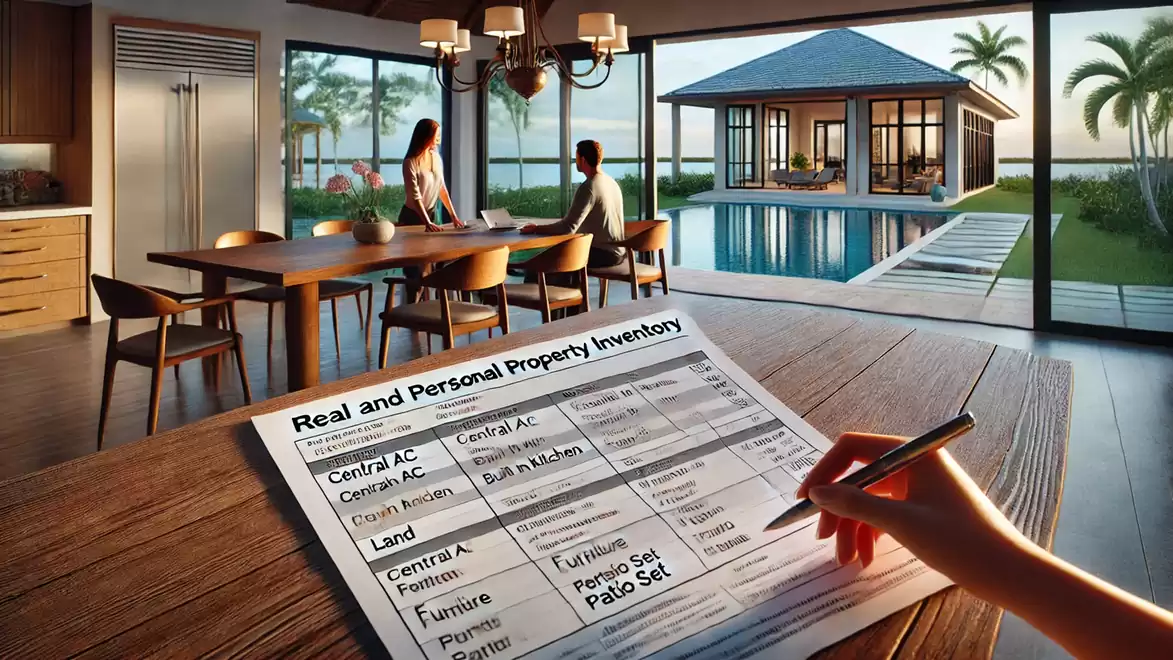
R

A person is writing on an inventory form at a table overlooking a modern kitchen and through a glass wall to a pool and pavilion outside.
AI generated

Real and Personal Property Inventory – List of included real estate and personal items

What is a Real and Personal Property Inventory?

A Real and Personal Property Inventory is a detailed list that specifies which items are included in a real estate sale. It distinguishes between real property (permanent fixtures and land) and personal property (movable items), and is commonly attached to purchase contracts in Florida.

Difference between Real and Personal Property

  • Real Property: Land, buildings, and fixed installations (e.g., HVAC, built-in appliances)
  • Personal Property: Movable items like furniture, electronics, artwork, patio furniture

Why this inventory matters

  • Prevents misunderstandings about what’s included in the sale
  • Essential for turnkey vacation homes sold fully furnished
  • Helps buyers assess value and insurance needs
  • Used to separate taxable assets when needed

Florida-specific notes

  • In Florida, it’s common to sell vacation rentals fully furnished—but furnishings must be itemized
  • Personal property is not recorded with the deed or public records

? Tip: When buying real estate in Florida, carefully review and sign the Real and Personal Property Inventory—anything not listed may be excluded from the transaction.

A real estate appraiser in a suit stands with a clipboard in front of a modern house with palm trees in the background. A car with the words 'Appraisal Services' is parked in the driveway.
AI generated

Real Estate Appraisal – Professional property valuation for market accuracy

What is a Real Estate Appraisal?

A Real Estate Appraisal is a professional assessment of a property's market value conducted by a state-licensed appraiser. In Florida, it is required in most real estate transactions, especially when obtaining a mortgage loan.

When is an appraisal required?

  • Mortgage financing: Lenders require appraisals to justify loan amounts
  • Property purchases and sales: To determine fair market value
  • Estate planning and taxation
  • Legal disputes and divorce settlements

Common appraisal methods

  • Sales Comparison Approach: Based on recent sales of similar homes
  • Cost Approach: Based on replacement cost minus depreciation
  • Income Approach: Used for rental properties, based on net income (Cap Rate)

Florida-specific insights

  • Only licensed appraisers may perform appraisals in compliance with USPAP
  • If an appraisal comes in lower than the purchase price, financing may be denied or renegotiated
  • Buyers often include an appraisal contingency in their purchase offer

? Tip: In Florida real estate, a Real Estate Appraisal ensures you’re paying a fair price and gives lenders the confidence to approve funding.

A group of people in a modern office space discussing real estate projects. A screen shows plans and images of properties. A confident woman stands in the foreground.
AI generated

Real Estate Broker – Licensed professional authorized to manage agents and transactions

What is a Real Estate Broker?

A Real Estate Broker is a state-licensed real estate expert who has completed advanced education and testing and is legally permitted to operate a real estate office and supervise agents. In Florida, this is the highest level of licensing in the real estate field.

Difference from Agent and Realtor

  • Broker: May run their own brokerage and employ agents
  • Agent: Works under the supervision of a broker
  • Realtor: Refers to NAR membership; can be a broker or agent

Key responsibilities of a Broker

  • Manage transactions for buying, selling, and leasing properties
  • Advise clients on pricing, offers, and legal issues
  • Train and oversee agents within their firm
  • Ensure compliance with laws and ethical standards

Florida-specific notes

  • Florida brokers must complete advanced coursework and pass a state exam
  • A Broker Associate holds a broker’s license but works under another broker
  • Many brokers are also Realtors, but it is not required

? Tip: In Florida, working with a Real Estate Broker ensures higher expertise and transaction oversight—especially valuable for investors and high-value property deals.

Illustration of a REIT concept with modern buildings, financial charts, and documents in focus.
AI generated

Real Estate Investment Trust (REIT) – Publicly traded real estate investment structure

What is a REIT?

A Real Estate Investment Trust (REIT) is a company that owns, operates, or finances income-producing real estate. REITs allow individual investors to gain exposure to real estate assets without directly owning property.

Key characteristics of REITs

  • Revenue from rent, leases, and property sales
  • Required to distribute 90% of income annually to shareholders
  • Governed by IRS tax code and regulations
  • Invest in residential complexes, offices, shopping centers, warehouses, healthcare facilities, and more

Types of REITs

  • Equity REITs: Own and operate rental properties
  • Mortgage REITs: Invest in real estate loans and mortgages
  • Hybrid REITs: Combine ownership and financing functions

Benefits for investors

  • Liquidity: Public REITs trade like stocks
  • Diversification: Broader portfolio exposure to real estate
  • Consistent income: Dividends from rental cash flow
  • No property management duties for the investor

? Tip: A REIT is a smart way to invest in real estate passively, especially in the U.S. market where REITs are highly regulated and widely accessible.

A classroom with several people sitting at computers while a woman in the foreground holds a Florida Real Estate License certificate.
AI generated

Real Estate License – State-issued authorization to conduct property transactions

What is a Real Estate License?

A Real Estate License is an official credential issued by a U.S. state that grants permission to buy, sell, rent, or manage real estate on behalf of others for compensation. It is a legal requirement for anyone working professionally in real estate sales or brokerage.

Florida license requirements

  • At least 18 years old and a high school diploma or equivalent
  • 72-hour pre-license course (for Sales Associate)
  • Pass the state exam administered by the Florida Real Estate Commission (FREC)
  • Background check and fingerprinting

Types of licenses

  • Sales Associate: Entry-level license under supervision of a licensed broker
  • Broker: Allows independent operation and managing a real estate office

Why it matters

  • Required to earn commissions on real estate transactions
  • Protects the public through regulation and education
  • Issued by each state – not valid nationwide

? Tip: In Florida, always verify that your real estate agent holds an active license through the Florida Department of Business & Professional Regulation (DBPR).

Luxurious residential area with Mediterranean villas, palm trees, and a swimming pool at sunset.
AI generated

Real Estate – Land and property including structures and rights

What is Real Estate?

Real Estate refers to immovable property consisting of land and anything permanently attached to it—such as buildings, roads, or fixtures. In the U.S., it is a broad term that covers residential, commercial, industrial, and land properties.

Core components of real estate

  • Land: The base physical surface
  • Improvements: Permanent constructions and additions
  • Rights: Includes air, surface, and subsurface (mineral) rights, depending on local law

Main categories of real estate

  • Residential: Single-family homes, condos, townhouses
  • Commercial: Offices, retail spaces, malls
  • Industrial: Warehouses, factories, logistics centers
  • Land: Raw land, farms, or undeveloped plots

Florida-specific insights

  • Florida is a highly active real estate market with strong growth
  • High interest in vacation homes, rentals, and new developments
  • International investors frequently purchase Florida properties

? Tip: If you're investing in real estate in Florida, review zoning, ownership rights, tax rules, and rental regulations—preferably with help from a local broker or attorney.

A stylish real estate office with a man and a woman sitting at a table with a realtor. A house presentation is visible on a wall-mounted screen.
AI generated

Realtor – Member of the National Association of REALTORS® with ethical standards

What is a Realtor?

A Realtor is a licensed real estate professional who is a member of the National Association of REALTORS® (NAR), the largest trade association in the United States. Not all real estate agents are Realtors, but most are.

Realtors are held to a higher ethical standard than standard licensees and must adhere to the NAR’s strict Code of Ethics.

Agent vs. Broker vs. Realtor

  • Realtor: Licensed agent or broker who is a member of the NAR
  • Real Estate Agent: Holds a state license to sell real estate but may not be a Realtor
  • Broker: Manages a real estate office and supervises agents; must complete extra coursework and meet licensing criteria

Florida-specific insights

  • Most serious professionals in Florida are NAR-affiliated Realtors
  • Realtors in Florida enjoy MLS access and stronger client trust due to ethical requirements

? Tip: When buying or selling in Florida, working with a Realtor ensures greater professionalism, accountability, and market expertise.

An office with stacks of documents, a miniature house labeled 'County Clerk', and a gavel. People are working in the background.
AI generated

Recording Fees – Official document filing charges during closing

What are Recording Fees?

Recording Fees are government-mandated charges for filing legal documents related to real estate transactions in the county’s public records. These fees are a standard component of the closing costs in Florida real estate deals.

Documents commonly recorded

  • Deed (transfer of ownership)
  • Mortgage documents
  • Satisfaction of Mortgage (proof of payoff)
  • Easements, liens, and encumbrances

Florida-specific insights

  • Recording Fees are calculated per page (typically $10–$15, depending on the county)
  • Documents are filed with the County Clerk’s Official Records
  • Fees are usually paid by the title company or closing agent on the buyer’s behalf

Who pays the Recording Fees?

  • Buyers: Typically responsible for recording the deed and mortgage
  • Refinancing: The borrower usually pays the recording fees

? Tip: Always factor Recording Fees into your closing cost budget in Florida—check the exact amount in your Loan Estimate or Closing Disclosure.

A man in a suit stands at a counter in a recording department, receiving a document from a staff member. The room is filled with filing cabinets and a sign indicates public recording in Florida.
AI generated

Recording – Public registration of real estate documents

What is Recording?

Recording is the official process of filing real estate documents—such as deeds, mortgages, or liens—with the County Clerk or Recorder's Office. It ensures that the transaction becomes part of the public record and that property ownership and encumbrances are legally documented.

Key aspects of recording

  • Must be notarized to be eligible for recording
  • Assigned a recording date and document number
  • Priority of claims depends on the order of recording
  • Protects legal ownership and informs third parties

Florida-specific notes

  • A property sale is only complete when the deed is recorded
  • Title companies or attorneys usually handle the recording process
  • Provides legal clarity and protects against fraud

? Tip: After closing, always obtain a recorded copy of your deed from the county or your title company—it’s your official proof of ownership in Florida.

A modern shopping center with palm trees, a central plaza, and stores like Macy's and Target.
AI generated

Regional Shopping Center – Large retail complex anchored by major tenants

What is a Regional Shopping Center?

A Regional Shopping Center is a large-scale retail property typically ranging from 300,000 to over 1,000,000 square feet, serving a regional customer base within a 10 to 30-mile radius. It is anchored by major national or regional tenants such as department stores or big-box retailers.

Key characteristics

  • 2–5 anchor tenants (e.g. Macy’s, Target, Best Buy)
  • Inline retail stores, food courts, and entertainment offerings
  • Extensive parking and highway access
  • Can be enclosed malls or open-air lifestyle centers

Relevance in real estate

  • Considered a core investment class in commercial real estate
  • Valuation depends on foot traffic, lease terms, and tenant mix
  • Requires specialized property and asset management

? Tip: In Florida, many Regional Shopping Centers have evolved into experience-driven lifestyle destinations. Demographic and market research are key before investing.

Symbolic image of a real estate contract with a model house, keys, and a release stamp. A hand is signing the contract.
AI generated

Release of Lien – Legal document removing a recorded claim on property

What is a Release of Lien?

A Release of Lien is a formal statement by a creditor (such as a bank, contractor, or government agency) that a debt or obligation has been satisfied and the related lien can be removed from public records. This is essential for ensuring a clear title when transferring or selling real estate.

Common types of liens

  • Mortgage Lien: From a home loan
  • Mechanic’s Lien: Filed by contractors or subcontractors
  • Tax Lien: Due to unpaid property or federal taxes

When is a Release of Lien required?

  • Before closing a property sale to provide clear title
  • After paying off a mortgage or loan in full
  • Once construction invoices are settled on a new build or remodel

? Tip: In Florida, the Release of Lien is usually handled by the title company or closing attorney. Sellers should confirm that all liens are properly cleared to avoid title issues or delays.
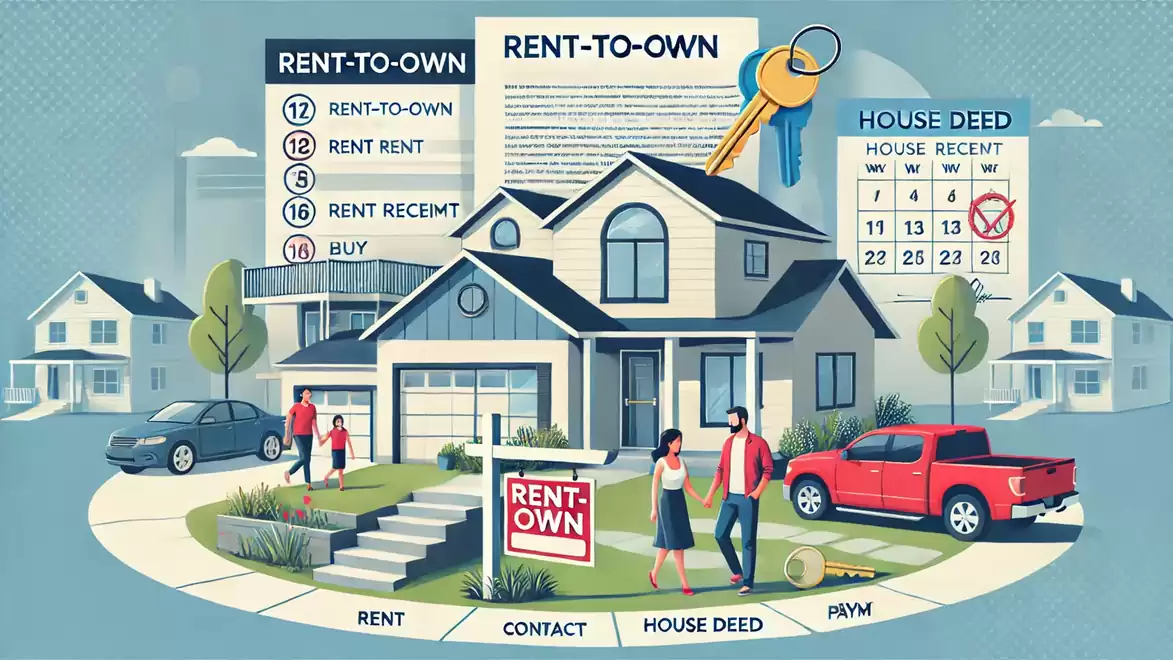
Illustration of a house depicting a rent-to-own model with people in the foreground and documents for contract signing.
AI generated

Rent-to-Own – Lease agreement with future purchase option

What is Rent-to-Own?

Rent-to-Own is a hybrid agreement where a tenant leases a property with the option or obligation to buy it later. A portion of the monthly rent may be credited toward the eventual purchase price.

Key features of a Rent-to-Own contract

  • Option to Purchase: Tenant secures the right to buy within a set period
  • Option Fee: Upfront fee (usually non-refundable) to hold the purchase right
  • Rent credits: Part of the rent goes toward the purchase price
  • Pre-agreed purchase price or pricing formula

Who is it for?

  • Buyers with low credit scores who need time to qualify for a mortgage
  • Newcomers or self-employed individuals with limited U.S. credit history
  • Investors who want to lock in a property before buying

? Tip: Rent-to-Own deals can be beneficial but require clear contractual terms. Always consult a real estate attorney before signing.

A home repair service in front of a suburban house with palm trees. Workers are on the roof, and tools and materials are visible in the foreground.
AI generated

Repairs – Maintenance and fix-related work on real estate

What are Repairs in real estate?

Repairs refer to actions taken to fix damage or restore function in a property. Unlike upgrades or improvements, repairs aim to return systems or structures to their original working condition.

Common types of repairs

  • Fixing leaks (roof, plumbing, pool)
  • Repairing HVAC systems or appliances
  • Replacing damaged windows, doors, or flooring
  • Mold or termite treatment

Responsibility and agreements

  • Lease agreements often specify who handles which repairs
  • “As-is” contracts in property sales mean the buyer accepts the current condition
  • Repair requests can be negotiated before closing

Florida-specific notes

  • Due to weather and humidity, regular inspections and maintenance are essential
  • Commonly handled by property managers or Homewatch services for vacation homes

? Tip: In Florida, early detection and timely repairs help avoid bigger issues. Schedule regular checkups—especially if the property is vacant for long periods.

A central residential building with a green roof and solar panels, surrounded by several two-story buildings with solar panels. Construction vehicles are visible in the area.
AI generated

Replacement Reserves – Budgeted funds for future repairs and capital improvements

What are Replacement Reserves?

Replacement Reserves are designated savings set aside by property owners or managers to cover major future repairs or replacements of building components. These reserves help maintain the property's value over time.

Typical uses of Replacement Reserves

  • Roof repairs or full replacement
  • HVAC system replacement
  • Elevator upgrades, windows, or exterior renovations
  • Interior improvements in rental units

Why are they important?

  • Protect long-term asset value
  • Avoid cash flow disruptions when large repairs are needed
  • Used in NOI adjustments and required by lenders or investors

? Tip: In Florida, sufficient replacement reserves are a critical factor in multifamily and condo underwriting—especially in aging buildings or HOA-governed communities.

Modern residential complex with elegant buildings, palm trees, and a security gate.
AI generated

Restrictive Covenants – Binding rules limiting property use or development

What are Restrictive Covenants?

Restrictive Covenants are legal obligations and limitations written into a property's deed or HOA documents. They control how a property can or cannot be used and are common in planned communities, subdivisions, and condominiums.

Examples of Restrictive Covenants

  • Prohibition of short-term rentals (e.g. Airbnb)
  • Design restrictions on exterior changes or new construction
  • Pet or vehicle limits on the property
  • Restrictions on business use or structural modifications

Where are they typically enforced?

  • In HOA-regulated subdivisions or condo associations
  • In deed-restricted neighborhoods
  • On properties in master-planned communities

? Tip: In Florida, always review HOA bylaws and deed-restriction documents before purchasing. Restrictive Covenants can greatly affect property value, use, and rental potential.

Shopping center with palm trees and people shopping, modern retail store at a sunny street corner.
AI generated

Retail Business – Consumer-facing business in a commercial property

What is a Retail Business?

A Retail Business is a consumer-facing company that sells goods or services directly to the public, typically from a physical storefront located in a commercial property. Examples include clothing stores, restaurants, supermarkets, and specialty shops.

Typical requirements for retail spaces

  • High visibility and customer traffic
  • Adequate parking and accessible entryways
  • Flexible layout for sales and storage areas
  • Proper commercial zoning designation

Florida-specific notes

  • Prime locations near tourist areas and shopping hubs are in high demand
  • High need for retail space in food, fashion, and tourism sectors
  • Many retailers lease space in strip malls or plaza-style developments

? Tip: When starting or relocating a Retail Business in Florida, focus on location, traffic, and lease terms. Also verify zoning, permits, and buildout options before signing a lease.
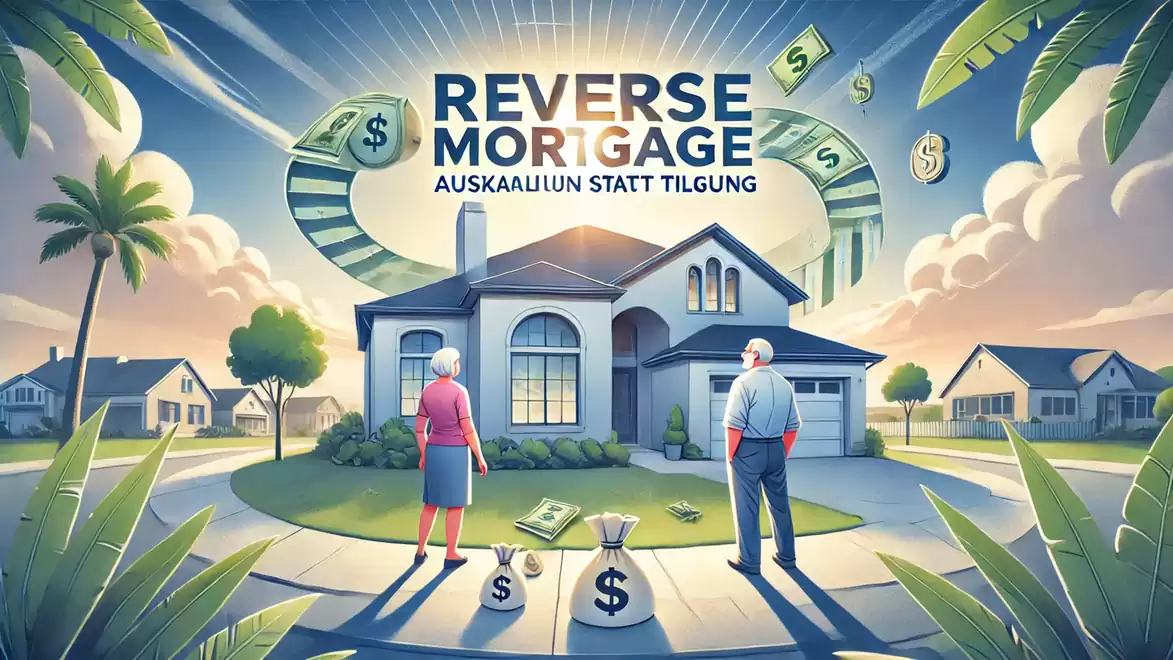
Illustration of an elderly couple in front of a house with the text 'Reverse Mortgage - Cash Out Instead of Paying Off'. Symbols for money and dollar signs are depicted around the house.
AI generated

Reverse Mortgage – Home equity loan that pays the owner instead of monthly payments

What is a Reverse Mortgage?

A Reverse Mortgage is a special type of home loan for seniors that allows them to convert part of their home equity into cash without having to make monthly mortgage payments. The loan is typically repaid when the borrower moves out, sells the home, or passes away.

The property serves as collateral. Unlike a traditional mortgage that is repaid over time, a reverse mortgage comes due only when the last borrower leaves the home or dies.

Eligibility requirements (e.g. under HECM)

  • Minimum age of 62 years
  • Primary residence must be owned
  • Sufficient home equity
  • Borrower must pay property taxes, insurance, and maintenance

Benefits

  • Supplemental income during retirement
  • No monthly mortgage payments required while living in the home
  • Flexible disbursement: lump sum, monthly payments, or credit line

Risks and drawbacks

  • Reduces inheritance for heirs
  • Loan becomes due upon moving out or death
  • Accumulated interest and fees can become substantial

? Tip: In Florida, reverse mortgages are common—counseling from a HUD-approved advisor is required to ensure borrowers understand all implications before signing.

S

Luxurious property with palm trees, swimming pool, and sailboat on a calm canal.
AI generated

Sailboat Access – Bridge-free boating access to the Gulf of America / Gulf of Mexico

What is Sailboat Access?

Sailboat Access refers to waterfront property with unrestricted boating access—meaning there are no fixed bridges between your dock and open water, such as the Gulf of America / Gulf of Mexico. This is ideal for sailboats or any vessel with a tall mast or superstructure.

Key features of Sailboat Access properties

  • No bridge height restrictions – suitable for sailboats and large yachts
  • Direct waterway access to rivers and the sea
  • Often found in premium neighborhoods like Cape Coral’s Yacht Club, Rose Garden, or Gold Coast areas

Benefits for owners and renters

  • Maximum boating freedom with no limitations
  • Higher property value and resale potential
  • Very attractive for vacation rentals with boating clientele

Florida-specific insights

  • Cape Coral is known for its extensive Sailboat Access canal network
  • Proximity to the Caloosahatchee River affects time to open water
  • Usually no locks or obstructions—just sail and go

? Tip: When buying a Sailboat Access home in Florida, consider canal depth, distance to the Gulf, and dock setup—they all affect boating usability and property value.
Illustration of office buildings for sale or lease, featuring real estate business symbols such as money, keys, and for sale signs.
AI generated

Sale-Leaseback – Real estate strategy: sell property and lease it back

What is a Sale-Leaseback?

A Sale-Leaseback is a real estate transaction in which the owner sells the property and simultaneously leases it back from the new owner. This strategy is commonly used to unlock capital while maintaining operational use of the asset.

Benefits for the seller

  • Immediate cash flow from the sale
  • Continued use of the property for business or residence
  • Balance sheet improvement and potential tax advantages

Benefits for the buyer

  • Instant rental income from a committed tenant
  • No vacancy risk upon purchase
  • Predictable return based on lease terms

Common applications

  • Commercial properties like retail stores, warehouses, or clinics
  • Private homeowners seeking liquidity while staying in their home

? Tip: In Florida, a sale-leaseback can be a smart alternative to refinancing—especially in a high-interest environment. Always have the lease terms reviewed by an attorney to ensure long-term viability.

Contract signing in front of a house with a document confirming mortgage satisfaction.
AI generated

Satisfaction of Mortgage – Legal proof that a mortgage has been fully paid off

What is a Satisfaction of Mortgage?

A Satisfaction of Mortgage is an official document issued by a lender to confirm that a mortgage has been fully paid in full. It is recorded with the local County Clerk or Recorder to remove the lien from public property records.

What the document includes

  • Borrower and lender names
  • Details of the original mortgage (date, amount, record info)
  • Statement confirming full satisfaction of debt
  • Notarization and legal filing requirements

Florida-specific notes

  • Lenders must file the Satisfaction within 60 days of the final payment
  • If not filed, the lien remains on title records despite being paid
  • Essential for resale, refinancing, or clean title verification

? Tip: In Florida, after your final mortgage payment, verify that the Satisfaction of Mortgage has been properly recorded. If it’s missing, your property may still show as encumbered.

A stylish, modern living room with open windows and a person looking into the kitchen. In the foreground, someone is signing a document.
AI generated

Security Deposit – Rental deposit to protect against damage and unpaid rent

What is a Security Deposit?

A Security Deposit is a sum of money paid by the tenant at the beginning of a lease to secure the landlord against potential losses such as property damage, unpaid rent, or contract violations.

What can it be used for?

The landlord may withhold part or all of the deposit to cover:

  • Damage beyond normal wear and tear
  • Unpaid rent or fees
  • Removal of tenant’s belongings or trash
  • Cleaning costs if not returned in acceptable condition

When is it refunded?

In Florida, landlords must refund the deposit within 15 to 30 days after move-out or send a written explanation of deductions. Tenants have the right to dispute unjustified charges.

? Tip: Take photos and request a walkthrough at move-out. A clear record helps avoid disagreements about the return of your deposit.
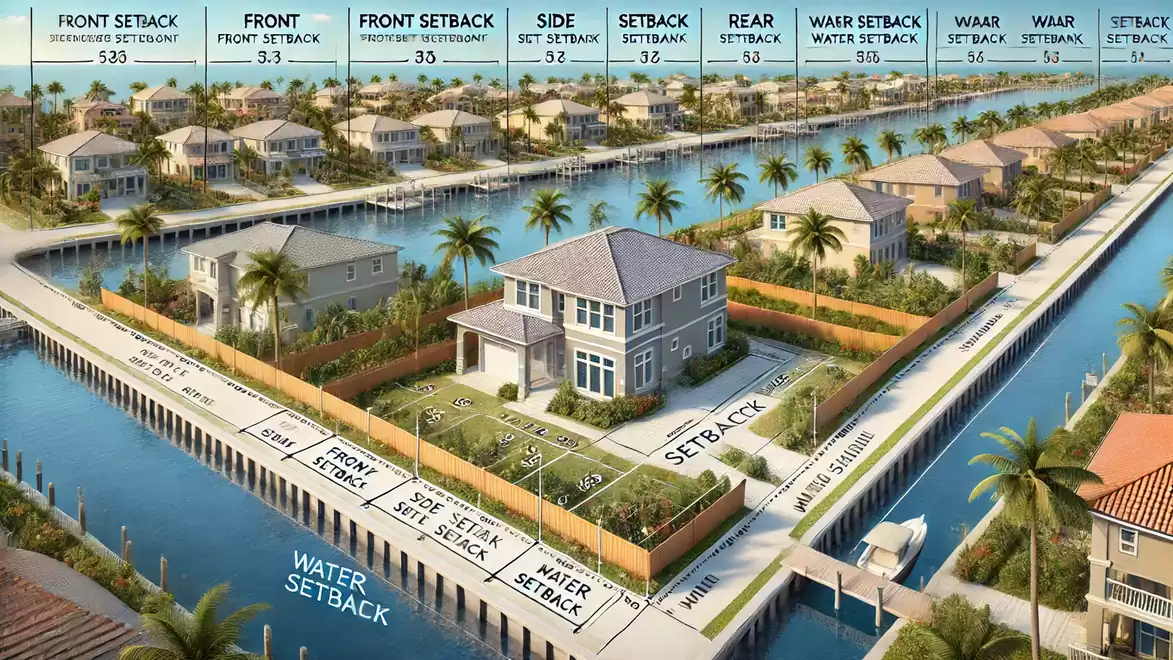
Aerial view of a modern residential area with water canals, palm trees, and uniform houses. Emphasis on layout and setback areas.
AI generated

Setback Requirements – Legal building distance from property lines

What are Setback Requirements?

Setback Requirements are zoning regulations that determine the minimum distance a structure must be from the edges of a property. These rules help preserve light, privacy, safety, and neighborhood aesthetics, and vary by location and zoning code.

Common setback types include:

  • Front setback: distance from the street or sidewalk
  • Side setback: distance from neighboring lots
  • Rear setback: distance from the back of the property
  • Waterfront setback: applies to canal or coastal properties

Florida-specific notes

  • Setbacks vary by county, city, and zoning designation
  • Canal and waterfront lots often have stricter requirements
  • Setback rules may also apply to pools, screen enclosures, docks, and sheds

? Tip: Before building or buying land in Florida, always check Setback Requirements with the local building department or zoning office. Ignoring them can lead to denied permits, fines, or demolition orders.

A man and a woman stand in front of a single-family home with a foreclosure sale sign in a sunny suburban area.
AI generated

Short Sale – Property sold for less than the outstanding mortgage balance

What is a Short Sale?

A Short Sale occurs when a property is sold for less than the total mortgage debt, with the lender’s approval to accept the reduced amount in order to avoid foreclosure. It is essentially a negotiated debt forgiveness process between the borrower and the lender.

A short sale is usually pursued when foreclosure is the alternative. The seller attempts to sell the property below the mortgage value with lender approval. To initiate the process, a letter of hardship must be submitted, along with a qualified purchase offer.

Requirements for a short sale

  • The property’s market value is less than the mortgage balance
  • The owner is facing financial hardship
  • The lender formally consents to the sale

Pros and cons

  • Sellers: Less damage to credit than foreclosure
  • Buyers: Opportunity to buy below market value – but with delays
  • Lender: May still pursue deficiency or impose conditions

? Tip: In Florida, short sales are highly regulated and documentation-heavy. Always involve an experienced agent and legal advisor who specialize in distressed property transactions.

Luxury vacation home with pool, tropical plants, and modern furnishings.
AI generated

Short-Term Rental (STR) – Vacation rental property leased for brief stays

What is a Short-Term Rental?

A Short-Term Rental (STR) refers to the temporary rental of a furnished property for a period typically less than 30 days per guest stay. In Florida, STRs are common in tourist areas such as Cape Coral, Naples, Fort Myers, and Miami.

Common features of an STR

  • Furnished vacation home or condo
  • Booked online through Airbnb, VRBO, or Booking.com
  • Flexible rental terms, ranging from 3 nights to a few weeks

Florida-specific legal requirements

  • STRs require proper state and local licensing
  • Florida mandates a DBPR Vacation Rental License for many STRs
  • Owners must collect and remit Sales Tax and Tourist Development Tax
  • HOAs may impose restrictions or outright bans on STR activity

Benefits for property owners

  • Higher rental income potential than long-term leases
  • Personal use flexibility between bookings
  • Global visibility through vacation rental platforms

? Tip: If you're offering a property as a Short-Term Rental in Florida, be sure to comply with licensing, tax obligations, and HOA rules, and consider working with a professional management company.

3D rendering of a modern house with garden, pool, and patio. Surrounded by a wooden fence, with neighboring houses in the background.
AI generated

Side – Lateral boundary area of a property or building

What does Side mean in real estate?

In real estate, Side refers to the left or right boundary areas of a property. It’s commonly used in zoning and construction to describe side setbacks, which regulate how close a structure can be to the neighboring property lines.

Common uses of “Side”

  • Side Setback: required clearance between a building and the side property line
  • Side Yard: the outdoor space along the side of a house
  • Side Entrance: a secondary access point on the side of the structure

Florida-specific notes

  • Side setback requirements vary by zoning code and property type
  • Side areas are often used for access to AC units, trash storage, or landscaping
  • Side easements for utilities or drainage may apply in dense neighborhoods

? Tip: In Florida, always verify side setback distances and easements before construction or purchase—noncompliance can result in permit denial or costly corrections.
Aerial view of a modern, turquoise single-family home - Villa Orange Cove - with a palm garden.
Licensed by: Nagel

Single Family Home – Detached residential property for one household

What is a Single Family Home?

A Single Family Home is a standalone residential building designed to house one family or household unit. It is not connected to any other dwellings and usually includes a private yard and dedicated utility connections.

Key characteristics

  • Fully detached structure on its own parcel of land
  • Private driveway and garage
  • No shared walls with neighboring homes
  • Independent kitchen, bathrooms, and living areas

Florida-specific notes

  • Popular with families, retirees, and real estate investors
  • Often used as a primary home, vacation property, or rental investment
  • May be located in HOA communities with rules and fees

? Tip: In Florida, a Single Family Home offers privacy, flexibility, and high resale value—especially if it includes waterfront access or a screened pool area.
Aerial view of the Villa Amazing by the water with a well-kept garden and a wide view over the canal.
Licensed by: Nagel
Villa Boaters Dream with manicured garden, palm trees, and blue sky in the background.
Licensed by: Nagel
Beautiful single-family home Villa Camille with palm trees and a well-maintained garden in a sunny area.
Licensed by: Nagel
Large two-story Villa Golden Globe with a manicured garden and palm trees, aerial view of the facade and surrounding green area.
Licensed by: Nagel
Aerial view of the luxurious residential home Villa Rosegarden in a tropical setting with palm trees and water view.
Licensed by: Nagel
Luxurious outdoor area with illuminated pool and hot tub at sunset, surrounded by palm trees.
AI generated

Spa – Whirlpool or relaxation feature in residential properties

What does Spa mean in real estate?

In the real estate context—especially in Florida vacation homes—a Spa typically refers to a heated whirlpool or Jacuzzi, either integrated into the pool or as a standalone hot tub. Sometimes the term also includes indoor wellness features like saunas or steam rooms, but for most listings it means a built-in outdoor whirlpool.

Common Spa features in Florida homes

  • Heated and equipped with massage jets
  • Can be pool-attached or freestanding
  • Controlled separately from pool heating
  • Highly attractive for vacation guests and buyers

Florida-specific notes

  • Popular in vacation villas in Cape Coral, Fort Myers, and Naples
  • Often enclosed in a screened pool cage
  • Boosts rental value and is frequently highlighted in listings

? Tip: A Spa is a key selling and booking feature in Florida vacation rentals—especially in the cooler season. Choose systems with efficient heating and simple controls for the best guest experience.

The left side of the image shows a modern piping system in an unfinished building, while the right features a green garden with sprinklers in front of a large house.
AI generated

Sprinkler System – Fire suppression system or automated lawn irrigation

1. Fire Sprinkler System in Commercial Buildings

In commercial real estate such as offices, warehouses, or shopping centers, a Sprinkler System refers to an automated fire suppression system. It activates upon heat or smoke detection and releases water or foam to control or extinguish fires.

Key features

  • Required by code in many commercial buildings
  • Automatic activation via heat sensors or smoke detectors
  • Uses water or specialized fire retardants

? Tip: When buying or leasing commercial property in Florida, verify that the fire sprinkler system is code-compliant and properly maintained.

2. Lawn and Garden Irrigation System

In residential and vacation properties—especially in Florida—a Sprinkler System often refers to automated lawn irrigation. It ensures regular watering of grass, plants, and landscaping through preset programs.

Key features

  • Built-in irrigation heads in lawn and garden zones
  • Controlled via timer or smart controller
  • Fed by city water, well, or reclaimed water

? Tip: A properly working sprinkler system is a major asset for vacation rentals and second homes in Florida. Ensure regular maintenance and seasonal adjustments.
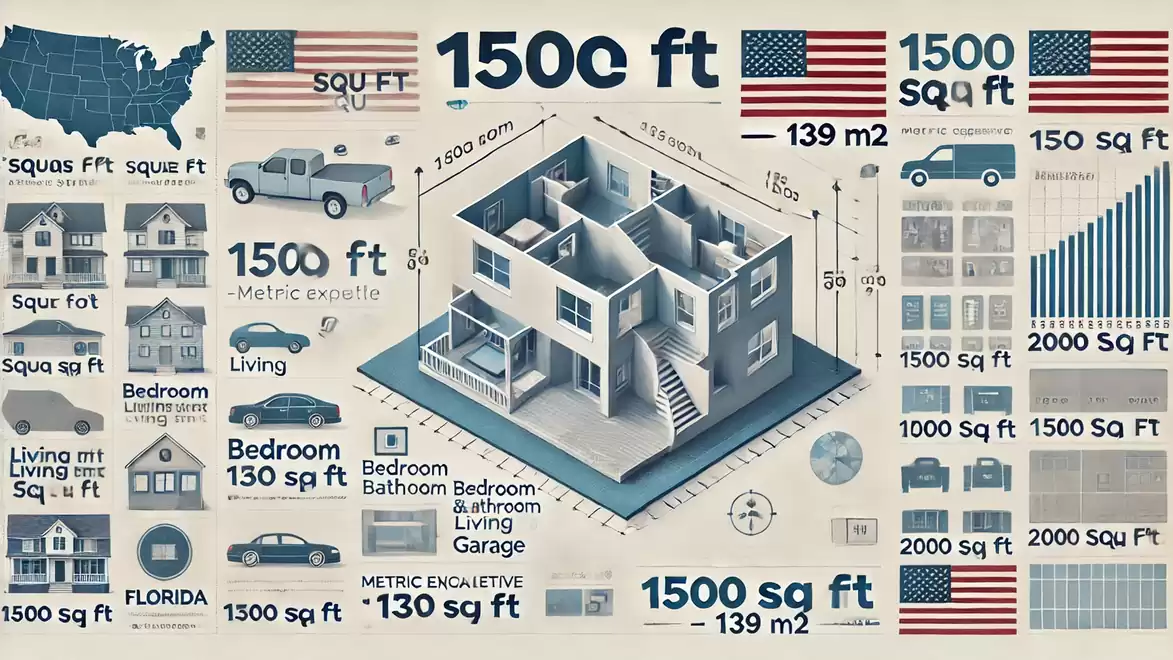
Infographic comparing American and metric area units with a 3D layout of a house and various equivalents.
AI generated

Square Foot – Standard unit of area measurement in U.S. real estate

What is a Square Foot?

A Square Foot (abbreviated as sq ft or ft²) is the primary unit used to measure area in real estate throughout the United States. It represents a square that is 12 inches by 12 inches, or approximately 0.093 square meters.

Common uses

  • Living area size in homes and condos
  • Total area including garage, patio, lanai (depending on listing)
  • Pricing metric: e.g., $300 per sq ft = cost per square foot

Conversions & references

  • 1 square foot ≈ 0.093 square meters
  • 1000 sq ft ≈ 93 m², 2500 sq ft ≈ 232 m²
  • Formula: sq ft × 0.092903 = m²

Florida-specific insights

  • Listings on MLS, Zillow, Realtor.com use square feet
  • Important distinction between Living Area and Total Area
  • Permit applications and plans must follow local measurement standards

? Tip: In Florida, always clarify what’s included in the square footage—some listings count screened lanais, garages, or exterior spaces, others don’t. Ask for a breakdown when buying or renting.

Two people reviewing architectural plans in a sunlit room with a view of palm trees. Plans and a laptop are on the table.
AI generated

Study Period – Due diligence timeframe in a real estate contract

What is a Study Period?

The Study Period is a designated timeframe in a real estate purchase agreement during which the buyer may inspect, research, and analyze the property. It is also referred to as the due diligence period. If concerns arise, the buyer can cancel the contract without penalty within this period.

What does it include?

  • Physical inspection (structure, systems, damage)
  • Review of documents (HOA rules, leases, permits)
  • Financial evaluation for income-producing properties
  • Title search and environmental issues

Florida-specific notes

  • Study Periods typically range from 7 to 30 days
  • Commercial or multi-family properties often require extended due diligence
  • If canceled during the Study Period, the earnest money is refunded

? Tip: In Florida, use the Study Period to conduct a thorough legal, technical, and financial review—preferably with help from a real estate agent, inspector, and attorney.

Aerial view of a modern residential neighborhood with palm-lined streets in a green landscape.
AI generated

Subdivision – Planned residential development or land division

What is a Subdivision?

A Subdivision is a planned residential area that consists of multiple individually platted lots. The term can also refer to the process of dividing a large parcel of land into smaller, legally defined lots for development.

Common features of a subdivision

  • Planned roads and utility access
  • Clearly marked individual lots
  • Often part of a Homeowners Association (HOA) with usage rules
  • Primarily residential use, sometimes mixed-use zoning

Florida-specific notes

  • New communities in Florida are frequently developed as subdivisions with modern homes
  • Cape Coral was originally planned as a massive canal-based subdivision
  • HOA-managed subdivisions may enforce rules on design, color, and property use

? Tip: Before buying in a Florida Subdivision, review HOA regulations, architectural restrictions, and fee schedules. A well-maintained subdivision can positively impact resale value and lifestyle.

A concerned couple sits in front of a house with signs indicating high-risk mortgages. Texts like 'High Risk Mortgage' and 'Subprime Mortgage' are visible.
AI generated

Subprime Mortgage – High-risk loan for borrowers with poor credit history

What is a Subprime Mortgage?

A Subprime Mortgage is a home loan issued to borrowers with low credit scores or limited credit history. These loans carry higher interest rates and less favorable terms due to the increased risk of default.

Common features

  • Higher interest rates than standard mortgages
  • Relaxed qualification standards for income and credit
  • Often adjustable-rate mortgages (ARMs) with potential for rate hikes
  • High loan-to-value ratios with minimal down payment

Risks and background

  • Subprime lending was a major factor in the 2008 housing market crash
  • Higher likelihood of foreclosure and payment difficulties
  • More tightly regulated today, but still used in specific lending programs

? Tip: In Florida, buyers with credit challenges should consider FHA or VA loans before accepting subprime offers. Work with a licensed mortgage advisor to explore safer alternatives.

A businessman signing documents in a modern office with a city view.
AI generated

Subscription Agreement – Legal contract to invest in real estate offerings

What is a Subscription Agreement?

A Subscription Agreement is a legally binding contract in which an investor agrees to purchase equity or ownership units in a real estate fund, syndication, or company. It outlines the terms of the investment and verifies the investor's eligibility and risk awareness.

Key components

  • Investment amount (subscription value)
  • Investor rights and obligations
  • Accredited investor status and risk disclosures
  • Details of the offering or fund
  • Legal acknowledgments and waivers

Use in Florida and U.S. real estate

  • Common in syndications, REITs, and private placements
  • Often paired with Operating Agreements or PPMs
  • Must comply with SEC and state securities laws

? Tip: Before signing a Subscription Agreement for a Florida real estate project, consult a qualified attorney and review all disclosures. This ensures compliance, transparency, and protection of your investment.

Contract paper titled 'Successors and Assists' next to a small model house and keys on a table.
AI generated

Successors and Assigns – Legal heirs and transferees bound by contract terms

What does "Successors and Assigns" mean?

Successors and Assigns is a standard legal phrase used in real estate contracts to indicate that the rights and obligations of the original parties continue with any legal heirs (successors) or transferees (assigns). It ensures the agreement remains valid even if ownership or management changes.

Where is the clause used?

  • Real estate purchase agreements
  • Lease and rental contracts
  • Mortgage and loan agreements
  • HOA declarations and governing documents

Common contract language

  • "This agreement shall be binding upon and inure to the benefit of the parties hereto and their respective successors and assigns."

Why is this important?

  • Ensures contracts are binding beyond death or sale
  • Allows for inheritance or transfer without renegotiation
  • Protects investors, heirs, and legal entities involved

? Tip: In Florida, make sure "Successors and Assigns" is clearly stated in any real estate, HOA, or lease document—especially if you use a trust or LLC structure for ownership.

A surveyor in a safety vest uses a theodolite to measure a modern house with pool and palm trees in a luxurious waterfront area.
AI generated

Survey – Official property boundary and improvement map

What is a Survey?

A Survey is a professional land measurement report that outlines property boundaries, structures, easements, and encroachments. Prepared by a licensed surveyor, it plays a critical role in real estate transactions across the U.S., especially in Florida.

What does a Survey include?

  • Exact lot boundaries and dimensions
  • Location of buildings, fences, pools, driveways
  • Easements for utilities, access, or shared use
  • Encroachments onto or from neighboring properties

Why is a Survey important?

  • Prevents boundary disputes and legal issues
  • Required for clean title insurance in many closings
  • Essential for construction planning and permit approvals

? Tip: In Florida, most lenders and title companies require a recent survey (no older than 6 months)—especially for single-family homes with fences, pools, or water access.

T

Business people in a modern office discuss construction projects with high-rise buildings and cranes in the background. A document on the table is titled 'Take-Out Commitment'.
AI generated

Take-out Commitment – Binding promise to provide long-term financing

What is a Take-out Commitment?

A Take-out Commitment is a lender’s formal promise to replace a short-term loan (such as a construction or bridge loan) with a long-term mortgage once certain conditions are met—usually project completion or lease-up. It provides financial assurance to developers and interim lenders.

Common use cases

  • Real estate developments financed through construction loans
  • Fix-and-flip projects or new builds requiring exit financing
  • Demonstrates a clear repayment strategy for temporary loans

Benefits of a Take-out Commitment

  • Reduces financing risk for developers and investors
  • Establishes loan terms and rates in advance
  • Strengthens loan applications and financial projections

? Tip: In Florida real estate development, a written Take-out Commitment should be secured before construction begins to ensure a reliable transition to long-term financing and minimize lender risk.

Illustration of a tax lien on a house with documents and a lock, representing bureaucracy and taxation concept.
AI generated

Tax Lien – Legal claim against property due to unpaid taxes

What is a Tax Lien?

A Tax Lien is a government-issued claim placed on a property when the owner fails to pay due taxes—such as property taxes or income taxes. It gives the taxing authority a legal right to the property until the debt is resolved.

Consequences of a Tax Lien

  • Recorded in public records, affecting title and ownership status
  • Blocks sale or refinancing until resolved
  • Negatively impacts credit and legal standing

How can a Tax Lien be cleared?

  • Paying the full amount owed including penalties and interest
  • Negotiating a payment plan or partial settlement
  • Risk of foreclosure if unpaid over time

? Tip: Always perform a thorough title search before buying property in the U.S. to uncover any existing tax liens or encumbrances.
Illustration of a house with infographics on property tax and capital gains, surrounded by charts and symbols related to real estate taxation.
AI generated

Tax – Government-imposed charges related to real estate ownership and transactions

What does "Tax" mean in real estate?

Tax refers to mandatory financial charges levied by federal, state, or local governments on activities such as owning, renting, buying, or selling real estate. These taxes affect both residential and investment properties.

Key types of real estate-related taxes

  • Property Tax: Annual tax based on assessed value
  • Income Tax: On rental income and other earnings
  • Capital Gains Tax: On profit from selling a property
  • Transfer Tax: Charged when ownership changes hands

Tax strategies and benefits

  • Depreciation deductions lower taxable rental income
  • 1031 Exchange defers capital gains taxes through reinvestment
  • Exemptions for primary residence or long-term ownership

? Tip: In Florida, work with a real estate-savvy CPA to ensure you're optimizing deductions and complying with all relevant tax rules—especially for investment or vacation properties.

Illustration of a house with real estate tax documents and IRS forms, surrounded by financial graphs and people.
AI generated

Taxable Income – Income subject to tax after deductions and adjustments

What is Taxable Income?

Taxable Income is the portion of an individual’s or entity’s income that is subject to taxation after subtracting allowable deductions, credits, and exemptions. It is the base amount used by the IRS to calculate federal income tax liability.

In real estate context

  • Rental income minus operating expenses and management costs
  • Depreciation deductions on buildings and improvements
  • Mortgage interest as a deductible expense
  • Capital gains from property sales (fully or partially taxable)

Common deductions for real estate investors

  • Property management and legal fees
  • Insurance, property taxes, repairs, and utilities
  • Travel expenses related to property oversight (in qualified cases)

? Tip: In Florida, smart tax planning using depreciation strategies and accurate record-keeping can significantly reduce your taxable income. Always consult a U.S. real estate-savvy CPA.

A man is sitting at a desk with a laptop displaying the IRS form W-7. In the background, US flags are waving and a woman is standing with a clipboard.
AI generated

Taxpayer Identification Number (TIN) – Required U.S. tax number for individuals and entities

What is a TIN?

The Taxpayer Identification Number (TIN) is a unique ID issued by the IRS to identify individuals and businesses for U.S. tax purposes. It is required for filing tax returns, receiving rental income, or selling property in the United States—especially for foreign investors.

Types of TINs

  • SSN – Social Security Number (U.S. citizens and certain residents)
  • ITIN – Individual Taxpayer Identification Number (for non-residents without SSN)
  • EIN – Employer Identification Number (for companies, LLCs, trusts, etc.)

When is a TIN required?

  • To report rental income from U.S. property
  • When selling real estate (to avoid excess FIRPTA withholding)
  • For claiming tax refunds from the IRS
  • To submit IRS tax documents properly

Florida-specific notes for foreign investors

  • In Florida real estate transactions, a valid TIN is essential for tax compliance
  • The ITIN must be applied for via the IRS, often through a Certified Acceptance Agent

? Tip: If you’re a foreign investor in Florida, apply for the appropriate Taxpayer Identification Number early in the process—this avoids delays and ensures tax compliance when buying, renting, or selling.

Modern office with planning preparations, workstations, and workers under an open ceiling in a sunny room.
AI generated

Tenant Improvements – Custom build-outs in commercial rental properties

What are Tenant Improvements?

Tenant Improvements (TI) refer to custom modifications made to a commercial rental space by or for the tenant to fit their specific business needs. These improvements are typically negotiated as part of the lease agreement and occur before move-in or lease renewal.

Examples of common Tenant Improvements

  • Interior walls, flooring, and lighting
  • Bathrooms, kitchenettes, or reception areas
  • Technology wiring, alarm systems, and HVAC adjustments

Who pays for Tenant Improvements?

  • TI Allowance: Landlord provides a fixed contribution toward improvements
  • Build-to-Suit: Landlord customizes space based on tenant specs
  • Tenant-funded: Improvements paid entirely by the tenant

Florida-specific insights

  • TI terms should be clearly defined in the lease agreement
  • Lack of clarity can cause disputes at lease termination
  • TI often impact lease length, base rent, and renewal terms

? Tip: In Florida, always include detailed Tenant Improvement clauses in commercial leases, specifying budget, responsibilities, timelines, and restoration terms.

Young couple signing documents with a real estate agent in a modern living room with large windows.
AI generated

Tenant – Individual or entity leasing a residential or commercial property

What is a Tenant?

A Tenant is a person or legal entity that leases a property for residential or commercial use. The tenant gains the right to occupy and use the premises for a defined term, under the terms of a lease agreement, in exchange for rent.

Tenant responsibilities

  • Timely and full rent payments
  • Proper care of the rented property
  • Compliance with lease terms (e.g., pet policy, noise, subleasing)
  • Reporting damages or maintenance issues

Tenant rights

  • Use of the property as agreed in the lease
  • Protection against unlawful eviction
  • Right to safety, privacy, and habitability

Florida-specific notes

  • Landlord-tenant laws are state- and city-regulated
  • Short-term tenants often occupy vacation rentals
  • Long-term tenants should review lease term, renewal, and security deposit rules

? Tip: In Florida, tenants should carefully review all lease terms—especially for furnished rentals or HOA-managed properties. When in doubt, seek advice from a licensed agent or attorney.

A pest control worker inspects a garden with a flashlight, while a large insect is visible in the foreground. An inspection form reads 'Termite Inspection'.
AI generated

Termite Inspection Certification – Proof of pest-free condition for home closings

What is a Termite Inspection Certification?

The Termite Inspection Certification is an official document issued by a licensed pest control professional that verifies a property is free of active termite infestations or damage—or details any evidence found during inspection.

When is this required?

  • Often required by lenders, especially VA and FHA loans
  • Typically conducted prior to closing at buyer’s or seller’s request
  • Especially important in Florida due to the subtropical climate

What does the inspection cover?

  • Active or past termite activity in the home or structure
  • Moisture issues and wood damage
  • Signs of other wood-destroying organisms like carpenter ants

? Tip: In Florida, a current Termite Inspection Certification (also called WDO report) is highly recommended for older homes, wood-frame structures, or properties near ground level. Plan early to avoid delays at closing.

A man in work clothes inspects wood for termite damage in a house, holding a flashlight with documents on a table.
AI generated

Termite Inspection – Property check for termites and wood-destroying organisms

What is a Termite Inspection?

A Termite Inspection is a professional pest inspection performed by a licensed expert to detect active or past termite infestations and other wood-destroying organisms (WDOs). It is a standard precaution in many Florida real estate transactions.

When is it performed?

  • During the due diligence phase before closing
  • Especially important for older homes or wood-framed structures
  • If there are signs of moisture, damage, or pest activity

What does it include?

  • Inspection for termites, carpenter ants, and beetles
  • Signs of wood damage, tunnels, frass, or mud tubes
  • Moisture-prone areas like basements or crawl spaces

WDO Report (Inspection Result)

  • The final result is a WDO Report (Wood Destroying Organism Report)
  • Often required by lenders and insurance companies

? Tip: In Florida, a termite inspection is strongly recommended, especially for homes with wood construction or tropical landscaping. It helps protect your investment and avoid costly surprises.

A desk with a real estate contract, hourglasses, and an analog clock, highlighting urgency in business.
AI generated

Time is of the Essence – Binding clause requiring strict adherence to deadlines

What does "Time is of the Essence" mean?

Time is of the Essence is a contract clause commonly used in U.S. real estate agreements to emphasize that deadlines must be strictly followed. Missing a date—without a valid amendment—may result in a default or cancellation of the agreement.

Where it typically applies

  • Loan commitment deadlines
  • Inspection and document submission periods
  • Closing dates for transfer of ownership

Consequences of missing deadlines

  • Contract default without further notice
  • Loss of earnest money deposit
  • No automatic extension unless mutually agreed in writing

? Tip: In Florida real estate contracts, a "Time is of the Essence" clause means that every day matters. Ensure timely action and written documentation to protect your position.

A colorful illustration of a timeshare building with several people gathered around and two hands holding keys. Palm trees and the sea are visible in the background.
AI generated

Time Share – Shared vacation property use for specific time periods

What is a Time Share?

A Time Share is a legal arrangement where multiple parties share the right to use a vacation property during specific time slots each year. It typically does not grant full ownership but rather a usage right tied to a set schedule.

Common types of Time Shares

  • Fixed Week: Same week every year
  • Floating Week: Flexible within a specific season
  • Points-Based: Credits used to book properties within a resort network

Pros and cons

  • Pros: Affordable vacation access, predictable scheduling
  • Cons: Limited flexibility, difficult to resell, ongoing maintenance fees

Florida-specific insights

  • Florida is a major Time Share market with offerings in Orlando, Miami, and coastal areas
  • Strict consumer protection laws are in place
  • Buyers have a statutory right of rescission within a limited period

? Tip: If you're considering a Time Share in Florida, carefully review the contract, annual fees, and cancellation policies—and avoid signing anything under pressure while on vacation.

Office with several people discussing real estate documents. A large window shows palm trees and a house in the background.
AI generated

Title Company – Neutral party ensuring legal and secure real estate closings

What is a Title Company?

A Title Company is a third-party entity responsible for managing the legal and financial aspects of a real estate transaction. Its role is to ensure that the buyer receives a clear and marketable title to the property.

It is the entity responsible for transferring ownership at closing and for recording the deed and transaction in the public records.

Services provided by a Title Company

  • Title Search: Review of legal history to identify any encumbrances or title issues
  • Title Insurance: Coverage to protect against future title claims
  • Escrow Handling: Securely manages funds until closing is finalized
  • Closing Coordination: Oversees documentation and disbursements
  • Recording: Ensures the deed and other documents are officially recorded

Benefits for buyers and sellers

  • Legal protection and assurance of valid ownership transfer
  • Defense against hidden title defects
  • Simplified transaction process through centralized coordination

Special notes for Florida

  • Often responsible for complete real estate closings
  • Buyers often choose the Title Company depending on the county
  • Acts as a neutral party representing both sides fairly

? Tip: Choose a Title Company familiar with Florida laws and procedures that offers clear communication, transparency, and local experience – especially important for international buyers.

An illustration of a house with symbols of justice and financial documents like mortgages and insurance policies. A gavel and shield symbolize legal protection.
AI generated

Title Insurance – One-time policy protecting against title defects and claims

What is Title Insurance?

Title Insurance protects real estate buyers and lenders from financial loss due to defects in the property's title. It covers issues that may not be discovered during a standard title search, such as liens or ownership disputes.

What does it cover?

  • Unrecorded liens or unpaid taxes
  • Unknown heirs or inheritance disputes
  • Errors in public records or deeds
  • Forgery or fraud in the ownership history
  • Missing or invalid signatures in prior transfers

Types of Title Insurance

  • Owner’s Policy: Protects the buyer’s interest
  • Lender’s Policy: Protects the mortgage lender

? Tip: In Florida, Title Insurance is typically purchased at closing and offers long-term protection for a one-time fee. It is especially recommended for foreign buyers or resale properties.

A businessman holds a land certificate in an office. On the desk are documents related to title search and insurance, with a house visible in the background.
AI generated

Title of Land – Legal ownership record of real estate

What is Title of Land?

The Title of Land is the legal documentation of ownership for a property or parcel of land. It confirms who holds lawful ownership and whether there are any existing liens, easements, or claims. In Florida, title records are maintained in the county public records.

What a land title includes

  • Owner’s name (individual or entity)
  • Legal description of the property
  • References to mortgages, easements, or liens
  • Chain of title based on past deeds

Title protection and verification

  • Title Search: ensures the title is clear and marketable
  • Title Insurance: protects against hidden defects or ownership disputes
  • Required for purchases, loans, or land development

Florida-specific insights

  • Clear Title of Land is required for any real estate transaction
  • Usually handled by a Title Company or closing attorney
  • Vital for inheritance, trust transfers, or investment sales

? Tip: In Florida, always ensure the Title of Land is free and clear before closing—use a licensed title agent and obtain title insurance for full protection.

An office with a computer screen showing a title search. Various documents, binders, and a map of Florida are on the desk. A cozy office environment with warm lighting.
AI generated

Title Search – Review of ownership and liens before property transfer

What is a Title Search?

A Title Search is a detailed examination of public records to verify the legal ownership of a property and identify any liens, claims, or title defects before it changes hands in a real estate transaction.

What does the Title Search review?

  • Chain of title (historical ownership records)
  • Mortgages, tax liens, or court judgments
  • Easements or access rights
  • Unpaid HOA dues or assessments
  • Accuracy of the legal property description

Who performs the Title Search?

  • Title companies or real estate attorneys
  • Results are used to issue Title Insurance

Florida-specific insights

  • Conducted through the County Official Records system
  • A Preliminary Title Report is often generated before closing
  • Clean title is essential for closing and title insurance approval

? Tip: Always request a professional Title Search in Florida to ensure clear ownership, avoid legal disputes, and qualify for Title Insurance.

A real estate contract on a table with a model house, keys, and a magnifying glass; palm trees and the sea are visible in the background.
AI generated

Title – Legal ownership and rights to a property

What does "Title" mean in real estate?

Title refers to the legal right of ownership to real estate. Holding title means you are the recognized owner of the property. Title can be held individually, jointly, through a trust, or by a legal entity.

Key features of Title

  • Establishes the legal owner recorded in public records
  • Documented by a Title Deed
  • May include liens, easements, or encumbrances

Title vs. Possession

  • Title: Legal ownership rights
  • Possession: Physical occupancy or control

Importance in real estate transactions

  • Title is transferred during closing
  • Title search ensures there are no legal defects
  • Title insurance protects buyers and lenders

? Tip: In Florida, a clean title is essential to closing. Always work with a licensed title agent or real estate attorney to ensure full ownership rights and protection from future claims.
Modern townhouses on a sunny street with palm trees.
AI generated

Townhouse – Multi-level attached home with private ownership

What is a Townhouse?

A Townhouse is a multi-story home that shares one or more walls with adjacent units, but is individually owned. Unlike condos, townhouse owners hold title to both the structure and the land beneath it.

Key characteristics

  • 2–3 floors in a vertical layout
  • Shared walls with neighboring townhomes
  • Private entrance, garage, and often a yard or patio
  • Typically part of a HOA-managed community

Florida-specific notes

  • Common in urban and suburban developments
  • Regulated by a Homeowners Association (HOA)
  • HOAs often cover roof maintenance, landscaping, and master insurance

? Tip: Before buying a Townhouse in Florida, carefully review the HOA rules, fees, and responsibilities—especially what’s covered and what’s not in terms of maintenance and insurance.
Modern shopping center along a palm-lined street, featuring several shops and blue signs.
AI generated

Triple A (AAA) – Highest credit rating for tenants and investments

What does Triple A (AAA) mean?

Triple A or AAA is the highest credit rating given by major rating agencies like Moody’s, S&P, or Fitch. It indicates minimal risk of default and excellent financial stability. In real estate, it is commonly used to describe top-tier commercial tenants.

Use in real estate

  • AAA Tenant: financially strong corporations (e.g., Starbucks, CVS)
  • Preferred for Triple Net Leases (NNN)
  • Implies reliable rental income and low vacancy risk

Why it matters to investors

  • Higher valuation and resale potential for AAA-leased properties
  • Lower financing risk due to stable tenant income
  • Ideal for single-tenant or retail investment strategies

? Tip: Properties leased to AAA Tenants offer high stability and long-term income, making them attractive to investors seeking low-risk, passive cash flow.

Illustration of an office building highlighting various lease terms and financial concepts such as base rent, taxes, insurance, and maintenance.
AI generated

Triple Net Lease (NNN) – Tenant pays taxes, insurance, and maintenance

What is a Triple Net Lease?

A Triple Net Lease (also known as Net-Net-Net Lease or NNN Lease) is a commercial leasing structure where the tenant is responsible for property taxes, insurance, and maintenance in addition to base rent. It’s one of the most landlord-friendly lease types.

Tenant’s responsibilities in an NNN lease

  • Base Rent – fixed rental payment
  • Property Taxes
  • Insurance Premiums
  • Maintenance & Repairs – including roof, structure, systems

Benefits for landlords

  • Predictable income with reduced expense liability
  • Low management involvement
  • Attractive for passive investors with long-term leases

Benefits for tenants

  • Lower base rent compared to full-service leases
  • More operational control over property

Florida-specific insights

  • Common in retail plazas, medical buildings, QSRs, and warehouses
  • Florida’s tax environment and population growth make it ideal for NNN investments

? Tip: If investing in or leasing a Triple Net Lease property in Florida, carefully review all lease terms—your true return depends on what is and isn’t included.

A desk with a safe featuring a miniature house on top. Next to it are a scale, an hourglass, and other symbols representing trust and law.
AI generated

Trust – Legal structure for holding and transferring property

What is a Trust?

A Trust is a legal arrangement where one party (Grantor) transfers ownership of assets to a Trustee, who manages them on behalf of one or more Beneficiaries. Trusts are often used in estate planning and asset protection.

Common types of Trusts in real estate

  • Living Trust (Revocable): Allows flexibility and full control during the grantor’s lifetime
  • Irrevocable Trust: Offers stronger asset protection and tax benefits
  • Land Trust: Used to hold real estate while keeping ownership anonymous

Benefits of using a Trust

  • Avoids probate after the grantor’s death
  • Protects privacy in property ownership
  • Streamlines inheritance and asset transfer
  • Provides legal protection from creditors (with certain trust types)

? Tip: In Florida, a Living Trust is commonly used to avoid probate and simplify succession. It’s especially useful for individuals with multiple properties or international heirs.

A businessman holding a document stands in front of a modern house with trust symbols graphics in the background.
AI generated

Trustee – Legal representative managing real estate in a trust

What is a Trustee?

A Trustee is an individual or institution appointed to manage assets held in a trust. The trustee acts in the best interest of the beneficiaries and in accordance with the trust document. In real estate, a trustee often holds title to property and is responsible for its administration, maintenance, or sale.

Trustee responsibilities

  • Managing and preserving real estate assets
  • Holding legal title to properties in the trust's name
  • Transferring or selling properties per the trust’s terms
  • Acting with fiduciary duty toward the beneficiaries

Florida-specific insights

  • Trusts are commonly used in Florida for probate avoidance
  • A trustee may be a private person or a professional entity
  • Real estate sales from trusts typically require a Certificate of Trust

? Tip: In Florida, ensure that the trustee is properly authorized and recorded in all real estate documents—especially for smooth transactions or inheritance planning.

An older man and a younger businessman stand in front of a house, with the older man holding a document titled 'House Sale'. A scale is in the foreground, indicating fairness and balance in real estate transactions.
AI generated

Trustor – Person who creates and transfers assets into a trust

What is a Trustor?

A Trustor – also known as a Grantor or Settlor – is the individual who establishes a trust and transfers property or assets into it. The trustor sets the terms and structure of the trust, designates the trustee, and names the beneficiaries who will benefit from the trust.

Role of the Trustor in real estate

  • Transfers real estate (e.g., home, land) into the trust
  • Defines the trust’s purpose (e.g., estate planning, asset protection)
  • May act as trustee during their lifetime if the trust is revocable
  • Often the primary beneficiary while alive, in a Living Trust

Florida-specific notes

  • Trusts are widely used to avoid probate in Florida
  • Real estate must be formally deeded into the trust by the trustor
  • A Revocable Living Trust gives the trustor flexibility to amend the trust

? Tip: In Florida, a trustor must ensure that all property is properly titled in the trust’s name—this guarantees full protection and functionality of the trust.

U

An office with a man sitting at a desk surrounded by papers and documents, with a model house in the background. A person stands at a whiteboard with mortgage underwriting notes.
Licensed by: Adobe

Underwriting – Risk assessment process for real estate loans

What is Underwriting?

Underwriting is the process by which a lender evaluates a borrower's risk profile to decide whether to approve a real estate loan. It involves a thorough analysis of the applicant’s financial situation and the property itself to ensure the loan is secure and manageable.

Key components of the underwriting process

  • Credit score and credit history
  • Proof of income and assets (pay stubs, tax returns, bank statements)
  • Debt-to-income (DTI) ratio
  • Appraisal of the property to confirm market value

Florida-specific considerations

  • Underwriting is handled by the lender after mortgage application
  • A Loan Commitment is issued upon approval
  • Delays may occur if documentation is incomplete or inconsistencies are found

? Tip: For buyers in Florida, especially foreign nationals or self-employed individuals, successful underwriting depends on complete and clearly organized financial documents.

Aerial view of a vast landscape with sandy paths, trees, and open grass areas under a cloudy sky.
AI generated

Unimproved Land – Raw land without utilities or development

What is Unimproved Land?

Unimproved Land refers to property that has not been developed or prepared for construction. It typically lacks infrastructure such as water, electricity, and access roads, and is often considered raw or undeveloped land.

Common characteristics of Unimproved Land

  • No access to water or electricity
  • No sewer or septic system in place
  • Lack of paved roads or driveways
  • No grading, drainage, or site preparation
  • May not be subdivided or approved for building

Opportunities and risks

Unimproved land is generally more affordable but requires significant investment and planning to make it usable or profitable. It may be ideal for long-term investment or future development.

? Tip: In Florida, verify if the land can be legally developed and whether future assessments or improvement costs are expected before purchase.
Cartoon about usury in Florida featuring a scale, a house, and a shadowy figure with a percent sign on a document.
AI generated

Usury – Charging excessive or unlawful interest on a loan

What is Usury?

Usury refers to the practice of charging interest rates above the legal limit set by state law. It is considered predatory or unlawful lending and can carry civil or criminal penalties depending on the severity and jurisdiction.

Relevance in real estate lending

  • Applies to private loans, seller financing, and mortgage contracts
  • Legal limits on interest vary by state – in Florida typically 18–25%
  • Usurious contracts may be void or subject to repayment adjustment

Consequences of Usury

  • Lender may lose right to collect interest
  • Borrower may recover overpaid amounts
  • Possible criminal charges in willful violations

? Tip: In Florida real estate deals involving private lending or installment sales, always consult a real estate attorney to ensure the interest terms comply with state usury laws.
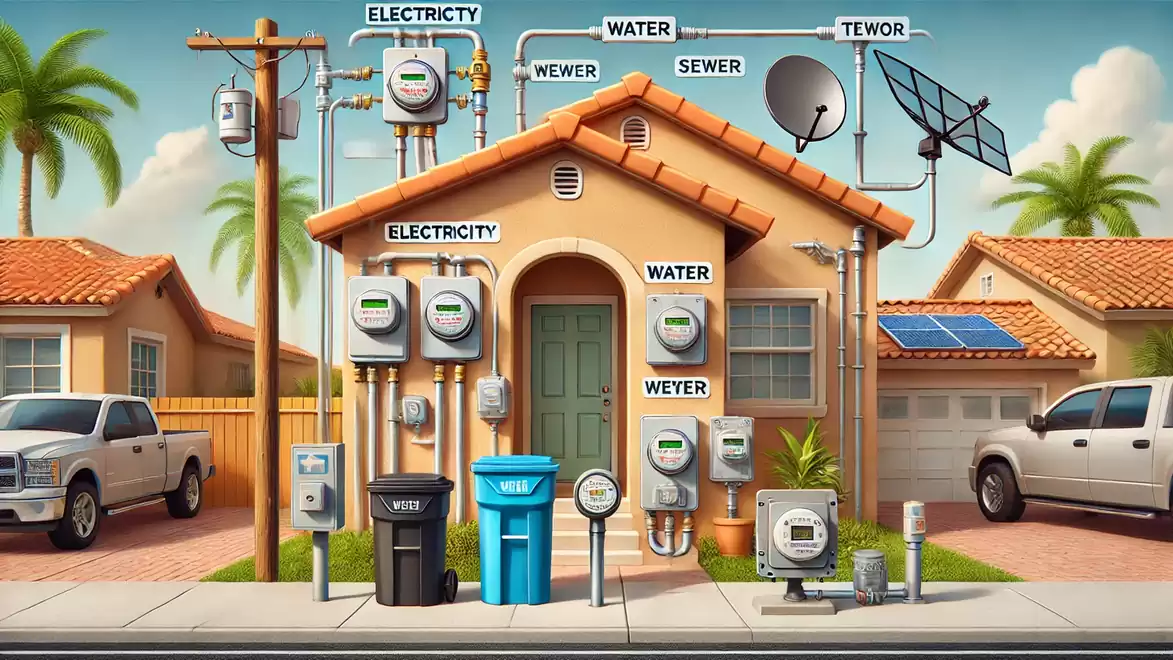
A house in a residential area with various energy and utility connections, such as electricity meters and solar panel, as well as satellite dish and trash bins in front of the door.
AI generated

Utilities – Ongoing property expenses for electricity, water, internet, and more

What are Utilities?

Utilities refer to all essential services that keep a property functional and livable. These include electricity, water, sewer, gas, trash collection, internet, cable TV, and phone service. Costs depend on location, provider, and usage.

Common utilities in Florida

  • Electricity: via providers like FPL or LCEC
  • Water & Sewer: usually managed by local city or county
  • Trash Collection: typically included in municipal services
  • Internet / TV / Phone: providers include Xfinity, CenturyLink, Blue Stream

Utilities in rental agreements

  • Long-term rentals: tenants usually pay utilities directly
  • Vacation rentals: utilities are typically included in rent
  • Always clarify utility responsibility in the lease contract

? Tip: In Florida, utilities can vary widely—factors like AC usage, pool heaters, and smart systems can significantly increase monthly costs. Plan ahead when buying or renting.

V

Illustration of a modern residential building with charts and graphs about vacancy rates on a clipboard.
AI generated

Vacancies and Collection Losses – Lost rental income due to vacancies and nonpayment

What does the term mean?

Vacancies and Collection Losses refer to lost rental revenue resulting from unoccupied units (vacancy) and tenants failing to pay rent (collection losses). This figure is crucial in investment property analysis and income projections.

Common causes

  • Tenant turnover, renovations, or weak demand
  • Delinquent or bankrupt tenants
  • Poor tenant screening or lease enforcement

Calculation and impact

  • Typically expressed as a percentage of potential gross income (e.g. 5%)
  • Directly reduces Net Operating Income (NOI)
  • Key factor in cash flow forecasts and property valuations

? Tip: In Florida rental markets—especially with vacation rentals or new developments—assume realistic Vacancy & Collection Loss rates. Good property management reduces risk and improves income stability.

A modern residential complex with several buildings and pools at sunset. A person holds a tablet displaying a vacancy ratio chart.
AI generated

Vacancy Ratio – Percentage of unoccupied rental units or space

What is the Vacancy Ratio?

The Vacancy Ratio measures the percentage of rental units or space that is currently unoccupied. It is a key performance indicator for property income potential and a useful metric for market analysis and investment decisions.

How it’s calculated

  • Vacancy Ratio = (Vacant space / Total rentable space) × 100
  • Or: (Number of vacant units / Total units) × 100

Why it matters to investors

  • High vacancy ratio: lower income, potential market saturation
  • Low vacancy ratio: indicates healthy demand and stable returns
  • Used in net operating income and cap rate calculations

Florida-specific insights

  • Vacation rentals are subject to seasonal fluctuations; average annual vacancy is more relevant
  • In popular markets like Cape Coral or Naples, well-managed properties often maintain vacancy rates below 10%

? Tip: In Florida real estate, make sure to analyze the Vacancy Ratio realistically—especially for short-term rentals. Rely on local expertise and comparable data for accuracy.

Modern residential buildings at dusk with rental signs on the facade.
AI generated

Vacancy – Period during which a rental unit is unoccupied

What does Vacancy mean in real estate?

Vacancy refers to a rental property or unit that is not currently occupied by a tenant. It is a key metric for landlords and investors when analyzing rental income, property performance, and market demand.

Types of vacancy

  • Physical vacancy: The unit is empty and not generating rental income
  • Economic vacancy: The unit is rented but not producing full income (e.g., due to concessions or non-payment)

Vacancy Rate

  • Essential KPI for property performance
  • Formula: Vacant units ÷ Total units
  • High vacancy rates indicate low demand or income risk

? Tip: In Florida, vacancy trends depend heavily on seasonality, location, and property type. Be sure to factor realistic vacancy assumptions into any rental property investment analysis.
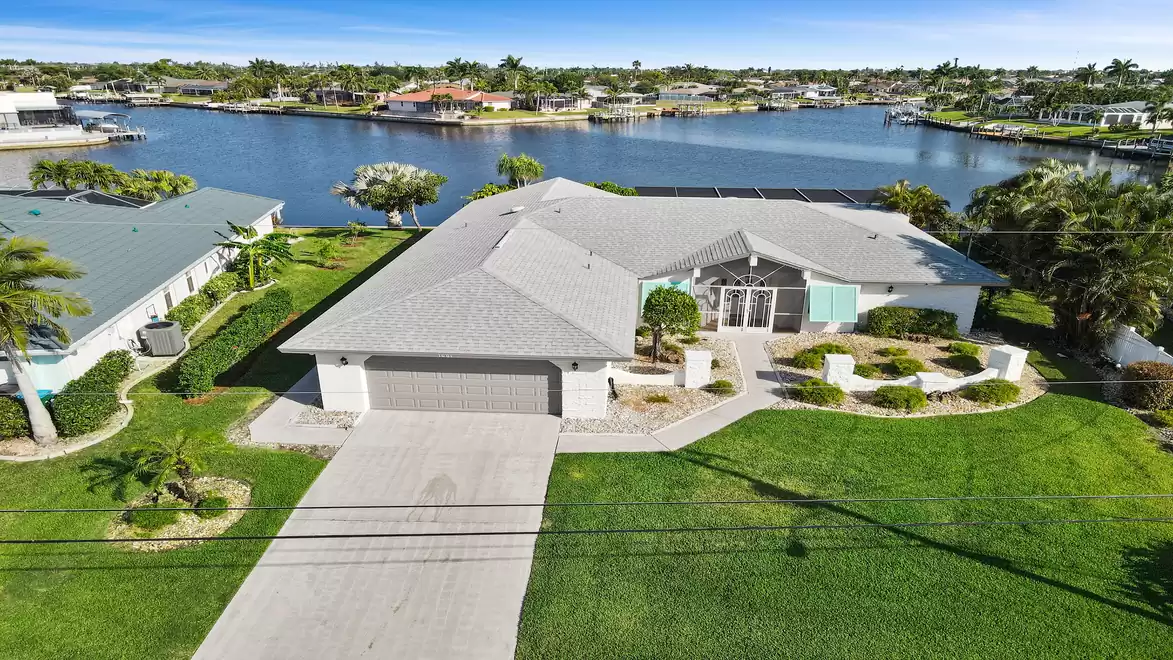
Villa Amazing - Aerial view of a modern single-family home with a well-kept garden, located directly by the water.
Licensed by: Nagel

A Vacation Home or Villa refers to a holiday property in Florida, used either for personal vacation stays or as a rental property for tourists. These homes are particularly popular in Southwest Florida – including Cape Coral, Fort Myers, and Naples.

Common Features of a Vacation Home

  • Detached house with private pool
  • Multiple bedrooms and bathrooms
  • Fully equipped kitchen and spacious living areas
  • Often waterfront with private dock access

Usage and Income Potential

Owners often enjoy their property during part of the year and rent it out to tourists the rest of the time, offering both rental income potential and possible tax benefits if certain criteria are met.

Popular Locations

Top Florida destinations for vacation rentals include:

Buyer Considerations

When purchasing a vacation home, it's important to review local rental laws, any applicable HOA rules, and consider professional property management.
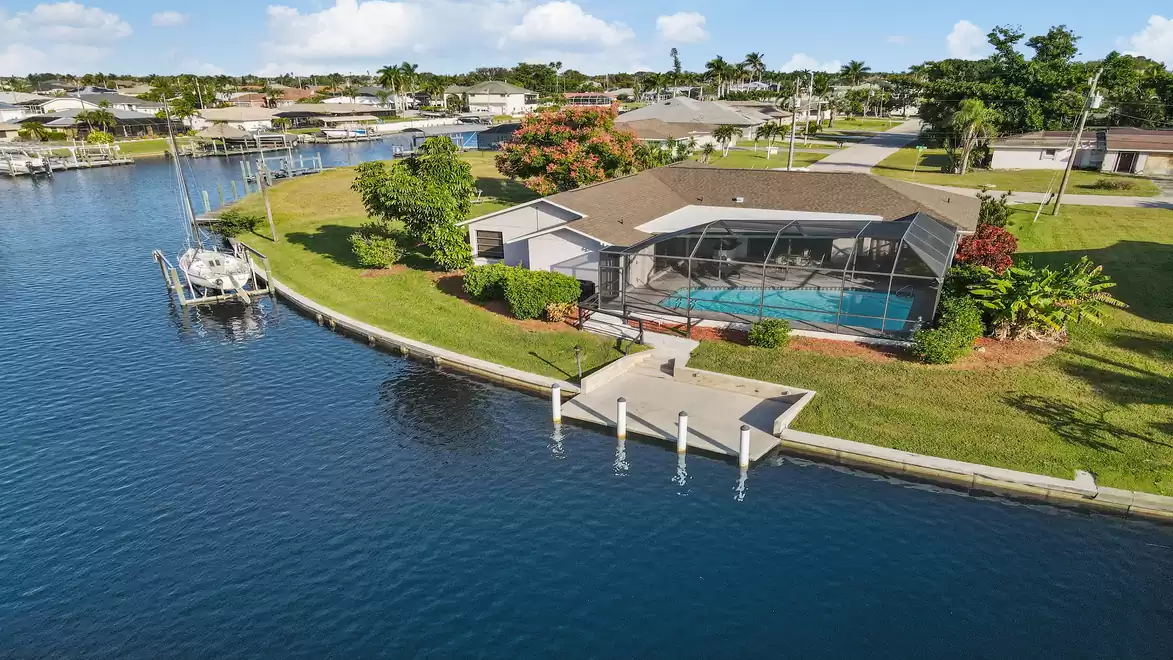

Villa Belle Paradise - Aerial view of a waterfront house with pool and boat dock
Licensed by: Nagel
Villa Boaters Dream - A modern pool area with blue loungers, a table, and a glass-covered roof in a sunny courtyard.
Licensed by: Nagel
Villa Camille - A modern single-family home with palm trees in the front yard, bright exterior walls, and a tiled roof. A perfect example of a luxurious property in a tropical climate.
Licensed by: Nagel
Licensed by: Nagel
Villa Coral Sunshine - Modern outdoor pool with canopy, surrounded by white fence and palm trees. In the background, a water canal and two blue chairs with a table.
Licensed by: Nagel
Pool area with two blue loungers, a table, and a hot tub. Plants and a lake are visible in the background.
Licensed by: Nagel
Villa Orange Cove - Aerial view of a blue single-family home with palm trees and a well-maintained garden.
Licensed by: Nagel
Villa Golden Globe - Large two-story house with a well-maintained garden and a centrally placed fountain, surrounded by palm trees.
Licensed by: Nagel
Villa Aldiana - Beautiful pool with covered outdoor area overlooking a tranquil lake on a sunny day.
Licensed by: Nagel
Villa Rosegarden - Luxury villa with a pool overlooking a scenic lake, surrounded by palm trees and blue sky.
Licensed by: Nagel

Vacation Home / Villa – Second home for private use or short-term rental

What is a Vacation Home?

A Vacation Home or Villa is a residential property that is not used as a primary residence, but rather for seasonal living, holidays, or investment purposes. In Florida, these homes are popular among snowbirds, tourists, and investors.

Common features

  • Used by owners for part of the year
  • Rented to vacation guests via platforms like Airbnb or VRBO
  • Often located in waterfront areas and equipped with private pools and screens
  • Fully furnished and ready for short-term stays

Florida-specific insights

  • High demand for short-term vacation rentals in areas like Cape Coral and Naples
  • Usually professionally managed with cleaning, guest service, and maintenance
  • Short-term rental laws and taxes must be followed

? Tip: A Vacation Home in Florida can be a lifestyle upgrade and a strong investment. Success depends on location, amenities, and expert property management like Dream Vacation Florida.

Villa Orange Cove - Aerial view of a blue single-family home with a well-kept garden and palm trees in a residential area.
Licensed by: Nagel
Villa Coral Sunshine - Aerial view of a screened swimming pool surrounded by palm trees next to a waterway with boat docks.
Licensed by: Nagel
Villa Golden Globe - Luxury villa with a manicured garden, palm trees, and a fountain in a quiet neighborhood next to a canal.
Licensed by: Nagel
Villa Boaters Dream - Spacious single-family home with palm tree, manicured garden, and blooming bushes under a bright blue sky.
Licensed by: Nagel
Villa Boaters Dream - Modern patio with a pool and lounge chairs under a blue sky.
Licensed by: Nagel
Villa Rosegarden - Luxurious single-family home with palm garden and view of a water canal in an exclusive residential area.
Licensed by: Nagel
Villa Rosegarden - A yellow house with a tropical garden, two green kayaks, and two bicycles in the foreground.
Licensed by: Nagel
Villa Belle Paradise - Aerial view of a large house with a garden and paved driveway, with a canal and boats in the background.
Licensed by: Nagel
Villa Belle Paradise - Aerial view of a house with a pool and boat dock by the water in a residential area.
Licensed by: Nagel
Villa Amazing - Modern villa with a well-maintained garden overlooking a large canal in a sunny residential area.
Licensed by: Nagel
Villa Camille - Elegant single-family home with Mediterranean design, palm trees, and a well-maintained garden.
Licensed by: Nagel
Smart house with garden pool and digital visualizations of electricity use, water consumption, and repairs.
AI generated

Variable Expenses – Operating costs that fluctuate with usage

What are Variable Expenses?

Variable Expenses are non-fixed operating costs that change based on property usage, tenant occupancy, or seasonal demand. They are distinct from Fixed Expenses, which remain constant regardless of activity level.

Common examples of variable expenses

  • Electricity, water, and gas bills (based on consumption)
  • Repairs and maintenance
  • On-demand services like landscaping or pool care
  • Vacation rental supplies (e.g., linens, toiletries)

Importance for owners & investors

  • Affects Net Operating Income (NOI)
  • Essential for cash flow forecasting and ROI analysis
  • Requires local knowledge and seasonal adjustment, especially in Florida

? Tip: For Florida vacation rentals, Variable Expenses like utility costs or pool services can significantly impact profitability—track them closely and adjust rates accordingly.

Illustration of a house at the center of a financial chart with percentages and diagrams representing different mortgage rates.
AI generated

Variable Rate – Interest rate that adjusts over time

What is a Variable Rate?

A Variable Rate (also known as an Adjustable Rate) is a mortgage interest rate that can change periodically based on a financial index such as the SOFR or Prime Rate. The rate typically starts low and adjusts after an initial fixed period.

Common features

  • Initial fixed-rate period (e.g. 3, 5, or 7 years)
  • Annual adjustments thereafter
  • Rate caps to limit how much the interest rate can increase or decrease

Pros and cons

  • Pro: Lower initial payments
  • Con: Rate uncertainty after the fixed period ends
  • Best for: Buyers planning to refinance or sell in the short term

? Tip: In Florida, variable rate loans are common among investors or short-term homeowners. However, it’s crucial to evaluate future payment risks and interest trends before committing.
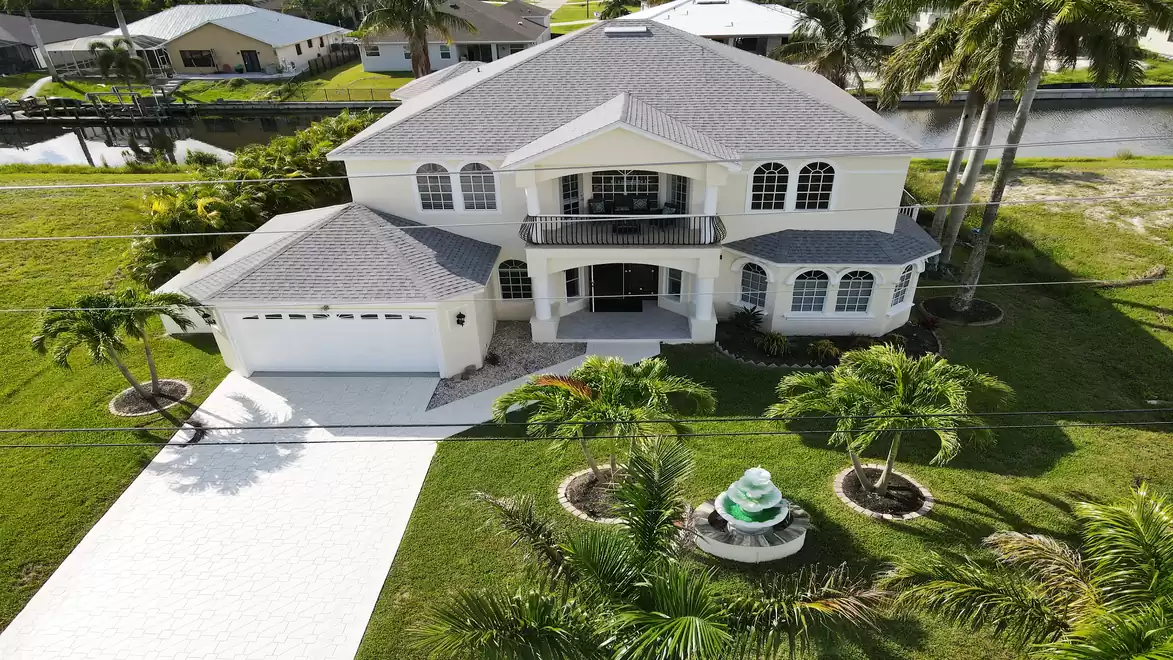
Aerial view of a large white house with a manicured garden and fountain, surrounded by palm trees in a residential area.
AI generated

Villa – Standalone luxury vacation home in Florida

What is a Villa?

In the Florida real estate market, a Villa typically refers to a detached, upscale single-family home often used as a vacation rental, second home, or investment property. Compared to a standard home, a villa emphasizes comfort, outdoor living, and premium features.

Common features of a Florida villa

  • Private screened pool area
  • Large lanai or patio for outdoor dining and relaxation
  • Waterfront location with boat dock (especially in Cape Coral)
  • Modern kitchen, A/C, garage, and multiple bedrooms

Use cases and target groups

  • Vacation home for private use or short-term rental to tourists
  • Investment property with strong rental income potential
  • Winter residence for retirees and snowbirds

? Tip: In areas like Cape Coral, Fort Myers, and Naples, well-located villas with amenities are in high demand—both for lifestyle buyers and investors seeking short-term rental returns.

A business meeting in an office where a man hands house keys to a couple. In the background, a modern building with palm trees is visible.
AI generated

Voluntary Alienation – Willful transfer of property ownership

What is Voluntary Alienation?

Voluntary Alienation is the intentional and legal transfer of property ownership by the current owner (grantor) to another party (grantee). This typically occurs through a sale, gift, or trust conveyance initiated by the owner’s decision.

Common types of voluntary transfers

  • Sale of property (via deed)
  • Gift deed to family or others
  • Transfer to a trust (e.g., Living Trust)
  • Inheritance during life via estate planning instruments

Difference from involuntary alienation

  • Voluntary: initiated by owner’s free choice
  • Involuntary: triggered by law, such as foreclosure, eminent domain, or intestate succession

Florida-specific notes

  • All transfers must be documented via a legal deed and recorded with the county clerk
  • Applies to gifts, trust deeds, and real estate sales
  • Should be reviewed for tax and liability implications

? Tip: In Florida, if you plan a voluntary property transfer—especially to family or into a trust—get professional advice to ensure legal clarity and avoid future complications.

W

A desk with a laptop, a waiver document, a scale, and a model house, while someone is signing.
AI generated

Waiver – Legal relinquishment of a right in real estate transactions

What is a Waiver?

A Waiver is a voluntary, written agreement to give up a legal right or claim. In real estate, waivers are commonly used in purchase agreements, rental contracts, and liability releases—such as when a buyer waives the right to conduct a home inspection.

Common types of waivers

  • Inspection Waiver: Buyer declines the right to inspect the property
  • Disclosure Waiver: Buyer agrees to limited or no seller disclosures
  • Appraisal Waiver: Lender does not require an appraisal for financing
  • Liability Waiver: Used in HOA or resort communities for shared amenities

Florida-specific insights

  • Waivers must be clear and documented in writing to be enforceable
  • Inspection waivers are often used in competitive markets to strengthen offers
  • As-is property sales frequently include multiple waivers

? Tip: Signing a Waiver in Florida real estate means you permanently give up a right. Always seek legal advice if you're unsure what you're waiving.

A man and a woman are sitting across from each other in a modern office. On the wall hangs a certificate labeled 'Warranty Deed'. In the background are shelves with files and a window overlooking green fields.
AI generated

Warranty Deed – Legal title transfer with ownership guarantees

What is a Warranty Deed?

A Warranty Deed is a legal document used in U.S. real estate transactions where the seller (grantor) guarantees the buyer (grantee) that they hold clear and marketable title to the property. It also ensures that there are no undisclosed liens or encumbrances.

Types of Warranty Deeds

  • General Warranty Deed: Full guarantee covering entire ownership history
  • Special Warranty Deed: Limited to claims during the seller’s ownership period

What a Warranty Deed includes

  • Valid transfer of ownership
  • Assurance against hidden claims or defects
  • Seller’s duty to defend title if challenged
  • Must be notarized and recorded with the local county clerk

Florida-specific notes

  • The General Warranty Deed is the most commonly used and secure deed in Florida
  • Often used in residential sales, new construction, and investor purchases
  • Buyers typically also order a Title Search and obtain Title Insurance

? Tip: In Florida real estate, opt for a General Warranty Deed whenever possible—this offers maximum protection for your ownership rights.

Illustration of two men shaking hands in front of a house. Around them are warranty and guarantee documents and symbols for home warranties.
AI generated

Warranty – Legal guarantee provided in real estate transactions

What does Warranty mean in real estate?

In U.S. real estate, a Warranty is a legally enforceable assurance regarding the property’s condition or ownership status. It may cover title rights, structural elements, or mechanical systems. The most common form is the Warranty Deed, in which the seller guarantees clear and marketable title to the buyer.

Types of Warranties

  • Warranty Deed: Full guarantee of ownership and freedom from encumbrances
  • Home Warranty: Contractual protection for systems like HVAC, plumbing, appliances
  • Builder’s Warranty: Coverage for new homes (typically 1–10 years depending on components)

Why warranties matter

  • Protects buyers against legal or structural issues post-closing
  • Limits out-of-pocket repairs for covered items
  • Useful negotiation tool in the purchase agreement

? Tip: In Florida, many sellers offer a one-year Home Warranty to provide peace of mind for buyers. Always check the exact coverage and exclusions in the policy.
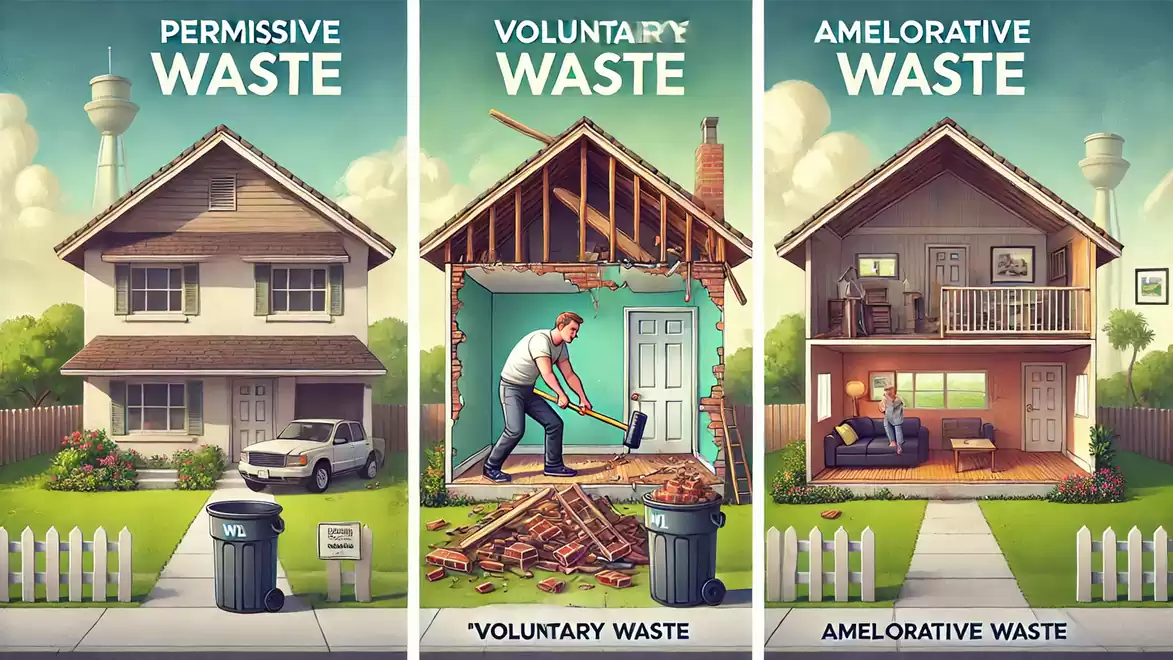
Three illustrations of a house depicting different types of waste: permissive waste, voluntary waste, and ameliorative waste.
AI generated

Waste – Legal term for damaging use or alteration of real estate

What does Waste mean in real estate law?

Waste literally means "destruction" or "waste," but in property law, it refers to actions or neglect by a property user (e.g. tenant or life estate holder) that cause harm to the property’s value or condition—even if not intentional.

1 – Waste, deterioration, or failure to maintain a property.

2 – Any structural or other alteration to the land or buildings, even if it increases market value.

Types of Waste

  • Voluntary Waste: Intentional damage or unauthorized changes
  • Permissive Waste: Failure to maintain (e.g. roof leaks, landscaping neglect)
  • Ameliorative Waste: Improvements made without permission that may raise value but violate ownership rights

Legal consequences

  • Claims for damages by the property owner
  • Lease termination for significant violations
  • Court orders requiring restoration

? Tip: In Florida, “waste” commonly arises in rental, estate, or trust properties. Owners should inspect regularly and set clear lease terms to prevent disputes.

Diagram showing factors influencing real estate appreciation: local economy, supply and demand, location, property improvements, inflation, and interest rates.
AI generated

What Influences Real Estate Appreciation?

Real estate appreciation is driven by a combination of economic, local, and property-specific factors. Understanding these influences is essential for investors and buyers aiming to maximize long-term property value.

Macroeconomic Factors

Broader economic conditions play a major role:

  • Interest rates: Lower mortgage rates increase buyer demand
  • Inflation: Real estate is often seen as an inflation hedge
  • Economic growth: Rising incomes boost purchasing power
  • Employment levels: Strong job markets drive housing demand

Location and Neighborhood Quality

Location is one of the most critical drivers of appreciation:

  • Infrastructure: Access to highways, airports, and public transport
  • Schools: Highly rated school districts attract buyers
  • Lifestyle amenities: Beaches, parks, shopping, and entertainment
  • Safety: Low crime rates increase desirability

Supply and Demand Dynamics

The balance between housing supply and demand directly impacts property values:

  • Housing shortages: Lead to rising prices
  • Oversupply: Can cause stagnation or price declines
  • New construction: Affects available inventory

Property-Specific Factors

Individual property characteristics also matter:

  • Condition: Renovated homes often appreciate faster
  • Layout and features: Modern designs are more attractive
  • Energy efficiency: Increasingly important for buyers

Florida-Specific Considerations

In Florida, additional factors influence appreciation:

  • Tourism demand: Strong short-term rental market
  • Population growth: Ongoing migration into the state
  • Waterfront locations: Often see above-average appreciation
  • Insurance and climate risks: Can impact long-term value trends

Conclusion

Real estate appreciation results from a complex interaction of multiple factors. Investors who understand these drivers are better positioned to identify opportunities and manage risks effectively.

A desk full of financial documents with a laptop and a window view of a house under construction. Construction workers are working on the roof. The desk displays charts, a calculator, and rolls of money.
AI generated

Working Capital Loan – Short-term financing to cover operating expenses

What is a Working Capital Loan?

A Working Capital Loan is a short-term loan designed to help a business cover daily operating costs such as payroll, utilities, maintenance, or insurance. In real estate, it's commonly used by property managers, landlords, and developers to maintain cash flow.

Use cases in real estate

  • Bridging seasonal income gaps in vacation rentals
  • Covering repairs and maintenance in income-producing properties
  • Paying expenses during vacancy or development phases

Key features of a Working Capital Loan

  • Short repayment terms (6 to 24 months)
  • Often unsecured or lightly secured (e.g. with receivables)
  • Higher interest rates compared to long-term loans

? Tip: In Florida’s real estate sector, working capital loans can help bridge cash flow gaps during renovation, permitting delays, or off-season rental periods. Use them strategically and with a clear repayment plan.

Y

A man and a woman in an office signing a lease agreement. A miniature model of a house is on the table. Shelves with binders and a computer screen are visible in the background.
AI generated

Year to Year Tenancy – Lease agreement that renews annually unless terminated

What is a Year to Year Tenancy?

A Year to Year Tenancy is a periodic tenancy that lasts for one year and automatically renews for another year unless one party gives proper notice to terminate. It is commonly used in residential and commercial leases where no fixed end date is specified.

Key characteristics

  • Duration: One full year, renewed annually
  • Notice period: In Florida, typically 60 days before lease anniversary (may vary)
  • Can be written or implied based on continued occupancy and payment

Benefits for landlords and tenants

  • Greater stability compared to month-to-month agreements
  • Reduced administrative hassle
  • Clear opportunity to renegotiate terms annually

? Tip: In Florida, always submit written notice within the legal timeframe to terminate a year-to-year tenancy. Local laws may differ, so consult applicable regulations.

A businessman views yield charts on a laptop in front of a luxurious villa with a pool.
AI generated

Yield – Key performance metric for real estate investment returns

What is Yield?

Yield measures the annual return on investment for a rental property, expressed as a percentage of the purchase price. It reflects the income-generating efficiency of a property, excluding appreciation or financing effects.

Formula for calculation

  • Yield = (Annual net rent / Purchase price) × 100
  • Example: $30,000 annual rent on a $500,000 property → Yield = 6%

Types of yield

  • Gross yield: based on rental income before expenses
  • Net yield: accounts for operating costs and vacancy
  • Cap rate: closely related, often used interchangeably

Florida-specific insights

  • Yield varies by location, property type, and rental strategy (long-term vs. short-term)
  • Vacation homes offer higher gross yields but also higher management and utility costs
  • Successful investors analyze yield alongside cap rate, cash flow, and risk factors

? Tip: In Florida, use Yield as part of a comprehensive investment analysis—especially if you're comparing short-term rental income with more stable long-term leases.

Z

Modern townhouses with clean lines and landscaped front gardens under a blue sky.
AI generated

Zero Lot / Zero Lot Line – Property built directly on the boundary line

What is a Zero Lot Line?

A Zero Lot Line refers to a type of residential construction where a house is built directly against one property boundary, usually leaving no side yard on that side. This allows for more usable interior or backyard space on compact lots.

Key features of Zero Lot Line homes

  • Structure touches or is very close to one lot boundary
  • One side yard, usually offset by a larger usable area
  • Efficient land use for smaller plots
  • Common in urban developments and planned communities

Florida-specific notes

  • Popular in dense developments in cities like Cape Coral and Naples
  • Subject to zoning laws and setback requirements
  • Buyers should check maintenance easements and HOA rules

? Tip: If you’re buying or building a Zero Lot Line home in Florida, review local setback laws, building codes, and neighbor access rights—this design is space-efficient but requires careful planning.
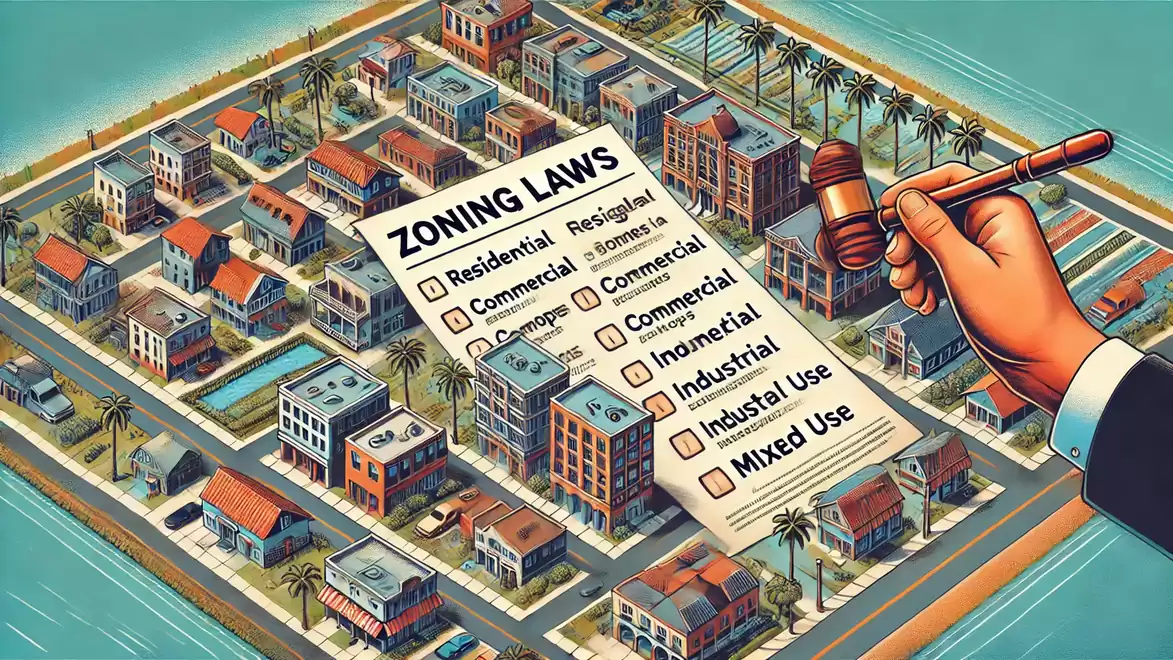
Illustration of a city with a list of zoning laws showing categories like residential, commercial, and industrial.
AI generated

Zoning Laws – Local regulations governing property use in Florida

What are Zoning Laws?

Zoning Laws are municipal and county regulations that determine how a property may be used. These laws define whether land is designated for residential, commercial, industrial, agricultural, or mixed-use purposes.

Common zoning categories in Florida

  • Residential (R): Single-family or multi-family housing
  • Commercial (C): Shops, offices, and restaurants
  • Industrial (I): Warehousing, factories, workshops
  • Agricultural (A): Farming and related uses
  • Mixed Use (MU): Combination of residential and commercial use

What else do Zoning Laws regulate?

  • Minimum lot size and frontage
  • Setback requirements and building height limits
  • Parking, driveways, and landscaping rules
  • Short-term rentals may be restricted or banned in some zones

Florida-specific insights

  • Each municipality and county has its own zoning codes and maps
  • Special uses (like STRs) often require permits or variances
  • Violations can result in fines, stop-work orders, or mandatory removal

? Tip: Before buying or modifying property in Florida, always check the zoning regulations—especially if you plan to build, rent, or run a business.

Illustration of a town with different areas such as commercial, industrial, agricultural, and residential zones.
AI generated

Zoning Ordinances – Local laws governing land use and development

What are Zoning Ordinances?

Zoning Ordinances are municipal or county laws that regulate how land and buildings may be used. They define permitted uses such as residential, commercial, or industrial and guide urban growth and property development.

Common zoning categories

  • Residential: Single-family or multi-family housing
  • Commercial: Retail, office buildings, restaurants
  • Industrial: Warehouses, factories, logistics
  • Agricultural: Farms, crop land
  • Mixed-Use: Combined residential and commercial use

Why zoning matters in real estate

  • Determines what can legally be built or operated on a property
  • Controls density, height, setbacks, and land use
  • Non-compliance can lead to fines, delays, or denied permits

? Tip: Always verify zoning with the local planning department before buying or renovating property—especially in Florida where zoning varies by city and county.
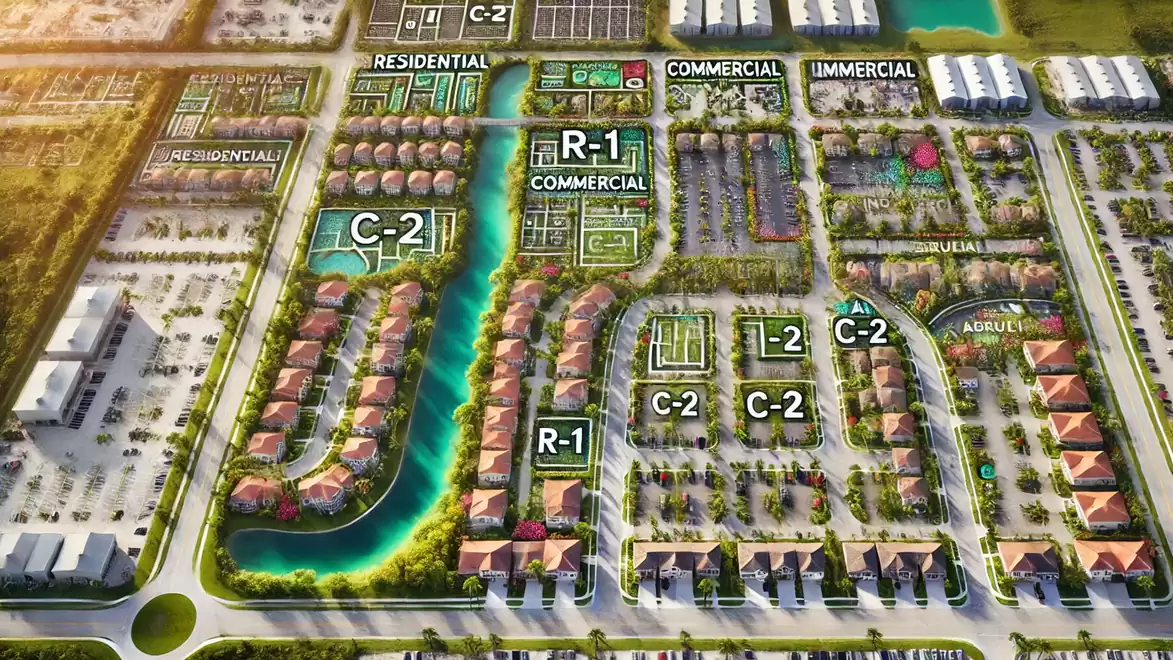
3D map view of an urban plan with residential and commercial areas, green spaces, and waterways.
AI generated

Zoning – Land use classification and property regulations in Florida

What is Zoning?

Zoning is the legal framework that determines how land and buildings may be used. Each city or county in Florida has its own zoning codes that classify properties into categories such as residential, commercial, agricultural, or mixed-use.

Common zoning designations

  • R-1, R-2: Single-family or multi-family residential
  • C-1, C-2: Commercial or retail zones
  • A: Agricultural zones
  • PUD: Planned Unit Development (flexible mixed-use)

Why zoning matters

  • Zoning dictates what you can do with your property—e.g., short-term rental may or may not be allowed
  • Rezoning or variances require formal applications and approval
  • All new construction or remodeling must comply with zoning laws including setbacks, height, and density

Florida-specific insights

  • Each municipality maintains its own zoning maps and definitions
  • In Cape Coral, for example, many lots are zoned as R-1W (Residential Waterfront)
  • Zoning rules apply to pools, garages, guest houses, and rental permissions

? Tip: Before purchasing or building in Florida, check the property's zoning classification with the local Planning & Zoning Department—this helps avoid costly legal or usage issues.

Real Estate Glossary Florida – Key terms for buying and selling property in Florida

Any Questions About Florida Real Estate?

Learn more about real estate in Florida, our full service, and vacation rentals.

Still have a question? We're happy to help — contact us and we'll get back to you as quickly as possible.